The Release Report: April 2026
April brings agentic execution to Vincent, a new citation safeguard for uploaded documents, hands-free dictation on desktop, and natural-language access to SEC filings. Each release pushes Vincent further toward how legal teams actually work. Here's what's new.
After a quarter focused on extending Vincent’s reach through firm-specific workflows in Studio, the new mobile app, and native DMS connectivity, April’s releases turn inward to sharpen Vincent’s core experience. Enhancements to performance and search make everyday work faster and more reliable, while Authority Match adds confidence by verifying citations from uploaded documents. Voice Mode now extends to desktop, making it easy to dictate prompts hands-free wherever you work. At the same time, Vincent provides natural-language access to three decades of SEC corporate filings, opening up a deeper layer of research without changing how attorneys already work.
GPT-5.5 in Vincent: A new bar for substantive legal work
On April 24, alongside OpenAI’s launch of GPT-5.5, every Vincent customer was upgraded to the new model for agentic mode and document drafting. The upgrade powers the agentic capabilities and sets the foundation for the next generation of end-to-end legal work in Vincent.
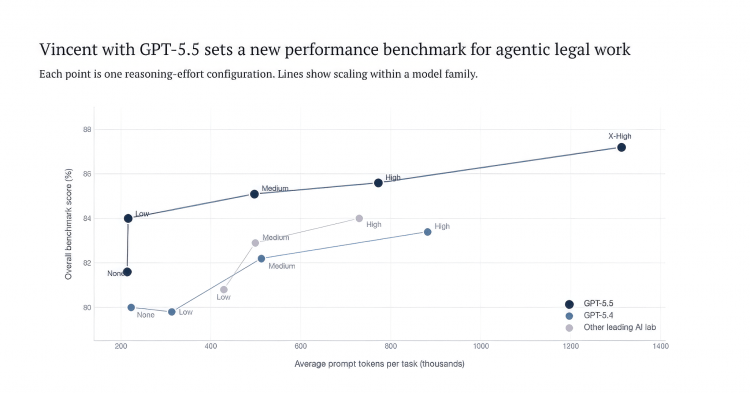
GPT-5.5 delivered the highest overall score we’ve recorded against our internal evaluation set at 87.2%, outperforming every other frontier model we tested. The biggest gains showed up in the work that pushes models hardest:
- Citing the controlling authority: On research tasks that require pinpointing the specific case, statutory section, or commentary rather than just describing the rule, GPT-5.5 delivers a 20% relative improvement over the prior generation.
- Reading the whole document: On contract analysis, deal-point extraction, and discovery across large file sets, GPT-5.5 captures the qualifying language earlier models would skim past, including survival periods, fraud carve-outs, and jurisdictional conditions. That works out to roughly a 7% relative improvement on document-analysis scenarios, with larger gains at higher reasoning effort.
- More efficient reasoning: GPT-5.5 spends fewer tokens deliberating internally for the same quality of answer. In one comparison, it used ten times fewer reasoning tokens per tool call, which means faster responses and more headroom in the context window for Vincent to retain context across long, multi-turn sessions.
Read the full GPT-5.5 announcement.
Authority Match: A new citation safeguard for uploaded documents
Vincent already cites directly to sources within the Clio Library during research workflows, giving your team a clear path back to the underlying authority in Vincent’s responses to legal research tasks. Authority Match extends that assurance to a different surface area: Vincent’s document analysis workflows. US and UK case citations mentioned in Vincent’s responses to document analysis tasks are now verified against the library, and the result of that check shows up alongside the citation itself.
Hover over any citation to instantly see whether the authority was found in Vincent’s library.
- Matched: verified against Vincent’s sources and ready to open.
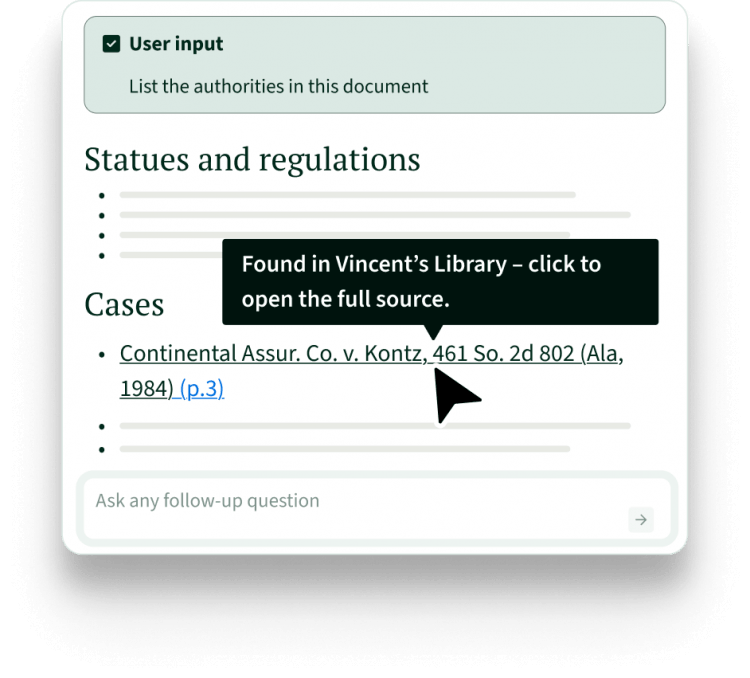
- No Match: not found in the library, which may reflect a citation variation or a gap in coverage, so attorneys can quickly verify the source if needed.

Attorneys get a fast visual signal of where every cited authority stands, and they can move from output to verification without leaving the response.
Voice mode on desktop: Hands-free dictation, wherever you work
Speech-to-text was one of the most well-received additions to the Vincent by Clio mobile app. April brings the same capability to desktop, so attorneys can dictate prompts hands-free at their workstation, whether they’re moving between documents or working through a long question that’s faster to speak than to type. Voice Mode now works across both surfaces, with no extra setup.

Studio User Groups: Workflow access without the manual overhead
Sharing a Studio workflow used to mean a binary choice: open it to the entire organization, or add users one at a time. Neither option scaled well for firms with distinct practice areas, regional teams, or rotating project groups. Adding a hundred names individually every time a workflow needed to ship was tedious and error-prone, while broadcasting workflows organization-wide left publishers without a clean way to scope access.
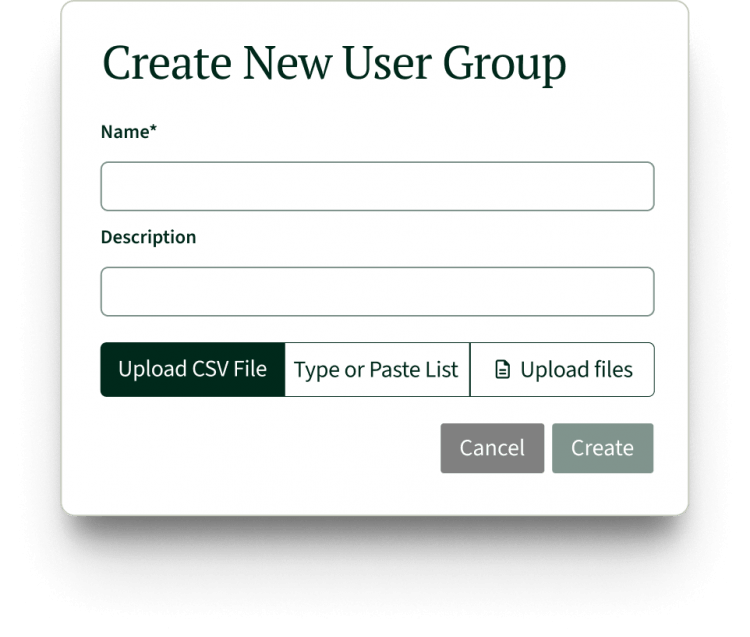
With User Groups, publishers can now create named groups (by practice area, office, matter team, or any other dimension) and share workflows directly with one or more groups in a single step.
- Create groups quickly: Add users via CSV upload using the provided template, or paste a comma-separated list of email addresses directly into the UI.
- Update with control: Edit groups manually in the UI, or re-upload a complete CSV to refresh the group in bulk. (Tip: export the existing list first, edit it, and re-upload to avoid overwriting members.)
- Share with one click: Once a group exists, it appears as an option under the Visibility section in Workflow Creation mode.
User Groups is now available for all publishers by default.
Explore SEC corporate filings: Natural-language access to EDGAR content
Corporate filings hold some of the most important information in business: how companies manage risk, structure deals, and make decisions. Yet the way legal teams work with that information has barely changed in decades. Filings get opened one by one, sifted through manually, and synthesized by hand.
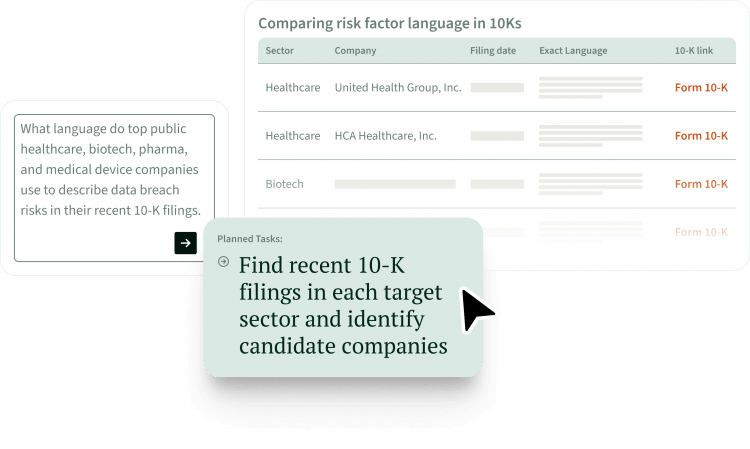
The new EDGAR Search workflow in Vincent changes that. Lawyers can ask natural-language questions across more than 30 years of SEC corporate disclosures and legal agreements, and get structured, source-grounded answers in seconds.
- Summarize company filings: Pull risk factors, financial metrics, and material agreements from 10-K and 8-K filings for any public company.
- Benchmark across a sector: Compare disclosure language and market practice across industries in minutes, not days.
- Mine exhibits for drafting precedent: Search thousands of transactional agreements to surface clause language and market norms.
Every answer references the underlying source filing, giving attorneys a direct path back to the original document. The exhibit library is already extensive and will continue to grow throughout 2026, with additional filing types on the roadmap for later this year.
Read the full EDGAR Search announcement.
Performance & precision
A handful of upgrades this month happen mostly behind the scenes but show up in everyday speed and the quality of results.
Faster, smarter Collections: We’ve upgraded the infrastructure behind Collections by integrating Turbopuffer, a high-performance vector search engine. The improvements work entirely behind the scenes, with no change to how your team interacts with Vincent.
- Search at scale without slowdown: Collections of any size, whether 10 documents or 10,000, stay fast and responsive.
- Deeper semantic understanding: Vincent finds relevant passages based on meaning and context, not just keyword matches.
- Faster availability: Documents are indexed and ready for analysis sooner after upload.
Your data stays within your existing regional environment, and Turbopuffer stores only the mathematical representations used for search, never the text of the documents themselves. New collections are already running on the upgraded engine, and we’re migrating existing ones automatically.
A faster, more powerful Tables engine: The Tables engine has been upgraded under the hood. Vincent Tables now runs noticeably faster and stays responsive even on the kinds of large, multi-document analyses that used to slow it down.

Smarter search across Collections: Beyond the infrastructure upgrade, Collections now include AI-powered similarity search for faster, more accurate results across your data.

Drag & drop uploads: Files can now be uploaded by dragging and dropping them anywhere a document upload is supported within Vincent. No more clicking through the file picker for routine uploads.
That’s the April release. Several more updates are already queued for May, including additional EDGAR filing types and continued progress on Vincent for Word. See you next month.