

It’s safe to say that artificial intelligence (AI) has infiltrated our lives. The technology can be used to write compelling content, answer questions, and fulfill commands in a matter of seconds–which has raised the question, will AI replace lawyers?
Despite the excitement this innovative technology holds, it’s also raised a litany of concerns around whether it may eliminate jobs in the legal profession. These fears have been further exacerbated as advances, like ChatGPT and Harvey AI, and other AI legal tools open up new possibilities.
In Australia, the conversation around AI in law firms is gaining momentum as practices explore how to integrate AI responsibly while maintaining compliance with ethical and professional standards set by bodies such as the Law Council of Australia.
So, is AI going to replace lawyers? The short answer: No. If anything, AI is poised to help lawyers.
In this blog post, we’ll examine the current state of AI in the Australian legal industry, the advantages and drawbacks of the technology, and what AI means for all legal professionals.
Ready to take your firm’s efforts to the next level? Manage AI (formerly Clio Duo) can help! Discover our dynamic AI-powered partner, transforming the way legal professionals work within their case management software–book a demo here.
Are lawyers likely to be replaced by AI?
AI won't eliminate the need for lawyers but will transform their roles. While it can automate routine tasks, legal strategy and client interaction complexities still require human expertise. Lawyers will leverage AI tools to enhance efficiency, focusing on higher-level tasks that demand critical thinking and empathy.
Will ChatGPT replace lawyers?
The current state of AI in law
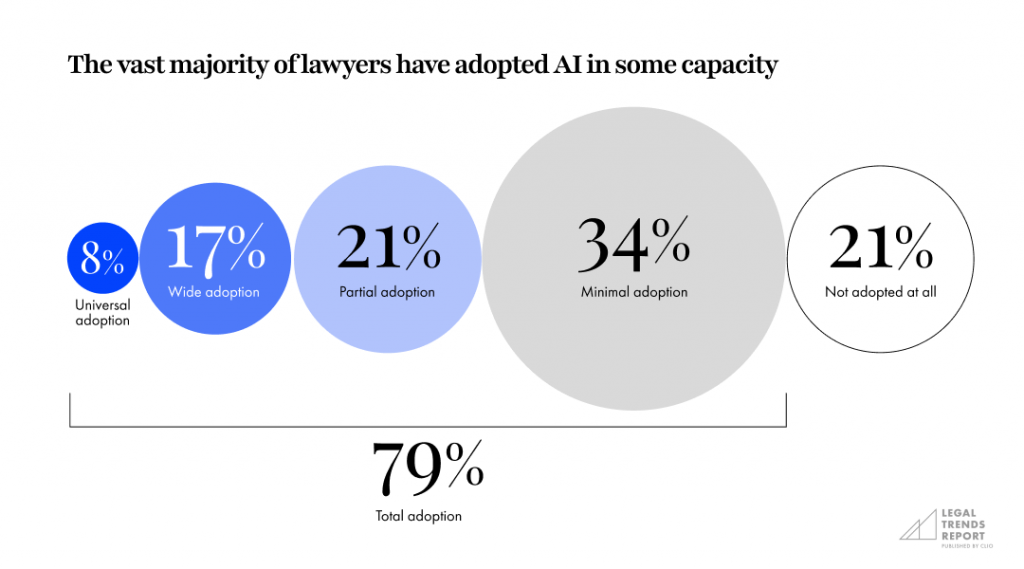
According to our Legal Trends Report, 79% of legal professionals are now using AI in some capacity in their practice, while 24% have adopted AI widely or universally. This is up from only 19% of law firms using AI in their practice in 2023.
As for how they’re using it, most are turning to the technology to automate tedious tasks, like legal research, contract analysis, and document review.
Clearly, the majority of legal professionals aren’t yet using AI to their advantage. So, what’s holding them back?
When asked about the barriers preventing adoption, the 2022 ABA Legal Technology Survey Report listed the accuracy of the technology as the number one concern (36.4%), followed by the cost to implement it (34.2%) and its reliability (33.8%).
Be sure to check out our resource hub on AI for lawyers in Australia to learn more.
Is AI a threat to law firms?
AI presents challenges and opportunities for Australian law firms. While it can streamline processes and reduce costs, potentially threatening traditional models, firms that embrace AI can enhance efficiency and client service. Those that adapt will thrive, while others may struggle to keep up in a changing legal landscape.
What is an AI lawyer?
Let’s leave the idea of artificial intelligence lawyers to SciFi for now—AI lawyers aren’t sentient robots in suits. They’re simply great lawyers like you who are empowered by AI tools: software powered by machine learning and natural language processing, designed to help with tasks like drafting documents, reviewing contracts, or digging through legal research.
AI lawyers think of these tools as super-fast assistants with a lot of data under the hood. They don’t argue in court or build strategy from scratch (yet), but they can speed up the parts of your workflow that would otherwise eat up hours. It’s not about replacing lawyers—it’s about letting them focus on higher-value work while AI handles the heavy lifting in the background.
But like any powerful tool, AI in law firms needs thoughtful use. The legal field is full of nuance, and there are ethical and practical concerns to navigate: bias in algorithms, privacy, accuracy, and accountability, to name a few. The goal isn’t to hand over the reins—but to learn how to drive with better navigation.
Will there be AI lawyers?
Not exactly—but AI will increasingly act as a powerful assistant to lawyers. While AI can draft documents, analyse contracts, and streamline legal workflows, it doesn’t meet the criteria to be a lawyer. It lacks the capacity for independent legal judgment, cannot represent clients in court, and doesn’t carry a legal license. What we’ll see instead is the rise of AI-powered legal tools in Australia that support—but don’t replace—licensed professionals. These tools will help lawyers work more efficiently, but the legal profession will remain rooted in human expertise, ethics, and critical thinking.
The perks and pitfalls of AI

Like any new technology, AI has both benefits and downsides for the legal profession. Below, we’ve summarised some of the key ones that lawyers in Australia should know about.
Pros of AI for law firms:
AI can save time. As any lawyer knows, legal work is filled with repetitive, mundane tasks that quickly fill up a day—whether it’s researching laws, summarising or pulling cited details out of documents with legal-specific AI tools like Manage AI, or using AI chatbots like ChatGPT for drafting assistance. AI has the power to automate this work and complete it in a fraction of the time. The result? Lawyers can focus on what truly matters and help more clients, which can increase job satisfaction, improve their bottom line, and elevate client relationships.
AI promotes greater productivity. By streamlining processes and automating workflows, lawyers can be more efficient in their work. Take eDiscovery, as one example. Trained algorithms in machine learning can identify patterns in vast amounts of data and identify what information is relevant at an astonishing speed. This allows Australian law firms to finish tasks at a much faster rate.
AI can elevate lawyers’ work. Legal professionals can use more sophisticated AI-powered tools to augment their work. These tools can assist with tasks like drafting legal documents, conducting legal research, and analysing contracts. In particular, document automation, which is offered through a legal software solution like Clio, speeds up routine tasks and allows lawyers to focus on higher-level work that require human judgment, such as negotiation, advocacy, and counselling.
Cons of AI for law firms:
Mistakes happen. Misused source material and factual errors are common downsides associated with artificial intelligence tools. Compounding this challenge is the fact that technologies, like ChatGPT, don’t provide sources for where information is collected from. As a result, many lawyers struggle to know what’s true and what isn’t—and must exercise increased caution when using them.
It carries ethical concerns. When using AI in law firms, practitioners must consider obligations under Australian privacy and professional conduct laws, including confidentiality, security, and the risk of bias or discrimination.
Strategic work can be a challenge. Lawyers are skilled at arguing cases and challenging outcomes in a way that machines simply can’t replicate. For instance, an attorney knows from experience if a client is withholding information, and can probe deeper to test versions of events. While AI tools can process and analyse data, it does not possess the critical thinking or emotional intelligence skills necessary for reading people. Plus, while humans can work with incomplete information, AI is poor at reasoning from it.
Will AI reduce the job market for lawyers?
AI may shift the types of legal jobs available, but it’s unlikely to shrink the overall job market for lawyers in Australia. As automation handles more repetitive tasks, the demand will grow for lawyers who can offer strategic thinking, specialised knowledge, and human judgment. New roles may even emerge—like legal technologists or AI governance specialists. Rather than eliminating jobs, AI in law firms will redefine them, making adaptability and tech-savviness key skills for the future legal workforce.
To sum it all up: it’s unlikely that AI will replace lawyers. This is largely because the technology lacks the ability to solve complex legal challenges, think critically, and even possess the empathy that’s so critical to client relationships.
That said, there are areas where AI can be beneficial, such as in automating tasks and time tracking to help increase billable hours. That’s precisely where its true power lies enhancing productivity while keeping human expertise at the centre of legal practice.
The potential impact of legal education
AI isn’t only transforming how law firms work in Australia; it’s also changing the way legal education is delivered.
In recent years, many law schools have evolved their curricula to include courses and training in AI legal technology and digital ethics. Doing so is playing a profound role in equipping law students with the skills needed to thrive in this changing landscape, whether it’s to use the technology for repetitive tasks, assess its accuracy, or protect client confidentiality.
As a result, many students are graduating with new skills that make them competitive. They can enter the workforce with the knowledge of how to construct legal arguments, and also stand out as an adopter of the latest in innovative technology and legal AI tools.
The future of legal with AI

Just as AI will augment—not replace—the work that lawyers do, so too will AI reshape the future of legal profession in Australia..
As we look to the future, here are three predictions for how AI will continue to shape the Australian legal industry.
1. A changing regulatory landscape for AI adoption
As AI in law firms becomes increasingly prevalent, there will be an even greater need for new rules and governance frameworks to ensure that these tools are used in a way that’s safe, ethical, and effective. In Australia, regulators such as the Law Council of Australia and state law societies are beginning to explore guidance for the responsible use of AI in legal practice. Lawyers will need to monitor emerging AI regulations closely to ensure ongoing compliance and client protection.
2. Access to justice will be top of mind thanks to AI
AI-powered legal tools have the potential to increase access to justice by making legal services more affordable and accessible. This is because it reduces the time to complete tasks, which means that law firms can pass those savings on to clients. Balancing innovation with equity will be key to ensuring AI in the legal system benefits everyone.
3. Law firm structure will change with AI
AI is likely to change the way Australian law firms are structured , with smaller firms having access to the same AI-powered tools as larger firms. This could level the playing field, making legal services more affordable and accessible. It may also lead to the creation of new types of legal service providers that specialise in AI-powered legal services.
So, will AI replace lawyers? Our final thoughts
While AI has the potential to reshape the legal profession in Australia and around the world, it is unlikely that AI will replace lawyers.
This is because AI simply can’t perform tasks that require human judgment, like arguing a case before a jury, offering a creative strategy, or building lasting relationships with clients.
Rather than making lawyers obsolete, AI tools will instead serve to enhance their work. Used effectively, it can empower lawyers to be more productive, produce work with greater accuracy, and focus on more strategic tasks. In short, it can help them gain a competitive edge.
The legal industry in Australia is constantly changing, and it’s more important than ever to stay informed on the advancements in AI and be prepared to adapt to the changing landscape. Continuous learning, training, and AI governance education are key to staying ahead.
Accerlate your casework—book a demo to see Manage AI in action at your firm.
Book a Manage AI demoFrequently Asked Questions
What will AI do to lawyers?
AI won’t replace lawyers—but it will reshape how they work. Routine tasks like document review, legal research, time tracking, and even drafting can be automated, freeing up lawyers to focus on strategic thinking, advocacy, and client relationships. In other words, AI will enhance lawyers’ capabilities, helping them work faster, reduce errors, and deliver better service. The lawyers in Australia who embrace AI tools will be better positioned to thrive in an evolving legal landscape.
What is an AI-generated lawyer?
An AI-generated lawyer refers to software or a digital assistant that mimics certain tasks a lawyer might perform—like legal research or document analysis—using artificial intelligence. However, these tools are not actual lawyers. They can’t hold a license, provide legal counsel, or represent clients in court. They’re designed to assist lawyers, not replace them.
How are AI-generated lawyers being used in court?
In a few experimental or limited cases, AI tools have been used to assist in court settings—such as helping defendants understand legal procedures or providing on-the-spot case law summaries. However, no AI tool has legal standing or can argue in court. These tools are sometimes referred to as “AI lawyers,” but they serve only as background assistants. Any use of AI in Australian court must comply with legal ethics and local jurisdiction rules.
Can I use ChatGPT as a lawyer?
Lawyers can use ChatGPT as a tool—but not as a replacement for legal expertise. It’s helpful for drafting, brainstorming, or summarising documents, but it shouldn’t be relied on for legal advice or strategy. Any AI-generated content must be carefully reviewed to ensure accuracy, compliance with ethical standards, and client confidentiality. Think of it as a productivity booster, not a licensed legal advisor.