The Release Report: June 2026
Q2 brings agentic execution, Vincent into Microsoft Word, a mobile app, and research that reaches beyond the library. See what's new in Vincent
In the second quarter of 2026, Vincent became more present across the legal workday.
Each release expanded where attorneys can put Vincent to work, how naturally they can direct it, and how much context they can bring into the conversation. Together, these updates point to a clear direction: legal AI that does not sit off to the side, but becomes part of the way attorneys research, review, draft, and move work forward.
This quarter built on Vincent’s foundation of authoritative legal intelligence by making it more accessible, more adaptable, and more connected to the places legal work already happens.
Agentic execution: Vincent works toward your goals
Attorneys think in outcomes, not individual steps. Agentic mode ensures Vincent works the same way.
Today, 90% of work done through Vincent goes through Agentic mode, where Vincent reasons through the steps to approach the task, and selects the right tools, jurisdictions and data sources to achieve its goal.
The reasoning stays just as rigorous at every step. Real-time thinking traces show what Vincent is doing as it works. Attorneys can interrupt, redirect, or refine at any point, staying in control of the outcome.
It’s a tool attorneys reach for without a second thought, not a workflow they have to remember.

Read the full agentic mode announcement.
Vincent Tables: Structured analysis, surfaced automatically
Tabular Review gives attorneys a structured way to analyze large volumes of documents, compare information across sources, and turn complex review into organized, usable outputs.
Now, Vincent can recognize when a task would benefit from that kind of structured analysis and surface it automatically. When attorneys ask Vincent to review, compare, extract, or organize information across documents, Vincent can bring the work into a table with structured rows, editable fields, and source links directly in the conversation.
The result is a more intuitive path to high-quality document analysis. Attorneys do not need to choose a workflow upfront or know which format will work best. Vincent helps shape the output around the task, making structured review feel like a natural extension of the conversation.
![Conversation Mode [Vincent]-[Vincent Tables in Agentic Mode]-[US]-[mid]](https://www.clio.com/wp-content/uploads/2026/07/Conversation-Mode-Vincent-Vincent-Tables-in-Agentic-Mode-US-mid-750x493.png "Conversation Mode [Vincent]-[Vincent Tables in Agentic Mode]-[US]-[mid]")
Vincent app: Legal AI for wherever the work is
The courtroom, the client meeting, the commute. Legal work happens everywhere, and now Vincent does too.
With the Vincent by Clio app, attorneys have full access to the Clio Library, voice dictation, and document analysis wherever they are. Work started on mobile syncs directly to desktop. A research thread opened on the way to a hearing can be picked up again without losing context. Vincent moves with the attorney, not the other way around.

Read the full Vincent app announcement.
Clio for Word: Research and drafting, inside Word
Most lawyers live in Microsoft Word. Clio for Word meets them there.
Vincent reads the live file, including comments and in-progress redlines, then delivers edits as native Word Track Changes. Each suggestion shows up as a redline to accept or reject, using the same review process attorneys already use with colleagues and opposing counsel.
The research stays in one place. There’s no need to copy outputs, switch tabs, or rebuild context. Drafting stays exactly as instinctive as it already was.

Read the full Clio for Word announcement.
SEC corporate filings: Natural-language research in minutes
Until now, finding risk factors, material agreements, and clause benchmarks in SEC filings meant opening documents one by one. An M&A associate searching for warranty carveout language across tech acquisitions could spend a day on what should take minutes.
Vincent now gives attorneys natural-language access to more than 30 years of SEC filings. Ask a question and get structured answers across 10-K annual reports, 8-K current reports, and thousands of filed legal agreements. Each answer provides a direct link back to the source. It fits directly into the drafting and research workflows where legal work already happens, so attorneys don’t have to change how they work to use it.
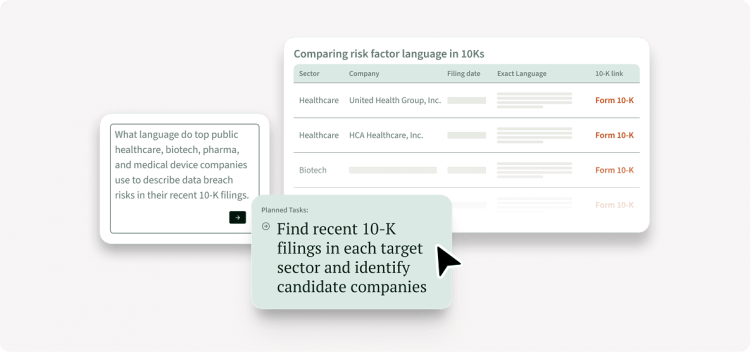
Read the full SEC corporate filings announcement.
Web sources: A complementary research layer for the Clio Library
Sometimes the legal answer starts with authority, but the full picture depends on what is happening around it.
An attorney assessing a new regulatory issue may need the statute, cases, and commentary, but also the latest agency guidance, a law commission paper, or public analysis showing how the change is being interpreted in practice.
Web sources bring that broader context into Vincent without blurring the line between authoritative legal research and open-web material. Clio Library sources still come first. Web results appear as a supplemental layer, clearly labeled in the Cited Sources Tray, so attorneys can see where each source came from and evaluate it accordingly.
The result is more complete research inside a controlled legal AI workflow. Attorneys can start with the authority they trust, then expand the record when the issue calls for current, emerging, or contextual material beyond the library.
![[Vincent]-[Cited Sources]-[Web Sources & Agentic Mode]-[Collage]](https://www.clio.com/wp-content/uploads/2026/07/Vincent-Cited-Sources-Web-Sources-Agentic-Mode-Collage-750x457.png "[Vincent]-[Cited Sources]-[Web Sources & Agentic Mode]-[Collage]")
Performance & precision: The details that don’t slow you down
A set of upgrades in recent months work at the level of everyday use: translation, dictation, citation confidence, drafting, and document access.
Full document translation: Vincent now handles full-length translation end-to-end, with no cut-offs and no manual stitching.
Voice mode on desktop: Voice dictation enables hands-free prompting when moving between documents or when the question is long enough that speaking is faster than typing.
Authority Match: Case citations in document analysis responses are automatically verified against the Clio Library and surfaced inline so attorneys can check authority without leaving the workflow.
Legal Pad: Attorneys gain a side-by-side editing space to refine AI-generated research into a cohesive first draft, without leaving the interface.
Read the full Legal Pad announcement.
DMS integrations: Direct integrations with iManage, NetDocuments, SharePoint, and Google Drive mean data stays in your secure environment, with no files touching local hardware.
Read the full DMS integrations announcement.
That’s the Q2 release. July will bring a series of releases to expand the power of the Vincent agent, as well as increased coverage for SEC filing types, and continued development in Clio for Word. See you next month.