The Release Report: May 2026
May brings Vincent into Microsoft Word with Clio for Word, plus full-length translation, web search, and agentic collections. See what's new.
May brings Vincent into Microsoft Word, a workflow for full-length document translation, multi-step research with every cited source surfaced inline, and the open web as a complementary layer to the Clio Library. Vincent also reaches further into matter collections, with agentic search across firm-curated documents. Here’s what’s new.
April’s releases sharpened Vincent’s core experience with agentic execution, citation safeguards, and natural-language access to thirty years of SEC filings. May’s releases extend Vincent’s range. Clio for Word brings Vincent into the Microsoft Word sidebar with native track changes. Translate Documents handles full-length legal documents end-to-end. Agentic research surfaces every cited source in a new side panel. Web search extends grounding beyond the Clio Library when a query calls for it. And Vincent can now agentically search across matter collections during multi-step research.
Clio for Word: Legal AI inside Microsoft Word
Most legal work happens in Microsoft Word, not in a chat window. Until now, using Vincent meant breaking the drafting flow to switch tabs, ask a question, or pull a citation.
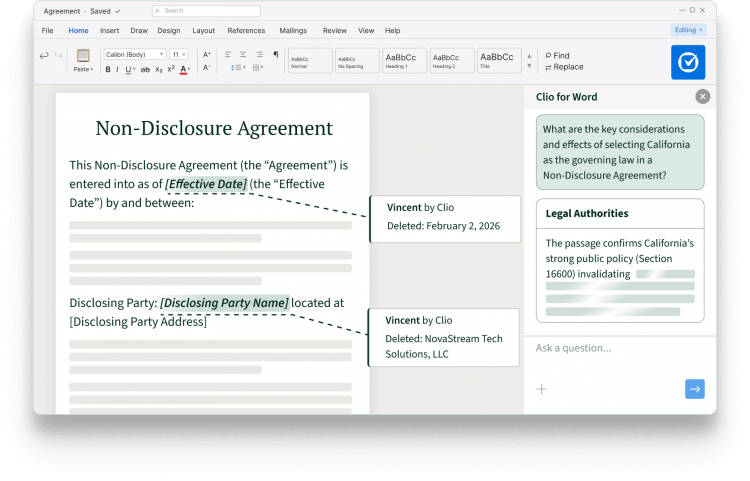
Clio for Word in beta, brings Vincent directly into the Word sidebar. Vincent reads the active document in full, including comments and existing redlines, and proposes edits using native Word Track Changes.
- Edits as native track changes: Every suggestion lands as a redline that attorneys can accept or reject using the same workflow they already use with colleagues and opposing counsel.
- Conversational document review: Ask Vincent to identify risks, inconsistencies, missing provisions, or structural issues without leaving Word.
- Draft from a blank page: Describe the situation, generate a first draft directly in Word, and iterate from there.
Translate Documents: Full-length legal translation, end-to-end
Pasting a long legal document into a generic chat usually ends one of two ways: the output cuts off partway through, or the model interrupts mid-document to ask if it should continue. Neither is acceptable when the qualifying language in a survival clause or jurisdictional carve-out matters as much as the prose around it.
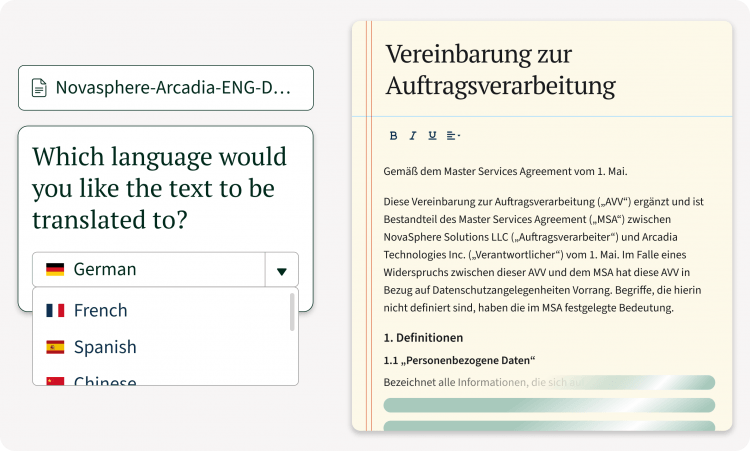
The new Translate Documents workflow handles full-length translation end-to-end. Upload one or more documents, pick a target language up front, and Vincent works through the file section by section in the background, returning one complete, polished translation.
- Language flexible: Accepts regional variants like English UK and Brazilian Portuguese. Vincent asks up front and re-prompts if the request is ambiguous.
- Built for length: No size limits, no chunking, no “do you want me to continue?” interruptions.
- One-click handoff: Upload, choose a language, get the translation. No manual stitching at the end.
Agentic legal research: Every cited source, surfaced inline
Vincent’s agentic research plans queries, gathers sources, and synthesizes answers across the Clio Library. Until now, the sources powering each answer lived inline in the response, harder to scan when a session ran long.
The new Cited Sources Tray surfaces every case, statute, and authority Vincent retrieves during agentic research in a clean side panel. Attorneys can open the tray and return to it at any point in the conversation. Each question in a session has its own cited sources view, so it’s easy to navigate between sources without losing your place.
Answers your team can trace back to their source are answers they can act on with confidence.

Web search: A complementary research layer for the Clio Library
The Clio Library is Vincent’s foundation: a curated, citation-quality corpus of cases, statutes, regulations, and commentary that every Vincent research and drafting capability is built on. Some research questions, though, need information that lives beyond the library: regulator guidance from this morning, news coverage of an active matter, an analyst note just released.
Web search brings the open web into Vincent as a complementary layer alongside the library.
Vincent always prioritizes Clio Library sources first; web search supplements the record when a query calls for materials outside the library. Web sources are clearly identified in the Cited Sources Tray as a distinct source type, so attorneys always know what they’re working with.
For a securities litigator working a fraud-on-the-market claim, that means pulling a defendant company’s recent earnings call and trade-press coverage into the same response that grounds the controlling precedent from the library. For regulatory counsel, it means citing an agency release from this morning alongside the statutory framework that governs it.
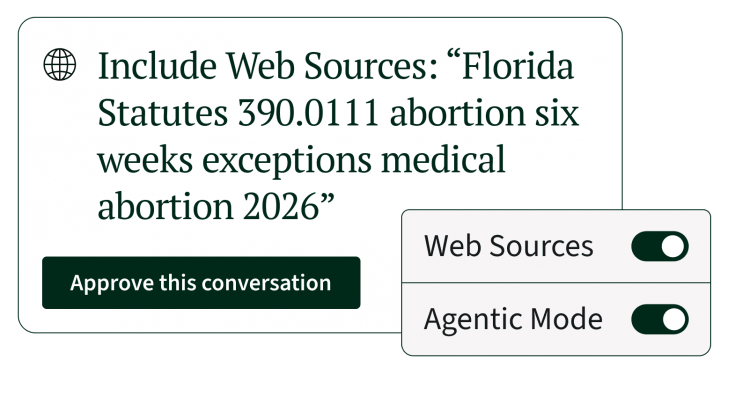
- Off by default: Web search is opt-in.
- Per-conversation control: Toggle on or off for each research session.
- Admin governance: Firm administrators can enable or disable web search at the organization level.
- Zero data retention: Research stays within your secure, governed environment. Contractual zero-retention guarantees ensure no queries are used for model training or retained by third-party providers.
Agentic collections: Matter-aware reasoning, at any scale
Collections already let firms group documents around a matter and run Vincent across them. Now Vincent can search collections agentically, reaching into them alongside its other research tools to pull the relevant clauses, exhibits, and precedent from the matter at hand.
Powering that is Turbopuffer, a vector search engine purpose-built for enterprise scale. Vector search is the technology that lets Vincent find content by meaning rather than by exact keyword: every document in a collection is converted into a mathematical representation (an embedding), and queries are matched against those representations to surface the most semantically relevant passages. Nothing changes in how teams interact with Vincent; the improvements work entirely behind the scenes.
Your data stays within your existing regional environment. Turbopuffer stores only the mathematical representations used for search, never the text of the documents themselves.
That’s the May release. Several notable updates are already queued for June, with new capabilities coming to Vincent and continued expansion of Clio for Word. See you next month.