Capture the workplace history
Preconfigured and custom fields record the employer, employee, role, dates, pay, termination, union involvement, allegations, and upcoming tribunal or court events, so nothing is re-entered.
Who We Serve
Software for sole practitioners, Large Law and in-house teams, across every area of law.
Overview
Resources
Explore insights, guidance, and learning to help you get more from your practice.
Trending Topics & Tools
Training & Events
Employment law
Employment law software should follow the issue wherever it goes. With Clio’s legal AI platform, people, policies, evidence, cited law, deadlines, and decisions stay connected as advice becomes an investigation, grievance, or tribunal claim.
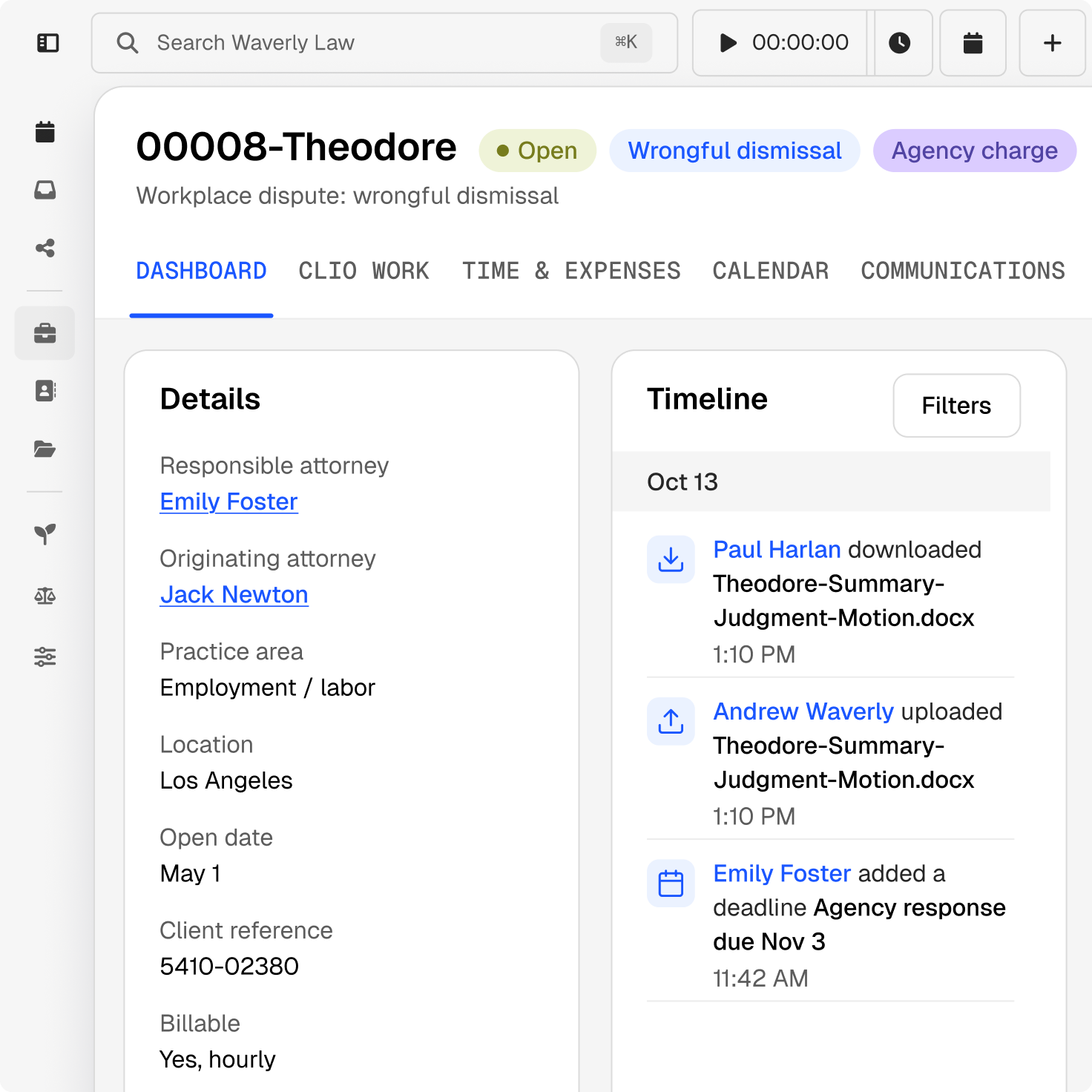
Preconfigured and custom fields record the employer, employee, role, dates, pay, termination, union involvement, allegations, and upcoming tribunal or court events, so nothing is re-entered.
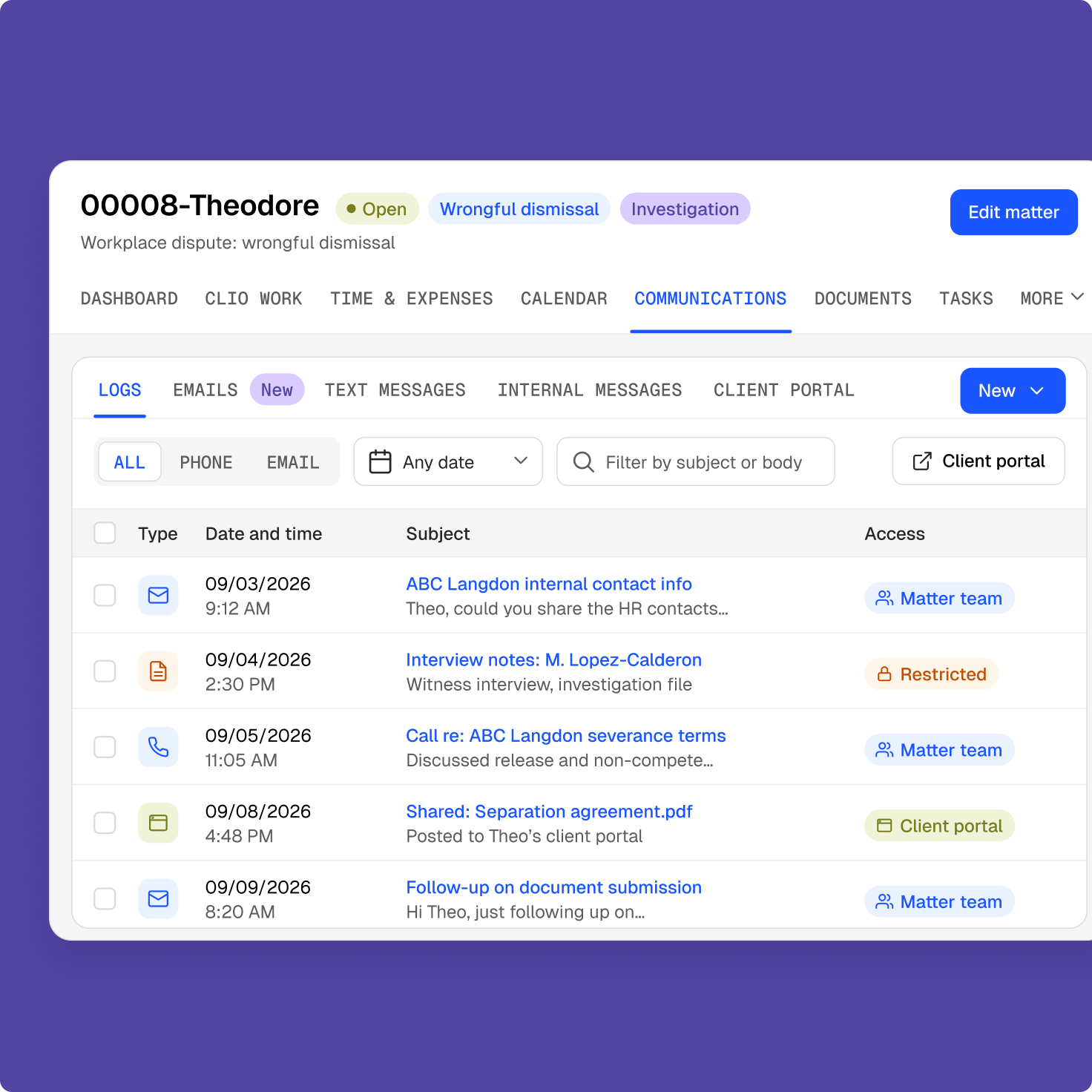
Sensitive matters stay restricted to authorised users, interview notes and source documents stay with the investigation, and those permissions carry into secure client communication.
Review policies and agreements, compare versions, research the governing law, and prepare advice, responses, settlement agreements, or litigation materials for your review.
Tasks, calendars, reminders, matter stages, time, bills, and payments sit with the issue.
Intake forms capture the employer, the employee, the role, the pay, the agreements, and the prior steps, and run conflict checks before the engagement. You decide the response with the whole history on the matter, whether the issue stays internal or reaches a tribunal or court.

Workplace facts can sit across HR files, email, managers, and union representatives. Interview notes, policies, agreements, and source documents live in the matter, restricted to the people who should see them. Share updates and documents through the client portal, where the matter’s permissions still apply.
Clio’s legal research covers employment legislation and case law, updated daily. Get answers on discrimination, reasonable adjustments, pay, benefits, and procedure, each linked to its source so you can verify it. Drafting prepares an advice memo, response, agreement, submission, or client letter from the matter, for your review.
Save a discrimination or unfair dismissal claim form to the matter as it arrives. Clio’s legal AI can extract the claims, protected characteristics, and facts and prepare potential responses, which your firm reviews. You decide which defences to raise, with cited authority behind each one.
Custom dates and tasks in calendaring track the statutory time limits that apply to each claim. Record time as the work happens, run billing, and manage client money in a client account.
legal professionals trust Clio
law societies and bar associations recognise Clio
average rating across 13,000+ reviews
Now, the engagement process is super fast. I’ll send someone an email while they’re on the phone, and they’ll click it as we’re talking and sign their retainer with us right then and there.
Managing Attorney, Ottinger Employment Lawyers (California and New York)
Employment law software keeps the people, policies, evidence, cited law, deadlines, and decisions for a workplace matter in one connected record, so the work holds together as advice becomes an investigation, grievance, or tribunal claim. Get a demo.
Clio was built so the workplace record and the work around it draw on one shared foundation. Parties and roles, policies and agreements, investigation material, cited research, document automation, deadlines, communication, billing, payments, and client accounting all sit together. That shared context lets Clio prepare work for professional review and return the approved work to the matter, so early advice still holds when the issue reaches a formal forum. Get a demo.
Yes. Clio can be configured around the parties, documents, permissions, workflow, deadlines, and fee model each side requires, whether it is an employer-side investigation, a claimant-side tribunal claim, or a grievance and collective consultation. Get a demo.
Yes. Custom roles and matter-level permissions can restrict a matter to selected users or groups, so interview notes and source documents stay with the people authorised to work on the investigation. Your firm remains responsible for configuring access, privilege, confidentiality, retention, and ethical obligations. Get a demo.
Yes. Your firm can use custom tasks, calendars, reminders, and matter stages to track tribunal and court deadlines, the limitation period for each claim, and Acas early conciliation dates. Get a demo.
Yes. Clio’s legal AI researches the Employment Rights Act 1996, the Equality Act 2010, the Trade Union and Labour Relations (Consolidation) Act 1992, the Working Time Regulations 1998, and TUPE. Employment Appeal Tribunal and Employment Tribunal judgments are fully indexed, and Scotland can be searched separately. Cited cases carry colour-coded treatment flags so you can see whether a judgment is still good law. It returns cited authority for you to evaluate and apply. Get a demo.
Yes. Upload a discrimination or unfair dismissal claim form and Clio’s legal AI can extract the claims, protected characteristics, and facts, and prepare potential defences for your review. It can also summarise a long witness statement and flag inconsistencies against the documents already on the matter. Your firm reviews every finding before it is relied on. Get a demo.

Matter permissions restrict sensitive investigations to authorised users, and Clio’s infrastructure complies with the UK GDPR and the Data Protection Act 2018. Your firm’s data is never used to train third-party models, and every AI-supported result stays available for your review.