Open each matter with authority
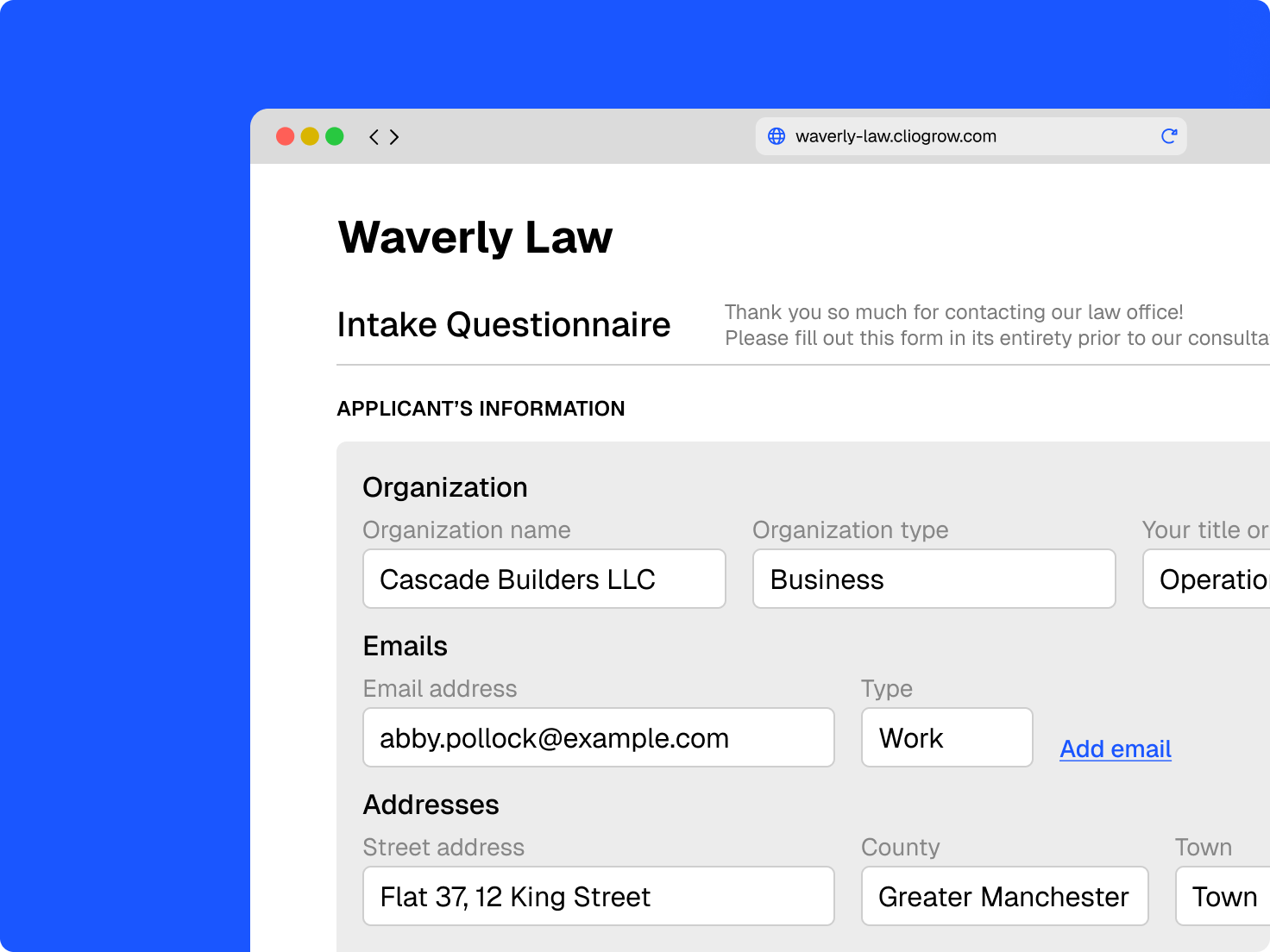
Capture the legal issue, the governing authority, the responsible office, and key deadlines from day one.
Who We Serve
Software for sole practitioners, Large Law and in-house teams, across every area of law.
Capture the legal issue, the governing authority, the responsible office, and key deadlines from day one.
Source documents, research, drafts, approvals, and final work sit in one record.
Templates, tasks, and rules-driven calendaring based on courts, claims, and agencies.
Configure case management without billing where appropriate for visibility and reporting.
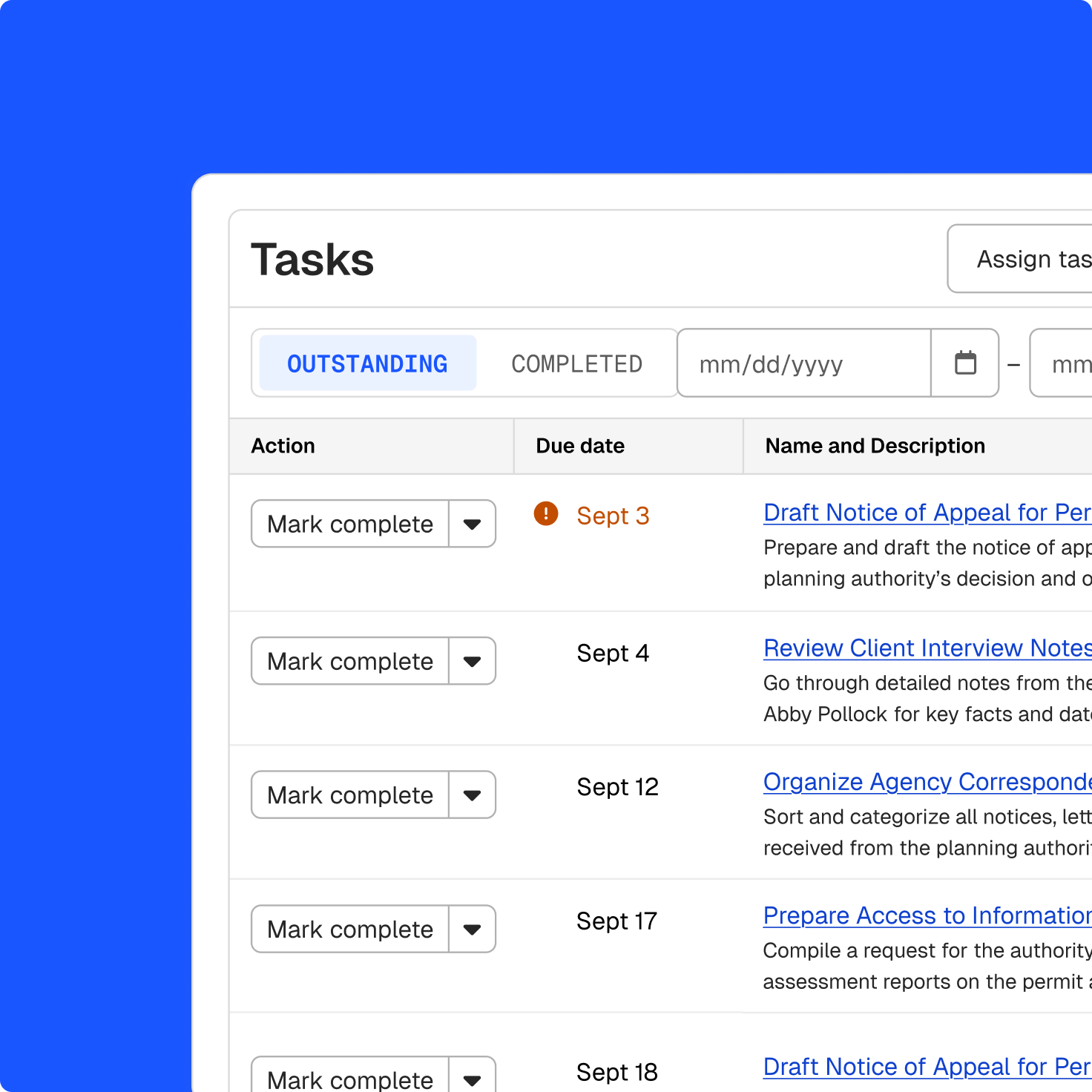
Work arrives as requests, claims, investigations, and statutory obligations, often before anyone owns it or knows what comes next. Clio puts each one on a structured record beside its deadlines and any docket alerts, so you decide what moves first and who takes it.

Rules-driven calendaring covers hundreds of US courts and the statutory windows for claims against public entities, including the claim presentation window and the entity response period. Calculated dates go on the matter with the rule behind each one. Your office verifies and meets every date.
Docket monitoring alerts your team to new filings, orders, and schedule changes. Retrieved documents save to the right matter folder, named and filed. Connect the court case to the matter once, then review each new order and assign the tasks that follow.
Legal research covers public records and open-meetings law, the Federal Tort Claims Act, and state government claims acts, each answer linked for your team to open and verify. Research runs beside your matters, documents, and drafts, so you weigh the authority with the record in view.
Advice, filings, and settlement positions can need more than one sign-off, and staff may change before the work is final. Task checklists set each review step and its owner, and case management holds the documents, notes, and activity when a matter is reassigned. You approve what goes out.
legal professionals trust Clio
law societies and bar associations recognize Clio, including all 50 state bar associations in the United States
average rating across 13,000+ reviews
Clio has proven to be less expensive and more user friendly than our prior system.
Attorney, Hamilton, Michaelson & Hilty, LLP
Government law software helps public legal teams manage matters from intake through final action, including the legal work, deadlines, approvals, and reporting involved along the way. The right system keeps the matter history, responsibilities, and next steps visible throughout. See Clio in action.
At minimum, look for structured intake that captures the requesting office, the issue, and the governing authority; a clear record of who owns the matter and what happens next; documents, research, drafts, and approvals held together; deadlines traceable to the notice or statute behind them; an approval path that can be assigned and tracked; reporting on effort and outcome whether or not the work is billed; and the option to run matters without billing at all. The exact mix depends on whether the office litigates, advises, or does both. See Clio in action.
Clio can support configurable matter workflows for public defense, prosecution, agency counsel, enforcement, claims, investigations, municipal work, and civil matters. See Clio in action.
Yes. A matter can be marked non-billable, which keeps it off every billing screen and prevents an invoice being raised against it. Time still records, at zero rate, so your office can report on hours worked, by whom, and against which matter or program. Productivity and utilization reporting works from that record without an invoice ever being generated. See Clio in action.
Yes. Clio can preserve a matter through reassignment by keeping its documents, notes, deadlines, ownership, and activity connected to the matter, helping an authorized new owner understand the history and what comes next. See Clio in action.
Yes. Because public-law litigation runs on the civil procedure code, your court’s general civil rules cover it without extra setup. Clio also has rule sets for statutory claims against public entities, calculating the claim presentation window, the entity’s response period, the late claim application, and the petition for relief. Administrative boards are covered too, and if an agency your office appears before is not yet included, it can be built. Your office sets the reporting and public-record dates that apply to its own calendar. See Clio in action.
Yes. Clio’s legal AI can summarize the records on a matter, whichever department or outside party they came from, and build a chronology from what it finds. It can also prioritize what needs attention across an office’s open matters. Every summary stays linked to the source material, so your office can check any point before relying on it. See Clio in action.
Clio is certified to the SOC 2 Type II standard, with the reports available to review. Data is encrypted in transit and at rest to FIPS 140-2. Matter permissions determine who can open a matter, and firm data is not used to train third-party models. Your office remains responsible for its own procurement and records obligations. See Clio in action.
Yes. Clio’s legal AI researches the US Code and state statutory codes, the Code of Federal Regulations and state administrative codes across all 50 states, and agency decisions from bodies including the Merit Systems Protection Board, the EEOC federal sector, and the GAO. It covers public records and open meetings law, the Federal Tort Claims Act and state government claims acts, alongside federal and state court decisions. Local municipal codes are not indexed, though your office can upload its own charter and ordinances to query them alongside primary law. See Clio in action.