Case and document management
Every case or matter, and every document tied to it, lives in one connected record, giving your team the context they need to keep work moving, no matter the type of legal work.

Every case or matter, and every document tied to it, lives in one connected record, giving your team the context they need to keep work moving, no matter the type of legal work.
Deadlines calculate automatically from court rules across hundreds of courts, then sync to Outlook or Gmail right alongside every email tied to the matter. No one has to track a date or save a message by hand.
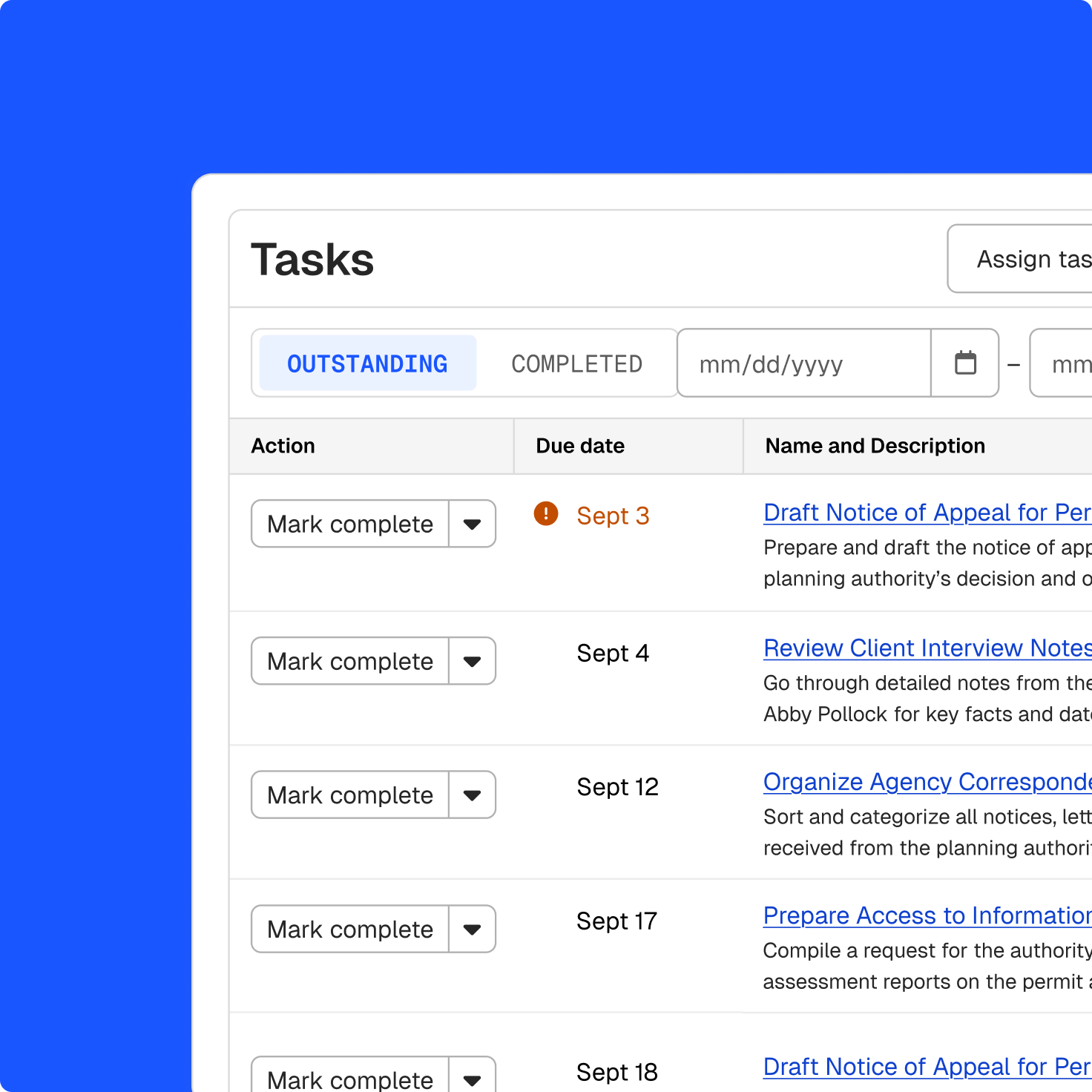
Assign and track every task on a matter, from motions to discovery deadlines, and see at a glance what’s overdue and who owns it, even during a busy caseload.
Share drafts, memos, and matter documents with colleagues and the requesting department in one place, with version history and comments, so nothing gets lost across separate email threads.
Generate agreements, legal opinions, and advice letters straight from the details already on the matter, so routine requests get a fast, consistent response instead of starting from a blank page each time.
Summarize case files and contracts, surface relevant precedent or key terms, and draft filings, motions, or agreements in minutes, all grounded in the details already on the matter.

Every case, document, and piece of discovery stays on one matter through reassignment. Case management keeps the file connected; document management keeps it searchable, so a new lawyer never starts from zero.
Access case files, notes, and calendars from your phone or tablet, whether you're at the courthouse, a detention centre visit, or a client meeting, so you're never stuck waiting to get back to a desk.
Keep every client's contact details, case history, and communication in one place, so any attorney picking up a file can see who the client is and what's already been discussed.
Summarize a high-volume case file and build a chronology from it in minutes, and see what across an open caseload needs attention first, all traceable back to the source document.
Clio is certified SOC 2 Type II. Your organization’s data is not used to train third-party models, and cited research, summaries, and drafts remain available for professional review.
Government legal software helps public sector legal teams manage cases, documents, and deadlines. The right system keeps the matter history, responsibilities, and next steps visible throughout the process. Get a demo.
At minimum, look for a clear record of who owns the matter and what happens next; documents, research, drafts, and approvals held together; deadlines traceable to the notice or statute behind them; an approval path that can be assigned and tracked; and reporting on effort and outcome across every matter. The exact mix depends on whether the office litigates, advises, or handles public defense work. Get a demo.
Clio is available directly or through resellers including Carahsoft and SHI, and can respond to your office's RFQ or RFP. Your office's own procurement rules apply. Contact our team to discuss further.
Clio can support configurable matter workflows for municipal legal departments, provincial and territorial ministries, Crown corporations, legal aid clinics, and regulators and tribunals. Get a demo.
Yes. Billing can be turned off entirely, removing rates, invoices, and every billing-related screen from Clio, not just from an individual matter. Time can still be tracked separately for reporting or utilization purposes if your office wants that. Get a demo.
Yes. Clio can preserve a matter through reassignment by keeping its documents, notes, deadlines, ownership, and activity connected to the matter, helping an authorized new owner understand the history and what comes next. Get a demo.
Yes. Your office can build deadline sets around the statutes, notices and tribunal dates it works to, assign them to the matter, and sync them to Outlook or Gmail, so nothing depends on someone tracking a date by hand. Get a demo.
Yes. Clio's legal AI can summarize the records on a matter, whichever department or outside party they came from, and build a chronology from what it finds. It can also prioritize what needs attention across an office's open matters. Every summary stays linked to the source material, so your office can check any point before relying on it. Get a demo.
Clio carries a SOC 2 Type II certification, covering security and availability standards, the report is available to review on our Trust Centre. All Client and matter data is stored in Canada, and with the exception of some AI features, all data is also processed in Canada at all times. Data is always encrypted in transit and at rest to AES256 and TLS 1.2+. Granular roles and permissions allow administrators to determine access to data down to the matter level, maintaining ethical walls within your organization. Clio maintains strict zero data retention agreements with providers of AI foundation model providers, ensuring that your department's data is never used as training material. Your office remains responsible for its own procurement and records obligations. Get a demo.
Clio is committed to protecting the rights of Canadians, and meets the requirements of PIPEDA, Canada's federal privacy law for private-sector organisations. Get a demo.
Yes. Clio's legal AI researches federal and provincial statutes and regulations, Crown liability and proceedings legislation, and access-to-information and privacy law, alongside decisions from the Supreme Court of Canada, the Federal Courts, the provincial courts of appeal and superior courts, and administrative tribunals. Coverage excludes Quebec and Nunavut. Municipal by-laws are not indexed, though your office can upload its own by-laws and charter to search them alongside primary law. Book a demo for more information.