


Business Formation & Compliance Law

Build the company record at formation. Use it for every decision that follows

Clio is the legal AI platform for business formation and ongoing compliance. Owner and entity details, governance choices, documents, cited law, obligations, contracts, financing, and changes stay connected, so later counsel begins with the decisions that formed the business.

Person in a blue suit walking, holding a silver laptop.

Manage business formation and compliance from first instructions through ongoing counsel

Build the entity and owner record before documents begin

Good business law software starts before the first filing. Use intake, related contacts, and custom fields to record the entity name and type, the corporation number and business number, the registered office, the owners, directors and officers, and the date of incorporation.

Prepare formation and governance documents from approved facts

Carry mapped text, date, and picklist fields into the firm’s reusable templates and prepare initial consents, agreements, policies, or client materials for professional review.

Hold every recurring obligation on the company record

Use task lists, custom dates, matter stages, reminders, and integrated workflow tools to track annual returns, renewals, corporate-tax and registration dates, governance steps, and client follow-up. A date can repeat for the life of the company, with a reminder ninety days out.

Review agreements and company records with cited law

Analyze contracts, compare redlines, extract obligations, and organize diligence or entity records in sourced tables, while your firm decides the legal and business response.

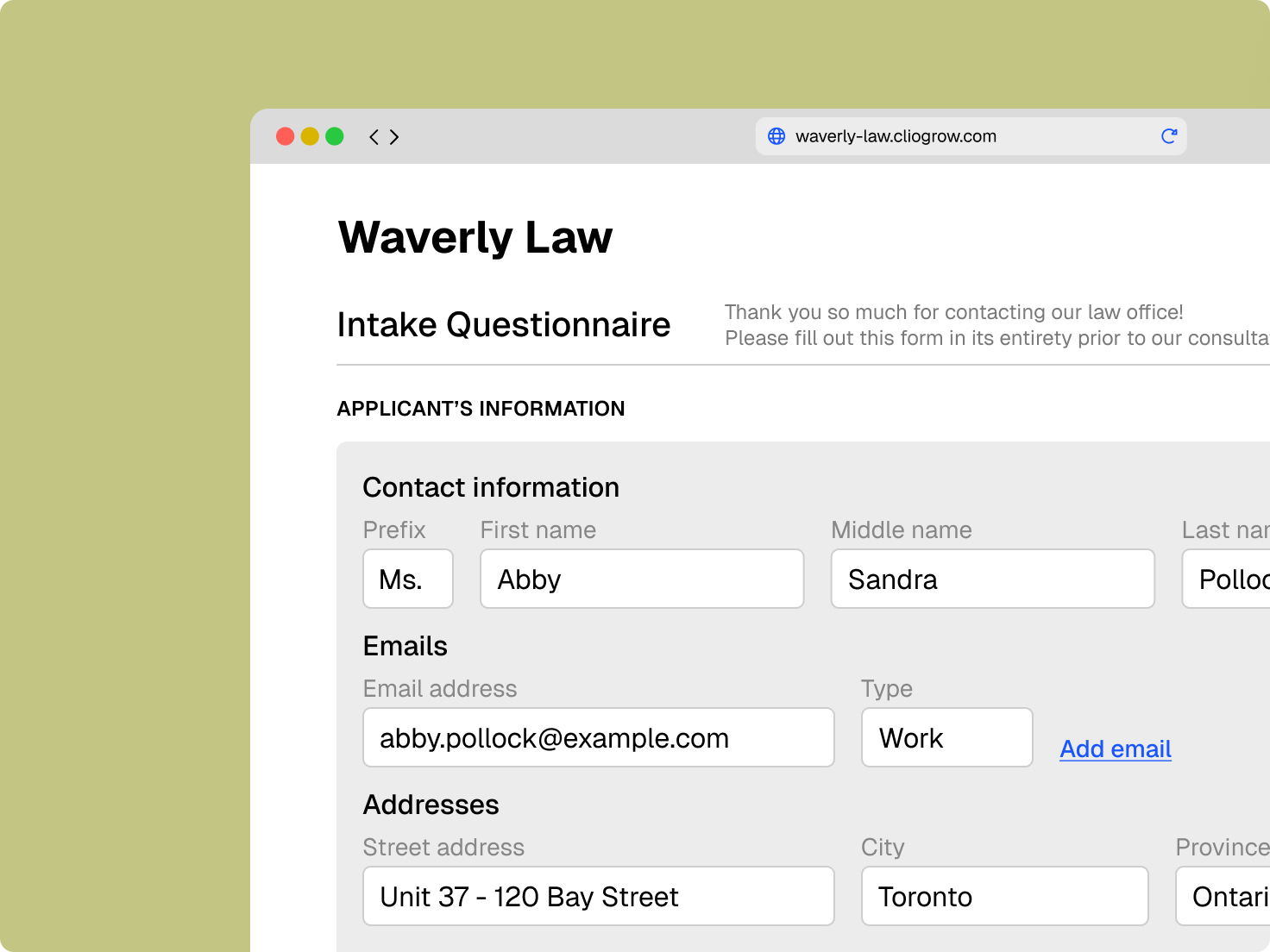
A law firm’s online intake questionnaire with a client’s name, email, and Toronto address filled in.

Start with the business the client is trying to build

A formation request is usually attached to a business decision: who will own the company, how authority will work, what the founders are contributing, where the entity will operate, and what must happen before the business can move.

Clio begins building the entity record at intake. Forms and custom fields collect the people, ownership, purpose, jurisdiction, related entities, requested structure, known deadlines, and existing agreements. Related contacts show how founders, owners, directors, officers, advisors, and counterparties connect to the work.

What can you do with Clio’s business law software?

Build the formation set from approved owner and entity details

Entity names, addresses, owners, directors, officers, percentages, jurisdictions, and governance choices repeat across formation documents, consents, agreements, registers, notices, and client correspondence.

Clio can carry approved client and matter data into the firm’s own reusable Word templates. Conditional logic can adjust approved clauses and included documents as the entity structure changes. Clio’s legal AI can build a questionnaire from the fields the set needs and send it to the founders.

Tie governance decisions to the documents they shape

Formation is the first decision in a longer record. Board and shareholder consents, officer appointments, equity decisions, amendments, financings, contracts, and ownership changes all depend on what came before.

Clio keeps the current governance documents, prior versions, approvals, signatures, client instructions, and communication with the entity. The firm can see what was authorized, who approved it, what changed, and which follow-up obligations remain.

Turn compliance obligations into visible, assigned work

Annual reports, registrations, franchise taxes, renewals, licences, governance meetings, and other recurring obligations can disappear once the formation file closes. The dates and owners need to remain connected to the entity and source requirement.

Clio can use custom fields, tasks, calendars, reminders, and matter stages to track verified compliance work. The source filing, document, rule, or client instruction stays beside the obligation it created.

Carry the entity history into contracts, financing, and change

The entity may later negotiate a commercial agreement, bring in an investor, change ownership, reorganize, hire, grant authority, enter a new jurisdiction, or face a dispute. Those matters rely on the company’s ownership, governance, approvals, and prior agreements.

Clio keeps the entity and relationship record connected to the next matter. Your firm can reuse verified details, review prior decisions, research the new question, and keep approved contracts, consents, amendments, and obligations with the company history.

Business Law Software FAQs

What is business formation software for law firms?

Business formation software helps law firms collect entity and owner information, prepare documents, manage signatures and filings, track tasks and deadlines, communicate with clients, and bill for the work. In Clio, the resulting entity record also supports governance, compliance, contracts, changes, and recurring advice.

Book a demo.

What should business formation and compliance software include?

At minimum, look for intake that captures the entity, the owners and the structure before drafting begins; conflict checking; a company record the details stay on so the next matter does not start from scratch; document automation for the formation set; annual dates that repeat with reminders; contract review against cited authority; and billing that handles a flat-fee incorporation and hourly counsel afterwards.

Book a demo.

Does Clio file with the corporate registry?

No. Articles, annual returns, and notices of change are filed through Corporations Canada or your provincial registry, and Clio holds the record of what was filed, when, and by whom.

Book a demo.

Can Clio hold a company record across years of matters?

Yes, and this is the difference between an incorporation file and a company record. The entity type, jurisdiction, corporation number, business number, registered office, and directors sit on the company itself rather than on one matter, so they persist for as long as the firm acts for it. A financing round three years after the incorporation opens with the structure already known.

Book a demo.

Can Clio populate formation documents from matter data?

Yes, from your firm’s own Word templates. The entity and owner details you have recorded carry into the set, and Clio’s legal AI can build a questionnaire from the fields the documents need and send it to the founders to complete. A whole incorporation set then populates from one round of answers rather than from a form your firm retypes.

Book a demo.

Can Clio track annual returns, corporate tax dates, and renewals?

Yes. A date can repeat for the life of the company, with up to five reminders on it, so a ninety-day warning on an annual return arrives every year without anyone re-entering it. Record the date once and Clio can list every entity with one falling due this quarter, so the question is answered across the book rather than matter by matter.

Book a demo.

Can Clio review the commercial agreements the company signs?

Yes. Clio’s legal AI can analyse a commercial agreement, compare it against an earlier version, and extract the obligations it creates, with the authority it relies on cited for you to check. Diligence and entity records can be set out in a sourced table. Your firm decides the legal and business response.

Book a demo.

Does Clio include business law research?

Yes. Clio’s legal AI researches the Canada Business Corporations Act and the provincial corporations statutes, the partnership acts, and the PPSA, alongside corporate decisions from the provincial superior courts and courts of appeal. Ask how a rule differs between federal and provincial incorporation and it returns a memo for each with a comparison table, so a question like director residency is answered across the jurisdictions you are choosing between.

Book a demo.

Does Clio include native cap-table management?

No. Share classes, option grants, dilution, and vesting live in specialist equity software, and Clio holds the legal matter around them — the documents, the approvals, the communication, and the billing. Ownership details can sit on the company record for reference, but Clio does not calculate them.

Book a demo.

Make the formation work pay off at every later stage

See how Clio connects formation, governance, compliance, contracts, financing, changes, billing, and payment around the entity record.