

Build the entity record first
Intake, related contacts, and preconfigured business fields record the entity name and type, state file number, EIN, registered agent, owners, managers, officers, and formation date.
Business formation and compliance law
Clio is the legal AI platform for business formation and ongoing compliance. It keeps ownership and entity details, governance decisions, documents, contracts, and the obligations and changes that follow all linked to the entity record, so counsel taking on a matter later can start from how the business was actually formed, not reconstruct it.

Intake, related contacts, and preconfigured business fields record the entity name and type, state file number, EIN, registered agent, owners, managers, officers, and formation date.
Mapped text, date, and picklist fields flow into your reusable templates to prepare consents, agreements, policies, or client materials for professional review.
Task lists, custom dates, and reminders track annual reports, renewals, franchise-tax dates, and governance steps, and a date can repeat for the life of the company.
Clio’s legal AI can analyze contracts, compare redlines, extract obligations, and organize diligence or entity records in sourced tables, and your firm decides the response.
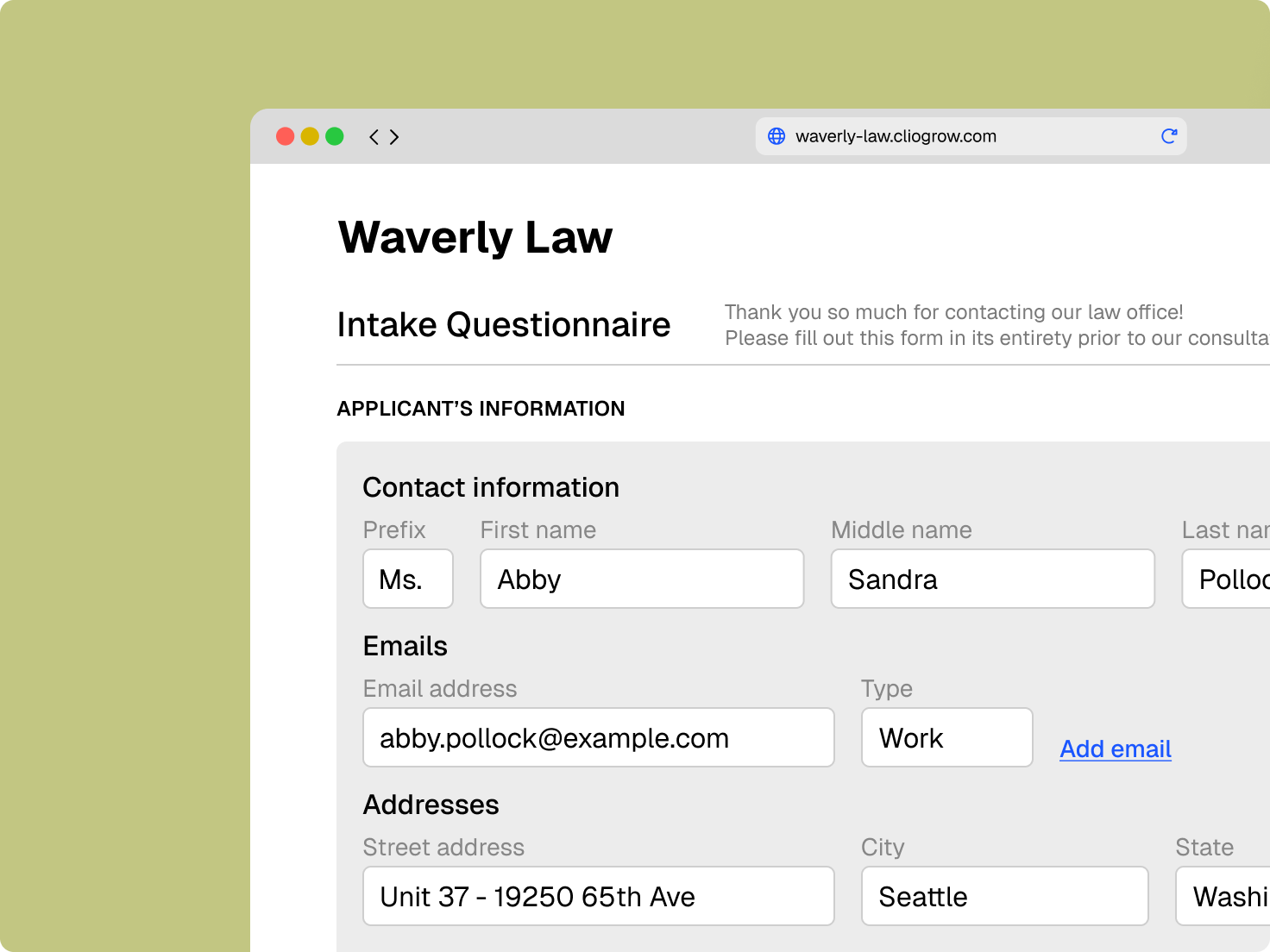
A formation request usually comes with a business decision: who owns the company, how decision-making authority is allocated, and where the entity operates. Clio gathers those answers through an intake form and carries them into automated workflows for the work ahead, and you decide which structure fits.

Annual reports, renewals, franchise taxes, and governance meetings come due years after the formation matter closes. Clio ties each date to the company’s matter through task lists and workflows that assign the next step, and your firm chooses who handles it and when the client hears.
Picking between an LLC and a corporation, or registering in a new state, turns on statutes that differ by jurisdiction. Clio’s legal AI answers with the authority cited, and you decide which rule shapes the advice and the formation documents that follow.
A financing or an ownership change has to fit the consents and agreements the company already signed. Clio keeps those earlier documents on the company’s matters and the officers who must approve in contact management, and document automation prepares the next consent for your review.
A formation is often priced as one flat fee, and later advice runs by the hour. Clio records both arrangements together, with time entries and invoices in one place and retainers held in trust, and you approve each bill before the client sees it.
legal professionals trust Clio
law societies and bar associations recognize Clio, including all 50 state bar associations in the United States
average rating across 13,000+ reviews
With Clio, I can deliver affordable peace of mind to more women business owners.
Owner, Mancabelli Law PLLC (New York)
Business law software keeps the owners, the entity, the governance documents, the obligations, and the deadlines in one connected record, so formation becomes the first chapter of an entity history that later counsel can build on. Get a demo.
Clio keeps intake, the entity and owner details, formation documents, recurring obligations, cited research, contract review, and billing on one company record. A later matter, such as a financing or an ownership change, opens with the structure and earlier decisions already known, and your firm reviews anything Clio’s legal AI prepares before it reaches the client. Get a demo.
Yes. Enter each annual report, franchise-tax date, and renewal as a custom date or task on the company’s matter. A date can repeat for the life of the company, with reminders set well ahead, and Clio can list every entity with a date due this quarter, so your firm plans the work across its clients. Get a demo.
Yes. Build reusable documents from your firm’s own Word templates, and the entity and owner details already recorded fill in the consents, agreements, and policies. Clio’s legal AI can also create a questionnaire from the fields the documents need and send it to the founders, and you review every draft before it is signed. Start a free trial.
Yes. Research corporation, LLC, and partnership statutes for all 50 states with Clio’s legal AI, and each answer links to the authority behind it. Ask how one question plays out in several states and the results can come back as a table, so your firm compares the rules before advising on where to form. Get a demo.
No. Articles, annual reports, and statements of information are filed through the state’s portal or your registered agent, and Clio holds the record of what was filed, when, and by whom. Store the filed copy on the matter, then set the next annual report as a date that repeats. Get a demo.
Yes. Billing handles a flat-fee formation and hourly counsel afterward, with trust accounting and payments on the same record. Charge the formation as one flat fee, then record time on later advice and invoice it hourly. Retainer funds stay in the trust account until you apply them to a bill. Start a free trial.
No. Share classes, options, dilution, and vesting live in specialist equity software. Clio holds the legal work around them: the consents, approvals, client communication, and billing. Ownership details can sit on the company record for reference, and Clio does not calculate them. Get a demo.