






Clio Operate

Legal work management that runs your best work

Clio Operate is the case and matter management system your legal work runs on. Your best lawyers have a way of running matters. Set it out once and every matter of that type follows it, inside your own permissions. Vincent reasons from the record as it builds.

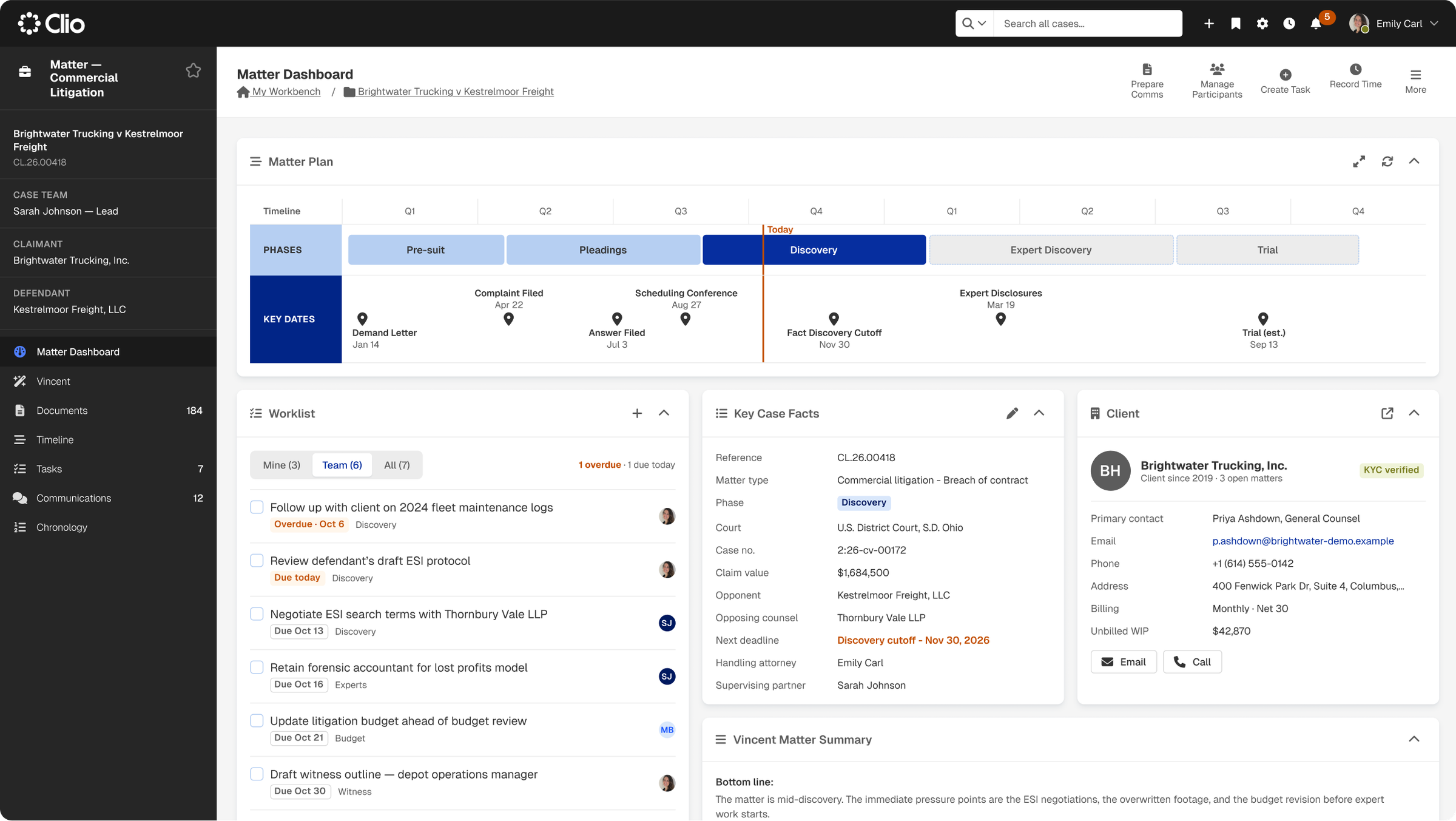
A legal software dashboard displaying a litigation timeline in the 'Discovery' phase, a task list, key case facts, and client contact details.
Two businesswomen stand by a window with a city view, one holding a laptop and smiling.

Your edge is how you run a matter

Your firm already has a way of running a matter that works: what gets settled before the file moves, who signs off and when, what never gets skipped. Right now it lives in your best people.

A Clio Operate matter dashboard showing the matter plan chart, worklist, key case facts, client details and comments.

Every matter follows the route your best team would take

Define a matter type once and Clio Operate runs it that way every time, with the stages, allocations and approval points your practice follows, inside your own permissions.

  • Model the work, not the workaround: work types and phase plans hold the sequence your practice follows.
  • Keep the checks where they belong: approvals and reviews sit in the matter rather than in someone’s memory.
  • Let the record build itself: decisions and review points accumulate as the work runs, without a separate write-up.
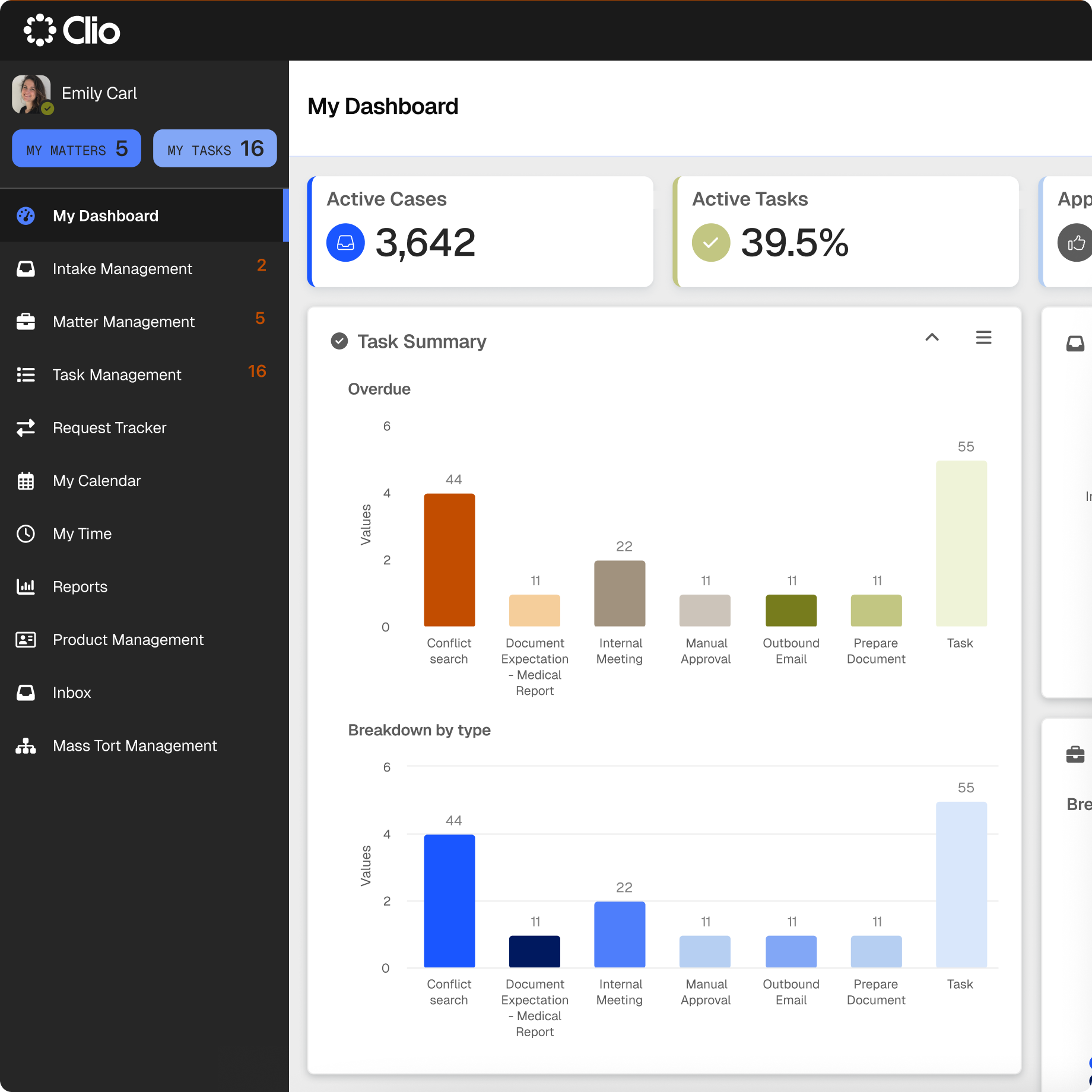
An instruction summary dashboard with four charts: instructions by type, instructions by phase, instructions received, and conversion.

See where every matter stands, across every practice group

Operate provides insights on progress, capacity and margin. Rather than waiting for a monthly report, get updates whenever you need.

  • Watch the lifecycle, not the inbox: see where every matter sits, by practice group, office and timekeeper.
  • Price based on analytics: review time, disbursements and recovery against the matter as it runs.
  • Answer the management committee with evidence: review utilization and profitability by matter type, built from the record.
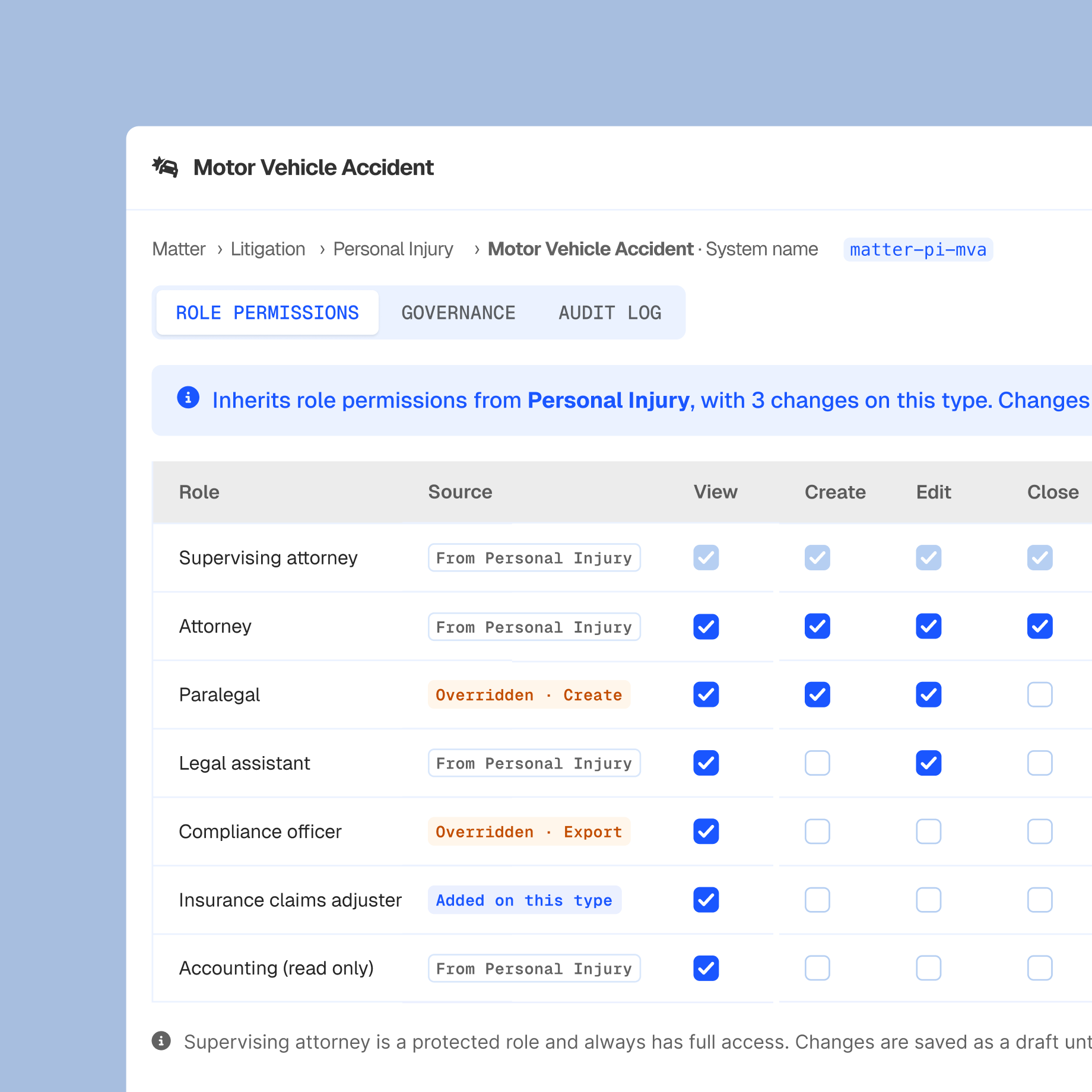
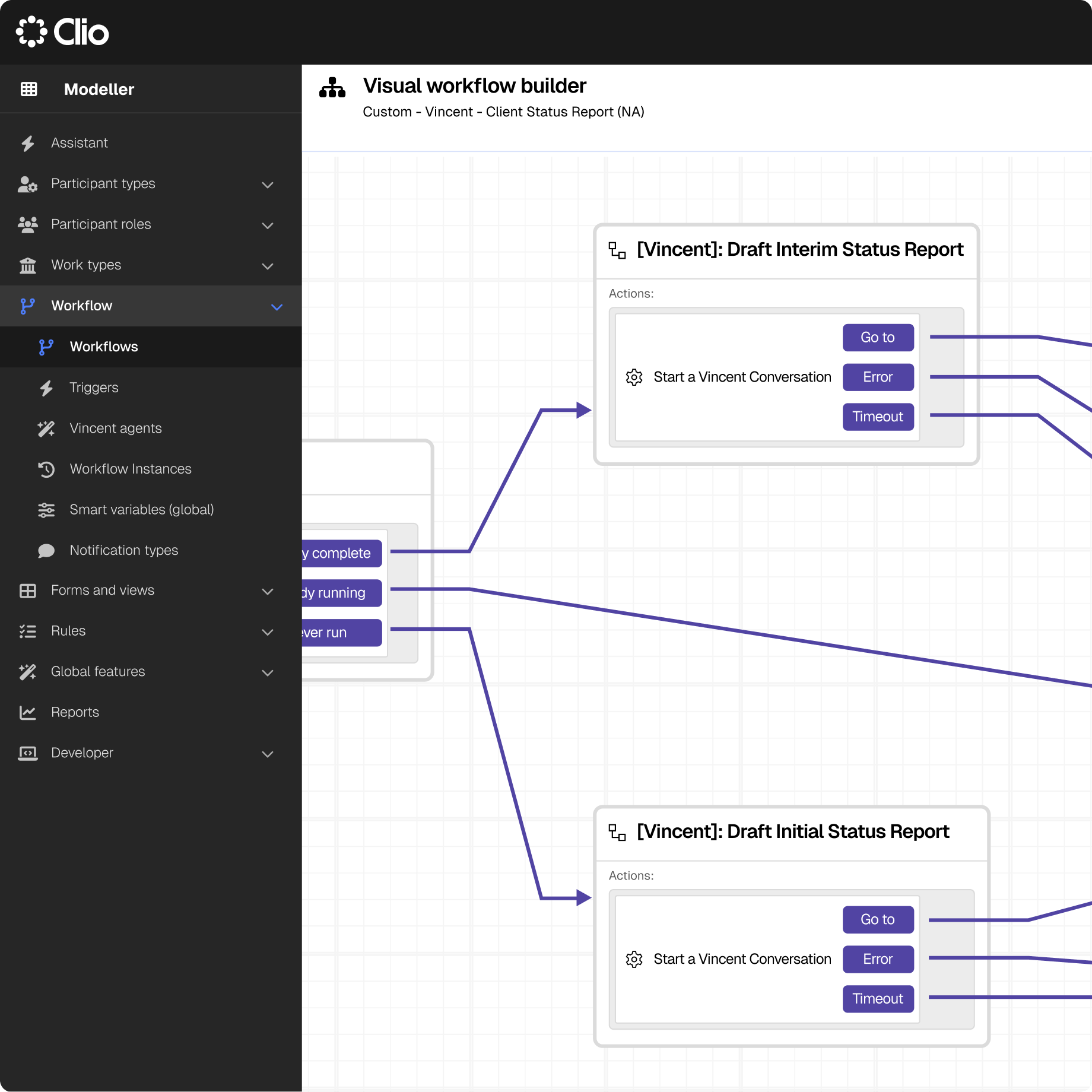
The Clio Operate modeller shows a work type hierarchy with different permissions set at different levels.

One standard to run your matters

No two practice groups run a matter type the same way, and the firm still needs one answer when a client or a regulator asks how the work is governed.

  • Configure by practice group and jurisdiction: the same matter type carries different deadlines and approvals.
  • Hold the standard: no file closes without the sign-offs your firm requires. What goes in it stays your call.
  • Change it without a project: a court moves a filing deadline, and the practice group updates the phase plan.
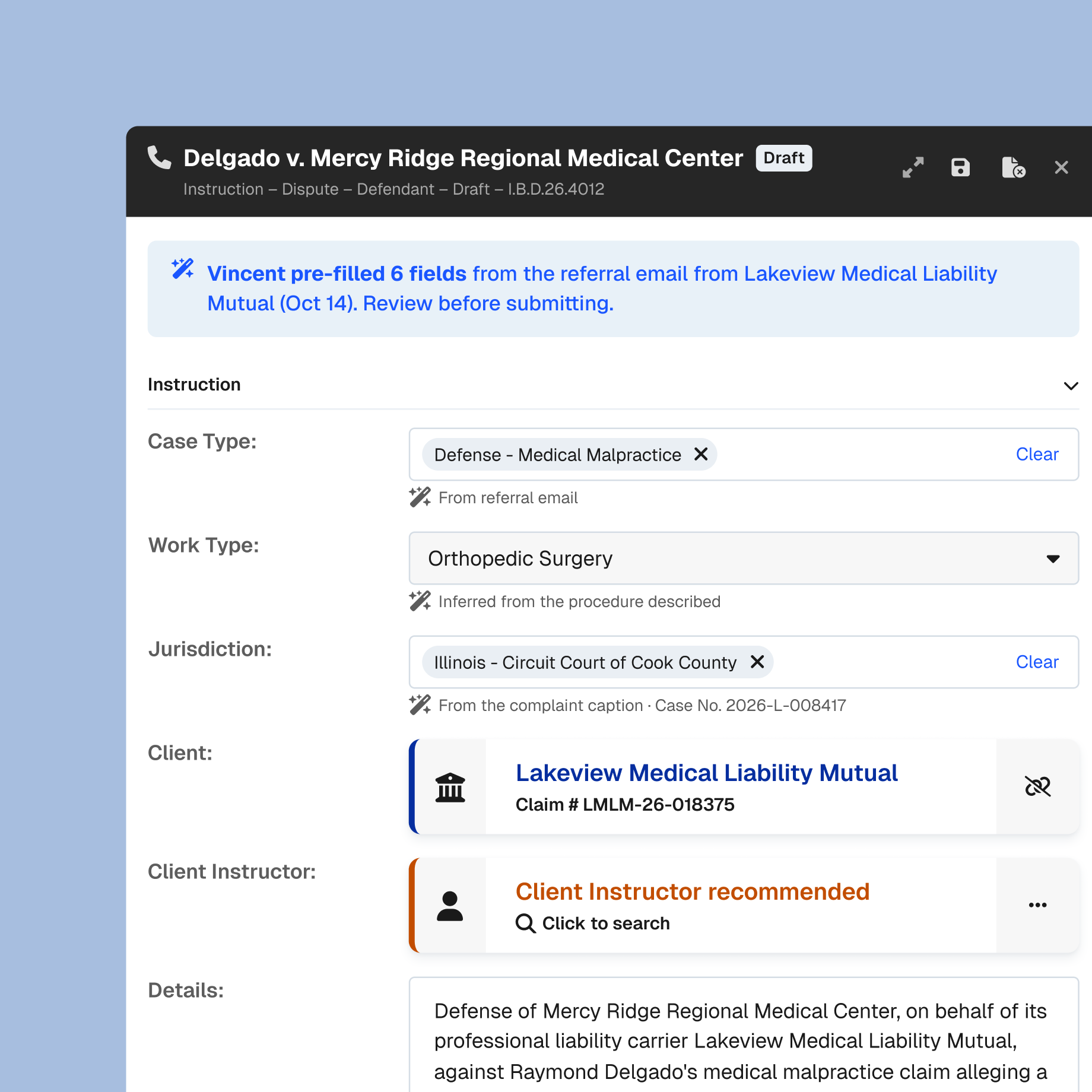
Vincent populating a Clio Operate Instruction blade from documents and correspondence received by the firm.

You open the matter, Vincent is already in it

Vincent is native to Clio Operate, so it reasons from the live matter, the standards your firm holds and the law. You start where the work is.

  • Ask on the matter itself: the facts, decisions and documents are already in front of it.
  • Your standards shape the work: playbooks and review requirements apply while Vincent drafts, so the first pass already meets them.
  • Findings land on the file: Vincent writes back to the matter, attributed, and your team picks up from there.
  • You approve what counts: Vincent carries out the steps your firm has permitted while consequential decisions stay yours.
Person in a pinstripe suit getting into a car on a city street.

The whole matter, from first inquiry to closed file

These all run on one matter record, which lets Vincent reason across them.

Client intake and onboarding

  • Decide whether to take it on: data arrives with the inquiry to assess it, and Vincent states the position on what was sent before anyone opens the file.
  • Clear it before you commit: conflicts and diligence run against your own record and the parties involved, and the check can be evidenced long after the matter closes.
  • Open the file without re-keying it: the engagement letter carries the terms and rates you agreed, and the accepted inquiry becomes a matter with nothing typed twice.

Matter and case management

  • Run matters your way: the matter opens already shaped for your practice, with the phases, allocations and approval points your group set.
  • Know where it stands without asking: the phase, who holds the next step, and the statutory dates nobody worked out by hand. Your client can see it too.
  • Ask about this matter: Vincent reasons on the facts on the file, and its findings go back onto the matter for a lawyer to approve.

Document management

  • Produce it from the file: names, dates and parties come off the matter rather than from retyping, and signatures track against the matter.
  • Review the set against your questions: Vincent Tables answers many documents at once, and every answer opens to the passage it rests on.
  • Start editing: a first pass built from the facts on the matter, the authority behind them and your own precedent, ready for you to take apart.

Workflow automation

  • Change the steps: the group that owns a matter type reworks its own phase plan, without waiting for a release cycle.
  • Your rules apply while the work happens: the firm’s standards run inside the matter, so less has to be caught in a review after the fact.
  • Own the matter: automatic notifications assign ownership based on matter stage.

Time and billing

  • Record time as you work: it goes on the matter as the work happens, from wherever it happens, and a supervisor approves it in context.
  • Bill on what was agreed: fixed fee, hourly and blended arrangements are held against the matter they govern, and the ledger stays in your finance system.
  • See the economics while it is live: what the matter has cost, what has been recovered and what is left, before it is written off.

Reporting and analytics

  • Open to your own work: each team member sees their own matters, not a general report.
  • Answer where the work stands: volume and position by matter type, phase, office and duration.
  • Track capacity and pipeline: timekeeper utilization and matter-type margin, built directly from the record.

Security and governance

  • Vincent inherits your permissions and ethical walls: it sees only what the person using it may see, matter by matter, rather than working around the barrier.
  • Control what Vincent does: what it may see, what it may act on and what must be approved first, configured by you per matter type.
  • Show the audit trail: who saw what, who changed what and when, for a client, insurer or regulator. Certified to ISO 27001, ISO 9001 and ISO 14001.

Integrations

  • Open the document from the matter, wherever it is filed: iManage, NetDocuments, SharePoint or Microsoft 365, with Vincent reasoning over what is in them.
  • Your finance system still issues the bill and keeps the ledger: time and costs recorded on the matter reach it without anyone re-keying them.
  • Take instructions from the insurer or approved counsel and report back through their systems: conflicts and AML screening exchange with the matter too, and your developers have documented APIs.

The time the platform saves us and the volume of work it allows us to do is significant. If we had to go back to our old systems, we would struggle to fit our workload into the working day.

Steve Dagleish

Head of Technology, Shepherd and Wedderburn

Built for work under privilege

Operate inherits your permissions, ethical walls and audit trail rather than working around them.

Permissions and ethical walls

Operate sees only what the person using it is entitled to see, matter by matter.

Every action on the record

AI actions are logged against the matter and can be reconstructed for a client, insurer or regulator.

Certified

ISO 27001, ISO 9001 and ISO 14001. Data residency and exit terms included in the contract.

A zigzagging stepped path connects a dot in the bottom-left corner to a dot in the top-right corner.

Implementation modelled on your practice

Scope

We map your systems and how each practice group runs a matter before anything is configured.

First go-live

We choose the first practice group with you, then it goes live on an accelerator.

Extend

The next practice group starts from your configuration rather than the accelerator, already closer to fit.

Firm-wide

Each remaining practice and jurisdiction starts from what the group before it learned.

Frequently asked questions

Common questions about running complex legal work in Clio Operate.

How long does implementation take?

Your timeline turns on how many practice groups go live and how much data moves with them, so we scope it with you. At Thompsons Solicitors Scotland each division went live faster than the one before it, because each build inherited what the one before it learned.

What drives the cost?

Users, the number of matter types configured, and the depth of integration with your existing systems. Implementation and change management are priced separately from the platform.

We already run ShareDo. What changes?

ShareDo is Clio Operate. The platform you run is the same platform, under Clio’s ownership and roadmap. Vincent is part of it now rather than something bought alongside it. Your configuration, your data and your support relationship carry over, and nothing needs re-implementing.

Does configuration survive upgrades?

Yes. Work types, phase plans, business rules and document templates are configuration rather than custom code, so they move through releases with you. Where you have gone past configuration into development, we flag it before the upgrade.

Does Clio Operate work for in-house legal teams?

Not today. Clio Operate is built for law firms and legal service providers running high volumes of matters. For corporate legal departments, Vincent is sold on its own and does not depend on Clio Operate.

Who configures Clio Operate, and where does configuration end?

Your team, once we have trained them. Work types, phase plans, business rules and document templates are the full extent of configuration, and none of it needs code. Anything beyond this is development, and we discuss it so you can budget for it.

Glass building corner reflecting golden light.

Start with one matter type