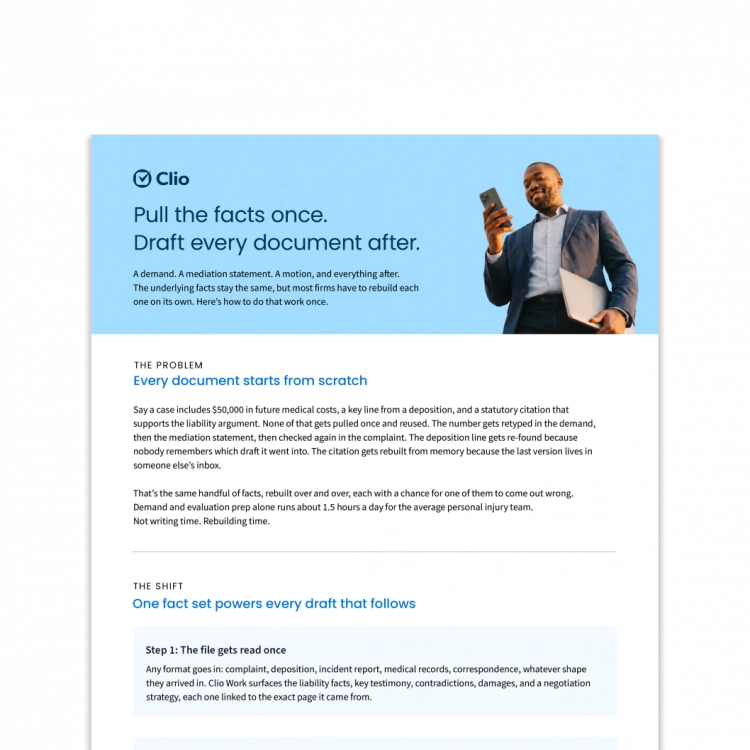
Every case document starts with the same step: pulling the key facts out of a complaint, a deposition, an incident report, or a stack of records, then rebuilding them into something new. Demand and evaluation prep alone runs about 1.5 hours a day for the average personal injury team, and most of it goes to redoing that work: reformatting a timeline, hunting for a citation used in an earlier draft, rebuilding an argument that already exists somewhere else.
In this guide, you’ll see how personal injury firms are using Clio Work to pull facts and citations from a case file once, then carry them into an attorney-ready draft of a demand, a mediation statement, and a motion, ready for attorney review, edit, and sign off.
The less time spent rebuilding, the more time left to shape the argument that matters. This guide walks through what that process actually looks like, from a varied case file to an attorney-ready draft.
Download this free guide to learn how to:
- Pull key facts, testimony, and citations from a case file, no matter what shape the documents arrived in.
- Go from blank page to an attorney-ready demand letter, mediation statement, or motion, built from approved facts and matter data.
- Decide the number you’re asking for, the tone each document takes, and what gets emphasized.
- Keep the facts fixed underneath every document, no matter how many versions you ask for or how many documents come next.
Download now and see what a first draft looks like when it already knows your matter.
Free download
AI document drafting FAQs for personal injury firms
What can Clio Work draft from a PI case file?
Mediation statements, motions, complaints, and correspondence, alongside the demand. Each one draws on the same matter file, so you are not rebuilding the same facts document by document.
Can I check where a fact in the draft came from?
Yes. Every fact links back to the document and page it was pulled from, so you can verify anything before the draft leaves the firm. The facts stay fixed across documents too, so a number or a date will not quietly shift between the demand and the mediation statement.
What does AI legal document drafting involve on a personal injury file?
Clio Work reads the case file, pulls the liability facts, the treatment history, the special damages, and the wage loss from the documents already there, then drafts from that set rather than from a blank page. You get a first draft that reflects the case, which you edit and approve. Expect it to get you most of the way rather than all of it.
Can it match our law firm's drafting style?
You can capture how your law firm wants documents drafted, and Clio Work applies that guidance across matters. A firm with a set structure or a preferred way of describing pain and suffering can record the approach once rather than correcting it every time.