

Capture the full picture at intake
Record custody, support, safety, and financial details with tailored intake, and carry them straight into the matter.
Record custody, support, safety, and financial details with tailored intake, and carry them straight into the matter.
See what you have and what’s still outstanding when Clio’s legal AI summarizes each record as it arrives.
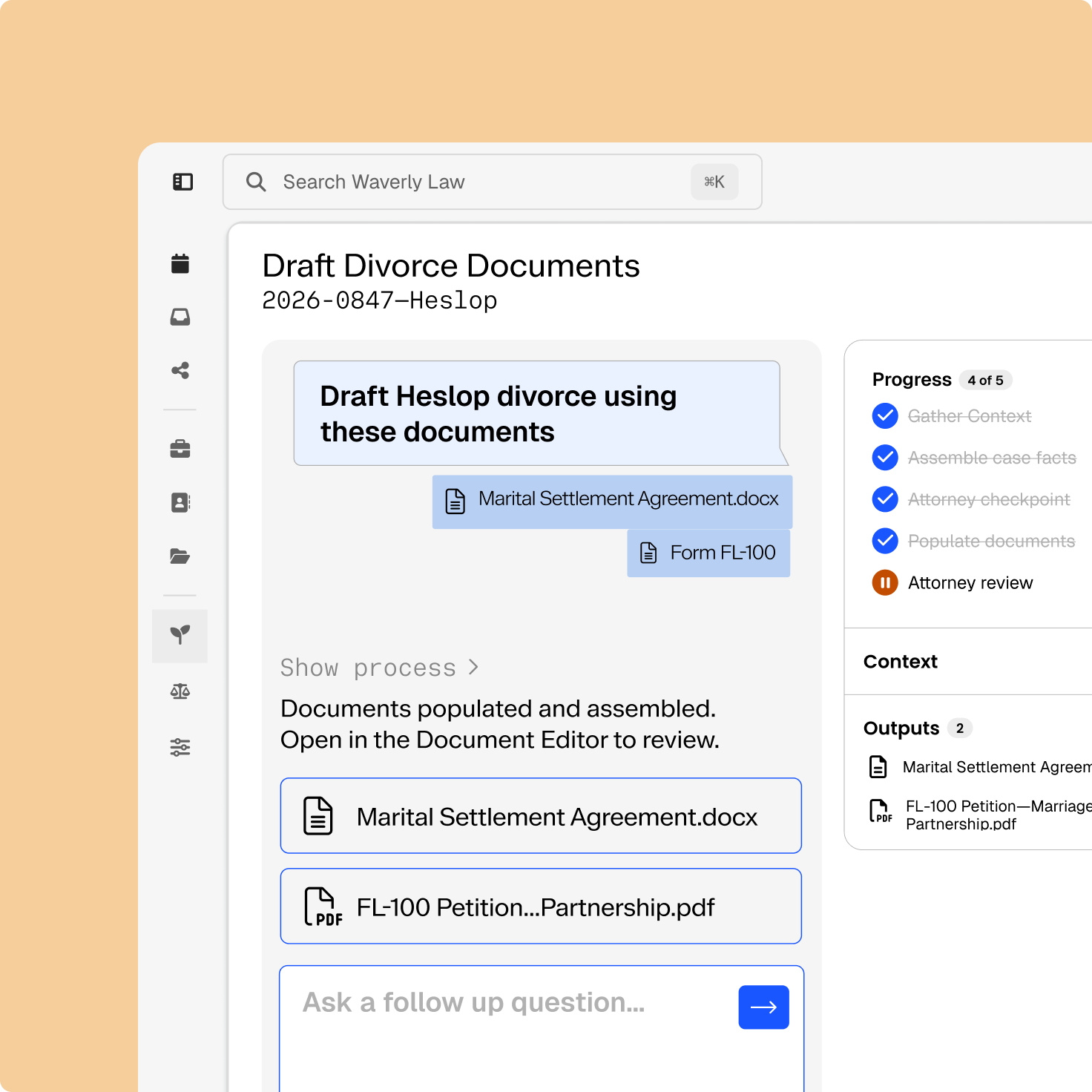
Fill in supported court forms and reusable templates from matter details, or start from a first draft that Clio prepares for your review.
Confirm the draft deadlines and tasks Clio prepares from custody and support orders, with billing and payments tied to the same matter.
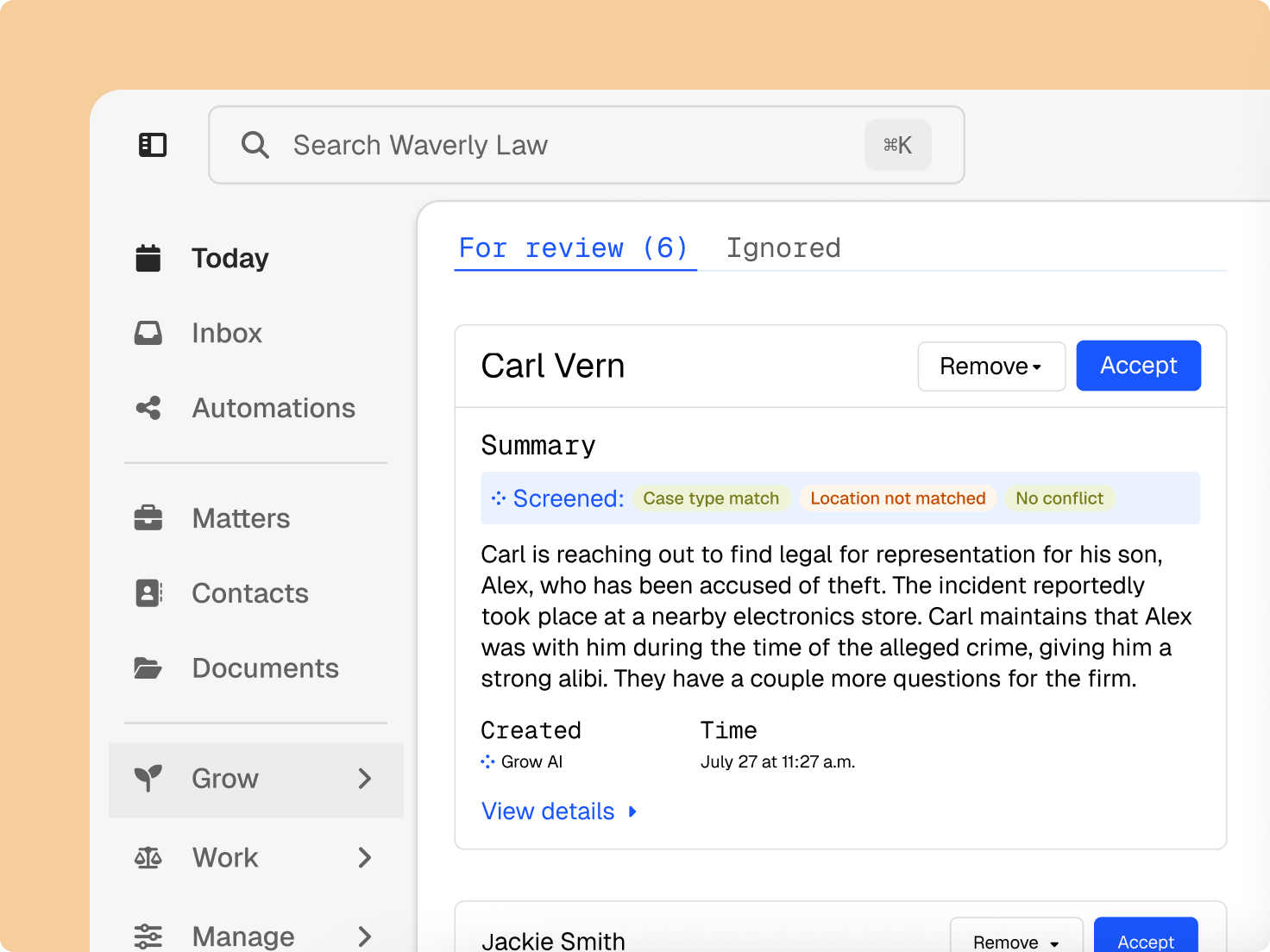
Respond to new inquiries faster with Clio’s legal AI, which answers after hours and screens for fit and conflicts before booking a consultation. You decide who becomes a client, and intake details carry into the matter.

Review each record a client uploads, such as business and brokerage statements in a high-net-worth divorce, from a summary Clio’s legal AI prepares. You check the figures and track what’s still missing.
Fill supported court forms and reusable templates from client and case details, or start from a Clio-prepared first draft based on the matter and the law. You review and finalize each document before it goes out.
Confirm the draft calendar events and related tasks Clio’s legal AI prepares from custody and support orders and court notices, with the source document beside each date. Build the remaining deadlines from US court rules.
Review and send AI-generated client updates based on matter activity. Share documents with opposing counsel in a collaborative case, or limit who sees each document when a case turns high conflict.
legal professionals trust Clio
law societies and bar associations recognize Clio, including all 50 state bar associations in the United States
rating from 13,000+ reviews
If I weren’t allowed to use this anymore, I might leave the practice of law. It’s actually made the practice of law fun again. My revenue has increased several thousand dollars per month...
Lorona | Mead, PLC
Family law software helps firms manage intake, family and financial information, documents, disclosure, court dates, client communication, billing, trust accounting, and payments. In Clio, that same record powers the full family law workflow. The case can move through negotiation, mediation, court, implementation, enforcement, and future modification without rebuilding the history in separate systems.
Clio was built so the family record, financial evidence, authoritative legal intelligence, documents, deadlines, communication, billing, payments, and trust accounting activity can work from a shared foundation. That shared context lets Clio prepare work for legal review and return the approved work to the case. The record becomes more useful each time the family circumstances or legal route changes.
Yes. Clio can turn the firm’s approved Word documents into reusable templates, populate supported court forms from client and case data, apply conditional logic, manage versions, and send documents for electronic signature. Your firm reviews every agreement, parenting plan, pleading, affidavit, and filing package before use.
Yes. Clients upload records through the secure portal, and Clio’s legal AI can read them, summarize the key figures in a table, and flag gaps or inconsistencies for your review. Custom fields, secure document requests, folders, and task lists organize the rest and track what remains outstanding. Valuation, support analysis, and legal judgment remain with your firm and any appropriate experts.
Yes. Clio’s legal AI researches state family law statutes and case law on custody, support, and property division across all 50 states and DC, and covers court rules by jurisdiction. It returns cited authority for you to evaluate and apply.
Yes. Clio calculates family court deadlines for divorce, custody, and support from the local rules that apply, so procedural dates stay connected to the matter that created them. E-filing and e-service to supported family courts are currently available in California, Texas, Georgia, Nevada, Illinois, and Virginia. Your firm verifies every deadline and reviews every filing package before it goes out.
Yes. Clio tracks trust and operating accounts on separate ledgers, logging every deposit, transfer, disbursement, and refund against the right client and matter. You can request the initial retainer, set an evergreen threshold that alerts you when funds run low, apply trust funds to invoices, and run three-way reconciliation to stay audit-ready. Your law firm remains responsible for compliance with its state bar’s trust accounting rules.
Yes. Where parties are using OurFamilyWizard for co-parenting communication and scheduling, the integration keeps that activity connected to the matter in Clio, so the firm works from one record rather than checking two systems.
Read up on how you can use family law software to improve your practice.