
Value-Based Legal Pricing: How One Small Firm Earns More Without Billing More Hours

Managing Attorney, Marlowe Law
A 30-page operating agreement used to take four to six hours of my time. Now, with AI handling the first pass, I finish that same review in about two hours, and the client gets the same careful read, the same professional judgment, and the same result.
That gap is what convinced me hourly billing wasn’t protecting my practice. It was capping it. What I needed was a way to bring value-based legal pricing into how I work, to price for the value I was delivering, not just the hours it took me to deliver it.
I’m the founder and managing shareholder of Marlowe Law, a business law and mergers and acquisitions firm based in Tampa Bay, Florida. My team is lean, with four support staff employees for two highly experienced lawyers, so staying on top of the latest tools and efficiencies is essential. I have over 40 years of experience as a business lawyer, but before that, I was a computer programmer. Technology has always been part of how I work, long before AI showed up in legal software.
That’s why I use Clio Work to change how fast my team and I can get the work done, and AltFee to price that work based on what it’s worth to the client, not how long it takes us to deliver it.
Here’s what using them looks like in my day-to-day practice, and how it’s paying off.
Why hourly billing stopped working for my practice
Looking back, it’s clear that for a long time, my pricing was a little scattershot.
It tended to depend a lot on either remembering or hunting down exactly how much I’d priced a prior job for someone else. If a similar project came up, I’d go back into Clio and try to dig up what I’d charged a client for something like it before—not just to be consistent with pricing, but to avoid a comment like, “The last time you did this for me, you charged me X.”
That’s exactly what happened, actually. A client recently brought up a project from five years earlier and told me what I’d charged him back then. It was a good reminder of how much more disciplined our pricing process has become since then.
Years ago, I often relied on memory and old files to work out what seemed fair. I cared about being consistent, but I didn’t have a system that made the reasoning behind a price easy to repeat or explain. Today, our pricing is much more structured. That doesn’t mean a matter should cost the same five years later. It means we can be clear about why we’re charging what we’re charging now.
Eventually, I moved pretty much everything I do to flat fees, except litigation.
Clients were asking for it. They wanted to know what a matter would cost before we started, and a flat fee gives them that. I’m clearly not the only lawyer hearing this. Clio's 2026 Legal Trends Report legal professional survey found that 80% of US consumers said they would like paying a flat fee for all the work, nearly double the 43% who said the same about hourly billing.
I’ve always tried to stay ahead of technology, and I was more efficient than a lot of my peers at flat-fee work. Put it this way: if I can do a job in two hours that takes someone else four hours, hourly billing actually works against me. Flat fees let me benefit from that efficiency rather than being penalized for it.
What changed when I started using AI for the work itself
AI didn’t just make me faster. It changed what kinds of work were even worth taking on. This has mostly affected how I work day to day, though, as you’ll see later, it’s changed my paralegal’s role too.
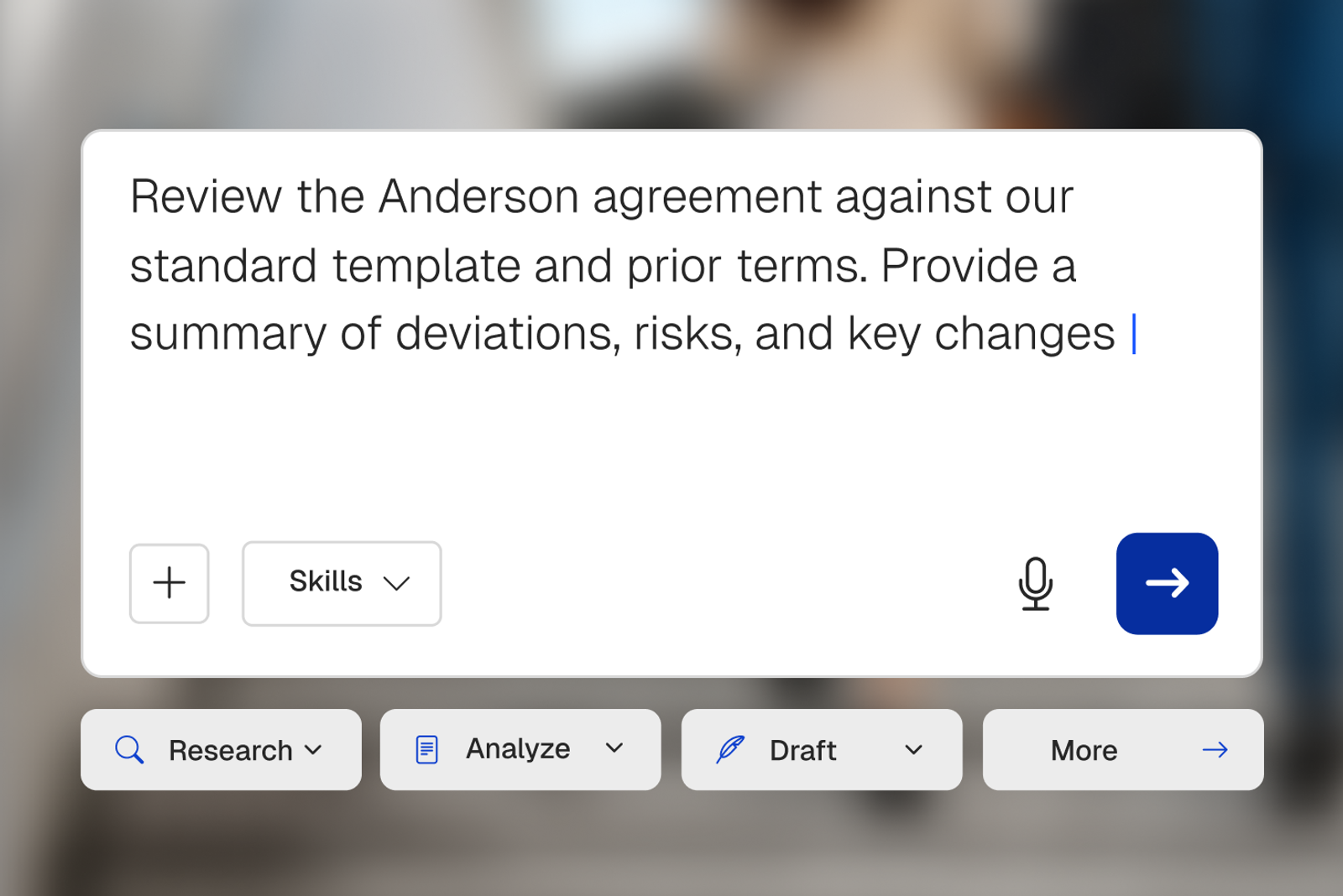
The biggest shift has been in how I handle document review. Take that 30-page operating agreement I mentioned at the start, something we see often at my firm. This used to mean scanning the full agreement to manually determine what issues I’d need to address and how long that would take. I could hand some of that off to a paralegal to flag concerns, but even that initial pass was often more than the project justified.
For a lot of smaller matters, that upfront cost alone was enough to make me pass.
Now, I can take the document, along with the concerns the client has raised, and run it all through Clio Work. It comes back with the issues it sees. From there, I go into AltFee and scope out what the response involves: a summary, a recommendation, a revised agreement, a client conference, depending on what the matter needs.
That whole process now takes about 15 minutes, whereas just the initial analysis used to take 45 minutes to an hour.
If the client says yes, Clio Work handles the first pass of the review, including highlighting issues and drafting a proposed redline based on the client’s concerns. So, what used to take me four, five, sometimes six hours going through a 30- or 40-page document by hand now takes a fraction of that.
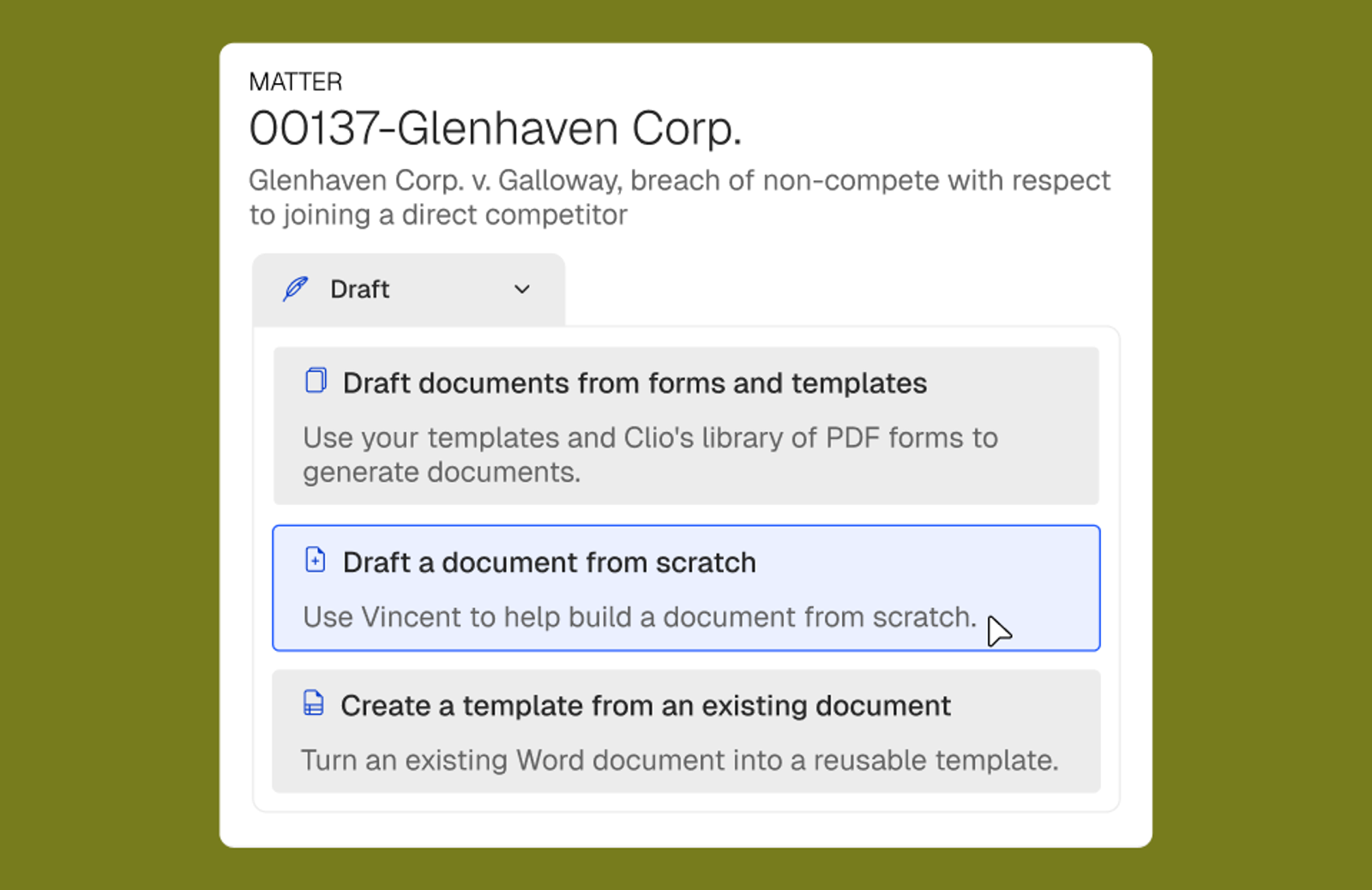
I still go through everything it flags. I’m not willing to hand that off. But instead of spending hours building a redline from scratch, I’m spending high-quality legal time focused on reviewing and refining one that’s already there. I can even have it summarize the changes in a client-facing memo before I get on a call with the client.
All told, a job that used to take maybe five hours now takes about two, which means I can often beat my competitors on price while also being a lot more profitable than they are.
How AI makes flat-fee pricing easier for small law firms
AI tools make it much faster for me to understand and organize what a matter is likely to involve, which takes a lot of the manual work out of scoping. Pair that with a pricing tool that provides a repeatable structure for turning that scope into a flat fee, and what used to be a slow, somewhat ad hoc process becomes a faster, more consistent way to arrive at a price.
The broader numbers point the same way. In Clio’s 2026 Legal Trends Report, 64% of legal professionals at firms using AI said it had a positive effect on revenue, up from 36% a year earlier. Holding AI adoption and other factors constant, firms using alternative fees, such as flat, capped, value-based, or success fees, were the most likely to report that AI improved revenue. Hourly-billing firms were the least likely. That makes sense to me. Once AI speeds up the work, the hourly model gets harder to justify.
This shift has changed how I think about billing entirely. Work that used to be too time-consuming to even quote—smaller projects, quick document reviews, a response to a demand letter I’d have otherwise turned down—is now something I can price accurately and take on efficiently. A job that wouldn’t have been profitable for me before Clio Work and AltFee now is.
If you’re a small firm wondering whether AI is worth it, consider this: what if it’s less about the big matters and more about all the small ones you used to have to turn away?
If you want to go deeper on this, Clio has a good breakdown of what’s actually driving pricing decisions in AI for solo and small law firms.
The moment I realized my fees didn’t reflect my value

For years, I was leaving money on the table by inadvertently underpricing many of my services. I didn’t have a clear enough picture of how those matters were actually performing financially, so some of my prices had simply stayed lower than they should’ve been.
Once I looked more closely at the data, with AltFee’s help, I started repricing some of those services to better reflect the value I was delivering. What surprised me was how little resistance there was. The market was far more accepting of the higher prices than I had expected, because I was now in a position to better articulate the value behind them.
That has had a meaningful impact on the economics of my practice. By correcting prices that had quietly fallen out of step with the value of the work, I’m generating more revenue from work I was already doing.
What is value-based pricing for law firms?
Value-based pricing charges for the outcome and the expertise a client receives, not for the number of hours it took to deliver it. When AI makes the work faster, the client still gets the same judgment and result, so the price should reflect that value, not shrink with the time spent.
That’s really the shift I had to work through, both practically and in my mindset about value. Getting faster with AI tools didn’t mean I should charge less. If anything, it made me realize that I’d been charging too little all along, because I’d been pricing based on how long something took me to do, not what it was actually worth to the client sitting across from me.
If you’re working through that same kind of shift, Clio’s guide to modern legal pricing lays out the fuller framework for law firm pricing models, from ditching the billable hour to structuring value-based fees.
How I built a repeatable system around my flat fees with AltFee

The idea of standardizing my pricing and exploring alternative fee arrangements clicked for me at a ClioCon demo several years ago. I was talking through how I priced M&A work and all the little variables that go into it: asset purchase or stock sale, foreign state registrations, vehicles involved, F-reorganizations, how big the deal was. Each of those components factored into price, but there wasn’t a lot of consistency behind it.
Explaining it out loud, it dawned on me how much time I was wasting pricing these projects one at a time, with no real system. There had to be a better way.
AltFee was demoing their software at that conference, and it was exactly what I needed. It gave me a way to take the pricing knowledge I already had and turn it into a structured, repeatable set of pricing guidelines. I could price similar project types consistently, while still accounting for the factors that made each new matter different.
It also gave me a way to incorporate value-based modifiers into the price. Things like timing, urgency, capacity, and other circumstances around the engagement could be considered deliberately rather than handled ad hoc. That meant I could be more thoughtful about which work I took on and make sure the price reflected the value and circumstances of the matter.
What value-based pricing looks like in M&A matters
On one recent deal, I realized I needed to charge extra for each vehicle involved. Vehicles mean lien searches, title transfers, and collecting and filing sales tax. So that’s simply factored into the price now, the same way everything else is. Deals with vehicles cost more; deals without them don’t pay for work they don’t require.
Beyond vehicles, I’ve built out the variables I used to price from memory, such as stock sale or asset sale, out-of-state registrations, F-reorganizations, drag-along issues, closing paperwork, or whether the deal is likely to move slowly. I click through what applies, and total flat fee pricing is calculated for me in seconds. I generate a quote, save it, and send it out. Even if I don’t hear back for weeks, that quote with all the details saved is there, ready to drop straight into my engagement letter. Nothing has to be remembered or rebuilt.
Business law can be a little different because the work ranges from highly repeatable to very custom. Where I do the same type of work regularly, I can build a pricing guideline around it and account for the variables that tend to change the scope or value. That makes those matters very quick to price.
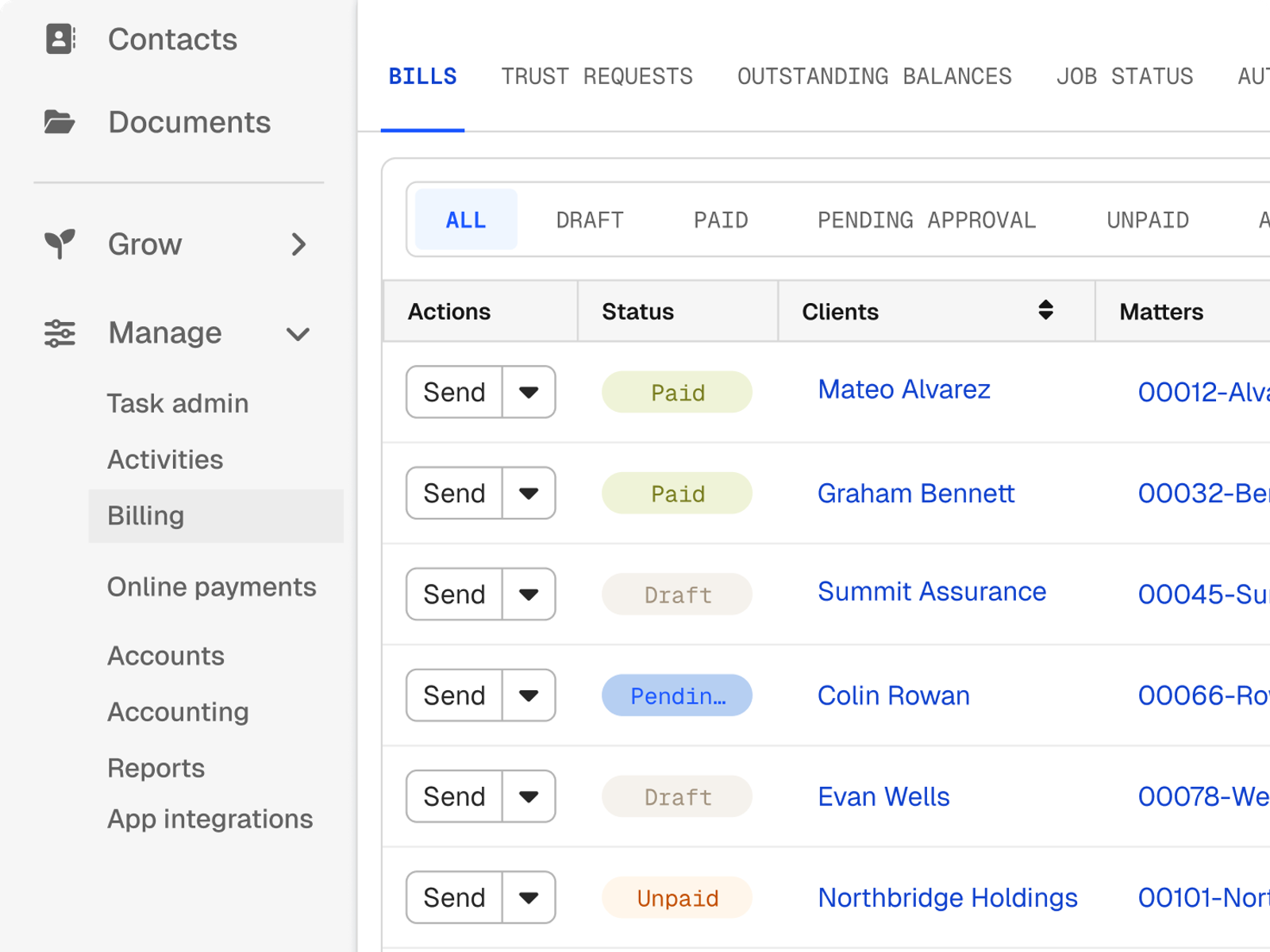
For more complex matters, I’ll often break the work into separate projects that effectively become stages of the engagement. Each stage can have its own scope and price, but they all sit under the same matter. If the client decides to move ahead with the next phase, I can add that project rather than starting the whole pricing process over again. Once it’s approved, the pricing syncs back to Clio, which makes it much easier to keep the billing organized as the matter progresses.
How did I start with alternative fee arrangements?
I started with the most repeatable matter types in my practice, and that’s where I’d tell anyone to begin. It’s the work you know best, where you already have a good sense of what typically affects the scope and how those matters have gone in the past. From there, you can expand into more complex or custom work as you build confidence with the model.
Once the system was in place, the speed matters beyond just saving me time. On a lot of smaller jobs, I’m one of several firms being asked to bid. Getting a quick written quote out, one that often costs less to produce because of lower administrative overhead, can be the difference between winning a repeat client and losing out on the work entirely. Being responsive from the first conversation sets the tone for everything that follows.
Having a structured pricing system also changed something less obvious. While I do use an automated timekeeping system, I don’t worry as much about timekeeping. If a project runs long, I don’t have to justify that to the client. And if I finish something in three or four hours that I priced at $4,000, $5,000, or $6,000, I don’t feel like I’m overcharging either. The price was for the outcome, not the clock.
What I got wrong with my pricing (and how I fixed it)
I wasn’t always right the first time, and not just in the direction you’d expect. Alongside the underpricing I mentioned earlier, I've also caught cases where I was overpricing, and adjusted those down.
I don’t tend to judge pricing off any single project, though. I take a bigger view of it, using the reporting that comes from my AltFee integration for Clio. If I do 10 similar projects, I’ll look at the group as a whole and see whether it’s actually profitable.
Take corporate formations, for example. For me, a formation isn’t just filing paperwork to create a company, it’s also the operating agreement and everything that comes with it. If someone just wants the company formed, they can do that themselves.
So I’ll look at a batch of 10 or 20 of these and weigh what it actually costs me in time against the total income after expenses, including things like recurring income for a registered agent.
If it isn’t profitable, I adjust the price. If that means I lose some new formation business, so be it. I’m not going to keep doing work that isn’t profitable for me.
That kind of analysis isn’t something I did once and moved on from. I’m running it constantly, across everything I do. I'm always checking pricing against what the work actually takes.
What this has meant for my practice
The clearest change has been in the kind of work I can actually say yes to. I used to turn down smaller projects like a quick document review because pricing and quoting them took more time than the work itself was worth.
Now I can run something through Clio Work, see what it flags, and go straight into AltFee to check off what the response actually needs. Work that used to be too small to be worth the time is now work that I can price accurately and take on profitably, which never would have happened before I had Clio Work and AltFee in place.
Clients mostly notice the speed, not what’s happening behind the scenes. They notice they’re getting answers faster and that we’re saying yes to things we might have turned down before. A lot of small projects can now turn around within 24 hours. That kind of responsiveness is part of the value the clients receive and why they come back. It shows up in how they talk about us, and you can see it in our reviews.
This matters more than price when clients choose a lawyer. When the Legal Trends Report consumer survey asked consumers to pick the top factors in choosing a lawyer, 35% named positive client reviews and 25% named responsiveness. Only 14% picked a competitive hourly rate, and just 6% picked a firm’s use of modern technology or AI.
Another big shift, and one that I honestly didn’t see coming, has been what it’s done for my paralegal’s role. The combination of Clio Work and AltFee allows me to offload to a paralegal more of the intake of business law matters that I would never have allowed a paralegal to touch before.
Now she runs client information and documents through Clio Work herself, and it tells her what’s missing or inconsistent before it ever gets to me. By the time I have that initial consultation with the prospective client, I already have what I need. I’m not fishing for information. I’m ready to say yes or no, and I can typically be ready to price it by the time I get it.
I expected Clio Work to save me time. The surprise was how much it freed me up once my paralegal could take on work that used to land on my desk.
My advice for other solo and small firm lawyers using AI
It’s simple: if you’re going to bring AI into your practice, use a legal-specific tool, not a general-purpose one. Anyone using a non-legal, consumer AI tool for legal work is asking for trouble.
I regularly use Clio Work, especially for quick document review, but I’ve tried multiple AI tools over the past three years. Clio Work wasn’t my first legal AI tool, but it’s now taking the lead over all of the legal AI tools that I have.
One reason for this is that Clio Work has caught up on things that mattered to me. For example, I’d been pushing Clio to add features other tools already had, like redlining, and I’m glad they eventually built it in, since it’s essential for the kind of work I do.
And AI alone isn’t enough. If you’re going to use AI to make legal work faster, you also need to think about how you price that work. Otherwise, you can end up doing the same work more efficiently while still billing it in a way that rewards the hours you spend rather than the value you deliver.
I’m seeing more lawyers run into this. Among AI users who bill hourly, the share who say AI makes billable-hour requirements harder to meet roughly doubled in a year, according to Clio's numbers: from 9% in 2025 to 19% in 2026. That’s what happens when the work gets faster and the billing model stays the same.
This is the gap a pricing tool like AltFee fills. It gives me a structured way to turn those efficiencies into flat fees that make sense for both the client and me.
Clio’s guide to implementing alternative fee agreements is a good starting point if you’re not sure where to begin with this.
If there’s one thing I wish I’d figured out sooner, it’s that I didn’t need to wait to have both. I’ve been using AltFee for two or three years, and I wish that I’d had Clio Work for that whole stretch too, so I could have been running them together the entire time. On their own, they’re both solid tools. Together, especially in the business law work I concentrate on, they’re a spectacular combination. I can’t imagine going back to working without both of them.
The real payoff of value-based pricing for small firms
Clio Work gave me back time. AltFee made sure the value of the work wasn’t lost just because I could now do it faster.
That’s really what the whole shift is about. It’s not just that the work got faster; it’s that I stopped pricing based on the clock and started pricing based on what the work was actually worth to my clients.
None of this required a dedicated pricing team, a back office, or anyone else to build out a system for me. I’m running a small practice, and this still worked. You don’t need to scale to price for value. You need the right tools doing the right jobs.
Clio Work and AltFee are what have worked for me, and are where I’d point you first.
Is a flat fee the same as value-based pricing?
Not exactly. A flat fee is a pricing structure: one set price for a matter, regardless of hours worked. Value-based pricing is more of a philosophy: pricing based on the outcome or value delivered, not the time it took. A flat fee is one way to apply value-based pricing, but a firm can also set a flat fee without pricing for value—for example, just estimating hours and rounding to a number.