Law Firm Key Performance Indicators (KPIs)
-
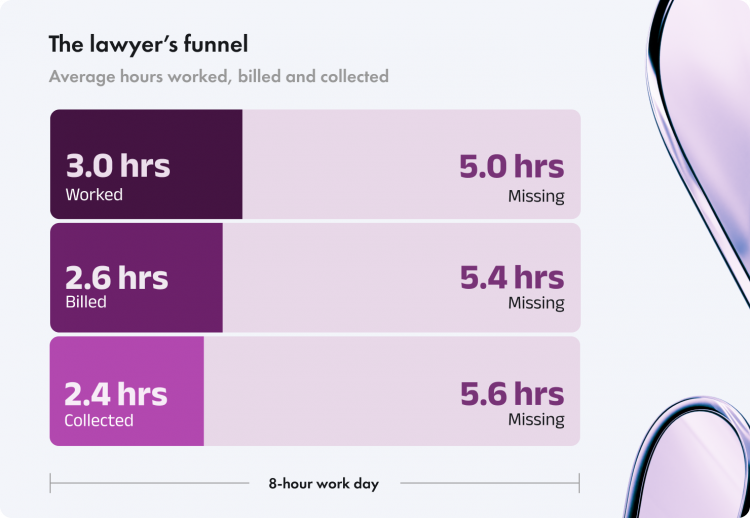

Clio’s key performance indicators for law firms provide important insight into operational efficiency and revenue:
Utilization rate
% of an eight-hour day that gets put towards billable work.
Realization rate
% of billable work that gets invoiced to clients.
Collection rate
% of invoiced work that gets paid.
-
Law firm utilization rates
in 2025
The average utilization rate for law firms in 2025 is 38%. In an average 8-hour work day, lawyers capture 3.0 billable hours.
-
Law firm realization rates
in 2025
The average realization rate for law firms in 2025 is 88%. In an average 8-hour work day, lawyers invoice 2.6 hours’ worth of billable work to clients.
-
Law firm collection rates
in 2025
The average collection rate for law firms in 2025 is 93%. In an average 8-hour work day, lawyers collect 2.4 hours’ worth of invoiced work from clients.
Lockup
“Lockup” is an accounting term that answers a critical question: How long does it take for your work to become cash in the bank? Lockup measures the total number of days worth of annual revenue is tied up as unbilled work or unpaid invoices.
A high lockup traps your hard-earned revenue, starving your firm of the cash it needs to operate and expand. Lowering it means faster cash flow, giving you the capital to cover expenses and fuel growth.
-

Measures of lockup
Lockup is calculated by converting the dollar value of your unearned revenue into the equivalent number of days of work. It has three parts:
Realization lockup
The value of all work you’ve done but haven’t billed for.
Collection lockup
The value of all invoices you’ve sent but haven’t been paid for.
Total lockup
The combination of work in both realization and collection lockup.
How do I measure lockup?
Ready to find your firm’s lockup number? Here are the three simple steps to calculate how many days’ worth of revenue is tied up in your billing process.
-
Realization lockup
= (value of unbilled work ÷ annual revenue) × 365 days
The value of all work you’ve done but haven’t billed for.
-
Collection lockup
= (value of unpaid invoices ÷ annual revenue) × 365 days
The value of all invoices you’ve sent but haven’t been paid for.
-
Total lockup
= Realization lockup + collection lockup
The combination of work in both realization and collection lockup.
This year’s lockup rates
-

Realization Lockup Rates
in 2025
The median realization lockup for law firms in 2025 is 43 days.
-

Collection Lockup Rates
in 2025
The median collection lockup for law firms in 2025 is 32 days.
-

Total Lockup Rates
in 2025
The median total lockup for law firms in 2025 is 93 days.
