

As AI-driven efficiency reduces billable hours, law firms must transition from traditional hourly billing to **flat-fee models** to maintain profitability and capture the full value of their services. By aligning pricing with client outcomes rather than time spent, firms can leverage technology to increase case capacity, improve cost transparency, and secure a competitive advantage in an evolving legal market.

With artificial intelligence, legal professionals are getting much more done in a day. But for law firms that bill primarily by the hour, this may not bode well. As lawyers complete their work faster for clients, they log fewer billable hours, which means less revenue for the firm.
Due to this conflict between efficiency and profitability, many have predicted that the use of AI will mean the end of hourly billing in legal.
In fact, for most routine legal work, hourly billing was never a great model to begin with. It rewards time spent, not value delivered, and for predictable, repeatable tasks, that’s increasingly hard to justify, especially with today’s systems for managing casework.
Research shows that the predominance of hourly billing is shifting. Nearly half of firms used to bill exclusively by the hour, but in recent years, more firms have opted to incorporate flat fees into their billing as well. This article looks at the problems inherent to hourly billing in legal, and why, with rapid innovations in AI technologies, it’s time for firms to embrace alternative billing models.

The problem with the billable hour in legal
Hourly billing is less than ideal for clients and is often more a matter of convenience for law firms. It also puts all of the cost-associated risk onto clients; if a case takes longer than expected due to unforeseen circumstances, the client pays for the extra time needed to address complications. For the client, every hour a lawyer spends on a case ends up being a sunk cost, and any overruns only compound the financial burden of achieving an outcome.
How hourly billing became the norm
Originally, hourly billing was designed to promote fairness, efficiency, and client satisfaction. It gave clients transparency into the work lawyers were doing on their case, while also allowing managers to track how time was allocated within the firm and better plan resourcing, accounting, and profits.
It was easy to administer from a clerical perspective and also fit with the strict ethical requirements that lawyers must work within, which eventually solidified hourly billing as the industry norm.
Why it falls short for clients and firms
In addition to taking on all of the risk, there are further disadvantages for clients:
- Lack of cost transparency: Even if a lawyer provides an estimate, clients typically won’t get any cost guarantees. Unless the lawyer provides regular updates, they may not even know how much they’ll be spending until they receive the final bill.
- Lack of cost incentives for lawyers: Lawyers are incentivized to spend more time on a client’s case, not less, when they bill by the hour. In other words, if there’s a better, faster, more efficient way of doing the work for a client, it’s in the lawyer’s best interest to avoid it. This is problematic because it ultimately hinders innovation, even when it would benefit clients.
Hourly billing is also inefficient and wasteful for how many law firms operate.
Each year, the Legal Trends Report benchmarks key business indicators, including average realization rates among law firms. Realization rates measure the amount of billable work that gets billed to clients. In 2025, the average realization rate for law firms was 88%, meaning that 12% of the time a firm puts towards billable work never actually gets billed.
This highlights an important gap in business performance, and write-downs are often a key issue. While they don’t actually count as an expense, write-downs represent a substantial cost for law firms, often because too much time gets put into a matter in the first place.
While many lawyers may be worried about spending less time on their cases due to AI, many already acknowledge that they spend too much time on that work anyway, as evidenced by their write-downs.
How AI threatens hourly billing revenue
According to the Legal Trends Report, as much as 74% of billable work done by legal professionals could be automated with AI. This is based on the fact that AI is incredibly powerful in its ability to read, interpret, reason, and draft content, and that it can handle much of the routine, document-heavy work that can be time-consuming for a lawyer or their staff to take on.
To give you just a few examples of AI use cases in law, and what this could look like in a given workday: Legal AI solutions can read and summarize a deposition, perform contract analysis, and identify relevant case law based on a few client notes. For many lawyers and their staff, these activities alone can make up a substantial portion of their day. Being able to do this with AI means that these tasks can be completed in minutes instead of hours or days.
Working with AI is also getting much easier. Instead of requiring detailed prompts that need to be typed into a chat interface, legal AI solutions have pre-built workflows for the many types of work done in a law firm. To analyze a deposition, for example, it’s as simple as dragging a file into the right box.
It truly is a revolutionary moment for law firms. If you haven’t kept up with the latest advancements and capabilities in legal AI solutions, it’s worth taking a moment to catch up. A lot can change even within the span of a few months.
However, it’s worth noting that while these technologies can take on a substantial amount of the work done in a law firm, they don’t replace the role of a lawyer or paralegal. No tool can replace the expertise and accountability of licensed legal professionals. Instead, AI shifts the focus of work from time-consuming prep work to a greater focus on strategy, verification, and oversight. It also frees up time to spend with clients, keeping them up to date, and making them feel like they’re being taken care of.
How firm revenues are affected by AI
There are differing opinions on how to account for the efficiency gains with AI, and legal professionals are responding in different ways.
| Raising prices across the board | Sarah, a senior paralegal, reports that her mid-sized entertainment and employment firm successfully raised their rates “across the board.” This was justified because the firm bills via a monthly subscription. AI enables them to deliver more work for clients, and the technology frees the firm owner to focus on those relationships, making them feel more valued. |
| Contributions get undervalued | Benjamin, an operations manager at an employment defense firm, notes a gap where legal professionals’ billable impact is undervalued because performance targets are still based on hours, not the value of the output. He explains that staff can complete 10 hours of work in 10 minutes with AI, yet are not recognized for that value due to low billable hours. |
| Time savings pay off in work-life balance | Henry, the owner of a small business law firm, accepts a small reduction in personal earnings as a trade-off for better efficiency and work-life balance. He uses AI to cut three-hour files down to two hours, keeps his hourly rate the same, and is willing to “eat the cost of better efficiency” to avoid working “absolutely crazy hours.” |
| Balancing time savings with pricing | Sebastian, a partner at a small real estate firm, advocates for a balanced approach to profitability and client savings. His method is to generate content with AI, review how long the task would have taken manually, and then “split the savings between the client and myself so that everybody benefits.” |
Source: Interviews from the 2025 Legal Trends Report
One thing is clear: Simply charging full price for something that doesn’t take nearly the same amount of time likely isn’t ethical. As Ezra, a partner at a general practice in Indiana, describes, “If you can do the same function in a quarter of the time with AI, you can’t ethically pass that on to your client.”
As legal professionals adopt AI more widely, they’re more likely to adjust their pricing in some way, either by increasing prices, reducing them, or introducing new fees for the use of specific AI services.
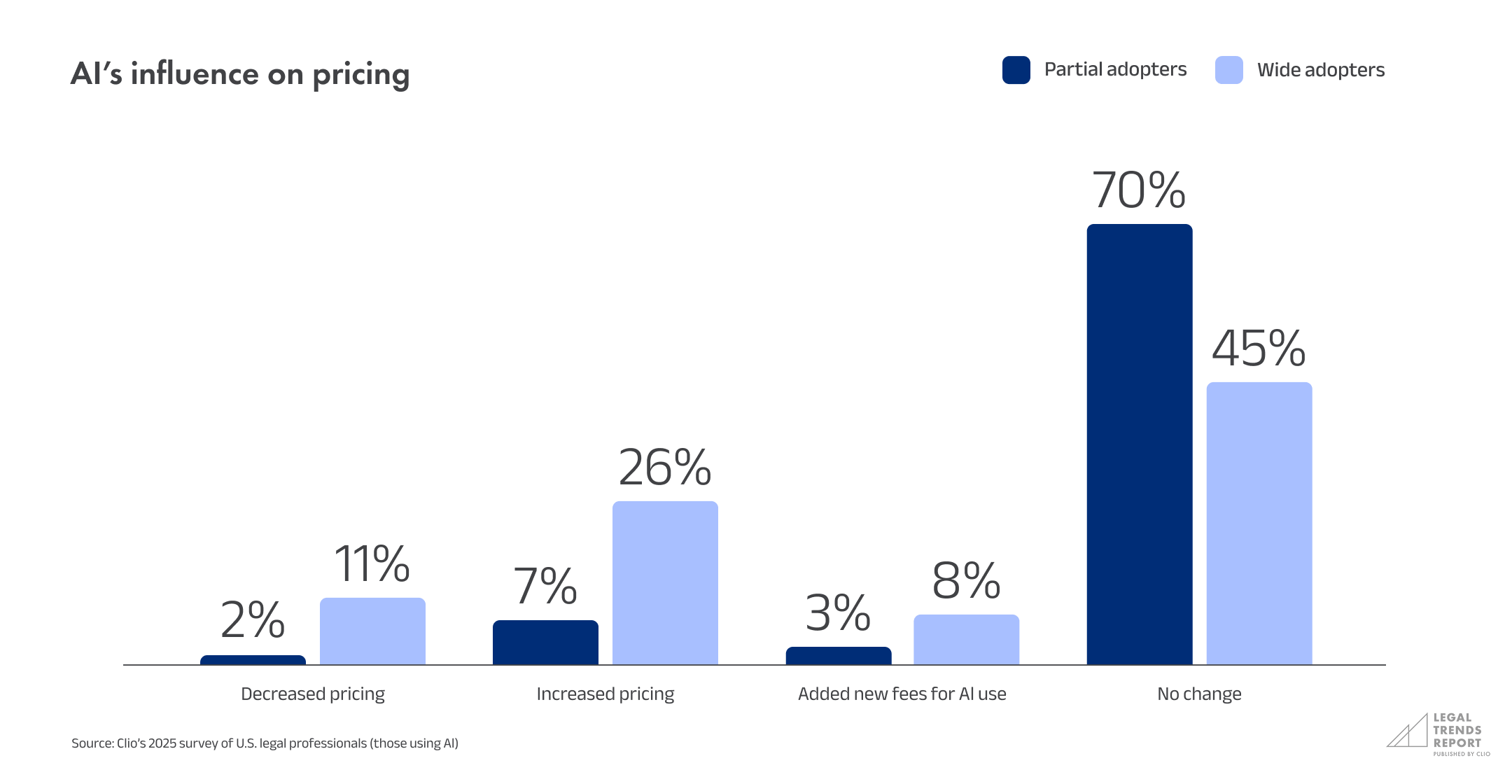
Additionally, the more law firms use AI, the more likely they are to improve their revenues. In total, among firms that have adopted AI more widely, 69% have seen revenues increase.

The argument for flat-fee legal services
While hourly rates create uncertainty and introduce the risk of cost overruns for clients, flat fee billing does the opposite, reinforcing transparency, trust, and convenience in the following ways:
- Upfront costs: When law firms provide legal services at flat rates, clients get the benefit of seeing upfront the total amount they can expect to pay.
- Less stress: If the costs to work a case are built into a flat amount, clients don’t need to stress about whether a question or conversation with their lawyer will run up the costs on their case.
- More convenience: When fees are tracked against specific tasks, it makes it easier for clients to review and understand what they’re being charged for, which reduces the risk that they’ll raise a dispute. When firms bill and collect payments electronically, they also make it easier for the client to quickly view their bill and pay it immediately from their phone.
Flat fees don’t just have advantages for clients; they also reduce administrative burdens for law firms. While it’s still a good idea for firms to monitor how much time gets put into cases (to better gauge their pricing), they don’t need to stress about reviewing and approving bills against their time logs before sending invoices to clients.
Greater benefits to flat fee billing when using AI
While firms billing by the hour risk losing revenue to efficiency gains with AI, those that rely more on flat fees stand to benefit. Being able to get work done faster doesn’t reduce the value of that service in the eyes of the client. For firms that charge a fee based on that value, and that are able to complete more cases in the same amount of time, they’ll be able to earn a lot more overall.
Being able to pass on some of those cost savings to clients will also make their services more affordable and more competitive when attracting new clients.
When flat fees aren’t ideal
While flat fees work well for predictable, repeatable types of legal work, they come with greater risks when it comes to cases that are truly novel, unpredictable, or complex. These types of cases carry a higher risk of time overruns, which makes them more suitable for hourly or hybrid fee arrangements to balance the interests of both the client and the firm.
Impact of AI based on billing model
| Criteria | Hourly billing with AI | Flat fees with AI |
| Ethical concerns | Potential ethical concern, as it is considered unfair to bill clients for the original amount of time when AI has dramatically reduced the actual time spent (e.g., cutting a task from four hours to one). This is often seen as “ethically questionable.” | Highly ethical, as pricing is based on the value or outcome delivered, not the time spent. Efficiency gains from AI are implicitly accounted for, and firms can share the savings with clients. |
| Incentives | Misaligned. Hourly billing inherently disincentivizes AI adoption and efficiency. Completing work faster (with AI) means fewer billable hours and less revenue, incentivizing lawyers to spend more time, not less. | Highly aligned. Efficiency gains from AI are directly rewarded. Faster completion of work (with AI) on a fixed-fee matter increases the firm’s profit margin and frees up capacity to take on more clients. |
| Profitability | Risk of revenue shortfalls and write-downs. The efficiency of AI directly reduces the number of billable hours, pressuring revenue. Write-downs are often necessary to make the bill palatable to the client, leading to lost productivity and revenue. | Potential for significant revenue increases. Firms can leverage AI-driven efficiency to increase overall client volume and revenue. |
How to set up flat fees at your law firm
To move from hourly billing to setting flat fees for their services, firms should aim to create a “menu” of services they offer. These fees should reflect the time spent and the value these services provide. To do this, firms should take a few steps:
- Take an inventory of the types of matters that the firm handles on a regular basis. This should include a survey of different practice areas that accounts for the many different avenues and permutations a matter might take.
- Audit the value of each case type and assign a price that covers 80–90% of your cases for that category, plus some padding to mitigate risk and ensure the work remains profitable. The goal is to create transparency and assurance for you and the client. Yes, there may be cases that take longer and force you to eat some of the cost, but you also benefit when the client sees you go above and beyond for them. And, with time and experience, you’ll hopefully be able to spot these issues ahead of time. You’ll also have cases that take much less time to complete (but that are still just as valuable to the client), which will help offset the cases that take longer.
- Note the types of work that have a high degree of variability. These are the types of cases where it may make sense to keep an hourly rate due to unpredictability. Still, it’s worth seeing if this is an area of law that can be broken into different subcategories and priced accordingly. Some types of matters may not have a single flat fee for the entire case, but several prices for individual phases or developments that can be purchased as unbundled services.
The work of setting flat fees for all the different types of cases your firm handles can seem daunting, especially at the scale of a larger practice working in many areas of law. But even in a small law firm with a narrow focus, this is where a practice management system can help.
With a platform like Clio Manage, you’ll be able to run reports based on detailed categorizations to better understand what proportion of your caseload falls within a particular type of legal problem, how much time gets spent on each type of issue, and the total value of billings and expenses for each area of law. With these insights, you’ll be able to accurately price your firm’s services and transition confidently from hourly to flat fees when it makes sense.
Get the Latest Legal Trends Report
The latest Legal Trends Report is here! See how firms achieve 4x faster growth, meet AI-first clients, and reduce stress by 25%, plus more insights driving the future of law.
Get the report
Increasing capacity for cases and clients
If firms spend less time on their clients’ cases, there’s an opportunity for them to work with more clients overall.
Research shows that the demand for legal services far outweighs the supply. According to the World Justice Project, 77% of legal problems don’t get professional legal support. In other words, despite being a competitive market for clients, there’s also the argument that law firms can do more to service those who are unable to find the support they need, whether it’s due to the perceived difficulty in finding a lawyer, the complexity in understanding their problem, or the uncertainty in their ability to afford support.
To improve client volume, law firms should market their services more widely, especially online. Clients want to see a strong reputation and demonstrated experience handling similar legal issues. It’s important to keep business profiles up to date, and to highlight as many positive reviews as possible.
Firms should also be ready to respond to clients when they reach out. According to recent research on firm responsiveness, only 52% of firms answered phone calls, and just 33% responded to emails. For these firms, the best advice for getting new clients is to simply pick up the phone and answer their emails.
This is where a dedicated intake solution can help keep track of all those who reach out to the firm, with the added benefit of online bookings, automated follow-ups, and the ability to streamline the intake process. Software like Clio Grow also allows you to set up and manage Google’s Local Services Ad campaigns and to get detailed insights into what marketing initiatives are driving the most business.
Again, just because a firm isn’t charging by the hour doesn’t mean it should be earning less. In fact, moving to flat fees should mean working with more clients and earning more for it.
Adapting to the future of legal practice with AI
Hourly billing has long been a mainstay in how law firms bill for their time. It’s unlikely that it will ever fully “die” or fade into obsolescence. For many complex cases, it offers the best, most transparent means for firms to bill their clients.
But for more routine types of legal work, flat fee billing offers both firms and clients a better means to take advantage of the benefits of AI in legal work. AI is an incredibly powerful technology, and it’s having a profound impact on the legal industry. The sooner that lawyers adapt to the opportunities presented by AI, the sooner they’ll be able to use them to benefit their business.
While hourly billing may never completely disappear, law firms should be prepared to put in the work to price their services with more transparency and cost assurance. This will help earn more trust with clients, while also setting firms up for greater success in the long term.
Clio can help you manage both the business and the practice of law. Learn how Clio can help you manage your practice and support your work.
Book a Clio demoIs the billable hour actually “dying” because of AI?
No. It’s not disappearing, but it is losing its dominance. AI is reducing the time required for many legal tasks, which weakens the economic logic of hourly billing. Most law firms are not abandoning hourly rates entirely, but many are blending them with flat fees, subscriptions, or value-based pricing.
Why is the billable hour a problem for clients?
It shifts all the risk to clients and creates cost uncertainty. Hourly billing lacks transparency, makes final costs unpredictable, and can discourage lawyers from working more efficiently, even when faster methods (including AI) would benefit the client.
How much legal work could AI realistically automate?
Up to 74% of billable work shows potential for automation. AI can read, summarize, analyze documents, draft content, and surface relevant case law, tasks that currently consume a large share of lawyers’ time. This doesn’t replace lawyers; it changes how their time is spent.
Does AI mean lawyers will earn less?
Not necessarily. It depends on pricing and capacity. Firms that keep pure hourly billing may see pressure on revenue per matter, but those that adopt flat fees, hybrid pricing, or increase client volume can maintain or even grow revenue.
What is the ethical issue with billing by the hour when using AI?
It can be unethical to bill for the same number of hours when AI dramatically reduces the time required. If AI cuts a task from 4 hours to 1, passing the original time cost to clients raises fairness concerns. Many firms are adjusting pricing to share efficiency gains with clients.
Why are flat fees better than hourly billing?
They provide certainty, reduce disputes, and align incentives. Flat fees give clients upfront pricing, reduce stress about “the meter running,” and let firms focus on outcomes rather than hours—while still tracking time internally for profitability.
How should a law firm set flat fees in practice?
Start with a service “menu” based on data, not guesswork. Firms should inventory common matters, analyze historical time and costs, price to cover 80–90% of cases with padding for risk, and keep hourly rates only for highly unpredictable work.
Subscribe to the blog
-


Software made for law firms, loved by clients
We're the world's leading provider of cloud-based legal software. With Clio's low-barrier and affordable solutions, lawyers can manage and grow their firms more effectively, more profitably, and with better client experiences. We're redefining how lawyers manage their firms by equipping them with essential tools to run their firms securely from any device, anywhere.
Learn More