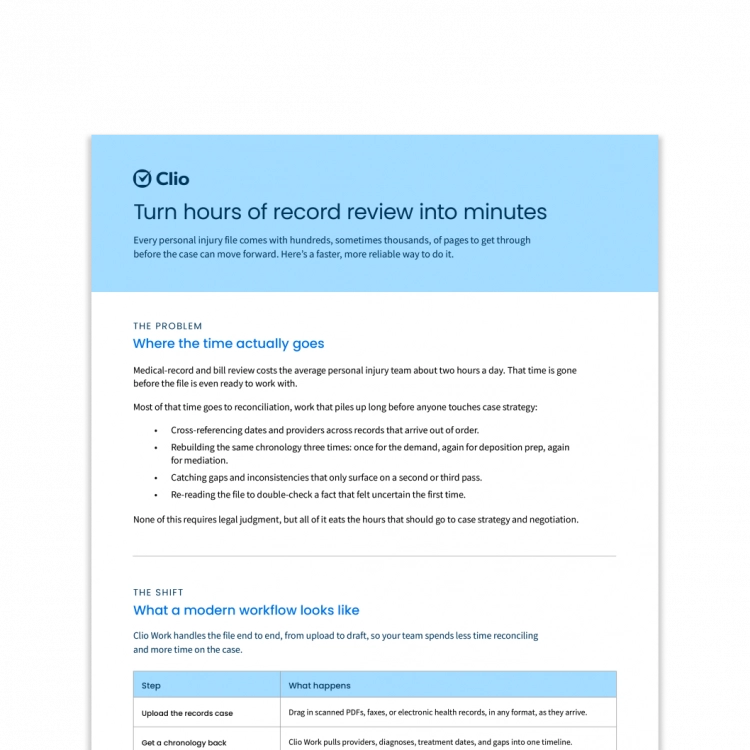
Medical-record and bill review costs the average personal injury attorney about two hours a day, before any of it turns into a demand, a deposition outline, or a settlement number. In this guide, you’ll see how personal injury firms are turning thousands of pages of records into an organized, source-linked chronology in minutes, without adding headcount or outsourcing the work.
Whether your team is buried in records for a single complex case or managing high case volume across multiple matters, this guide walks through what a faster, more reliable record-review workflow actually looks like in practice, and how to verify the work without re-reading the whole file.
Download this free guide to learn how to:
- Turn medical records of any volume or format into an organized treatment chronology.
- Ask follow-up questions about a case file and get answers pulled directly from the source.
- Verify AI-generated summaries in seconds instead of re-reading the file.
- See how other personal injury firms have moved off manual record review and point-solution tools.
- Move from chronology to demand letter, deposition outline, or mediation binder without starting over.
If your team is losing hours to medical-record review before the real casework even starts, this guide is the place to start. Download now and see what a faster record-review workflow looks like for your firm.
Free Download
Personal injury medical record review FAQs
Can AI replace an outsourced legal nurse or chronology service?
It changes what you need one for. Firms that send records out wait on turnaround and get back a static document, so a follow-up question means another email and another wait. Clio Work returns a working chronology you can question directly, then refine as more records arrive.
What does AI medical record review actually involve?
Clio Work reads the records in the matter and pulls out the providers, the dates of treatment, the diagnoses, the medications, the restrictions, and the gaps in care. It flags inconsistencies between providers and surfaces the treatment detail that supports damages. You can ask follow-up questions rather than waiting on a rebuild.
What medical record formats can it handle?
Scanned PDFs, faxes, and electronic health records, in whatever format they arrive. Records come from hospitals, specialists, imaging centers, physical therapy clinics, and pharmacies, rarely in order and rarely the same. You upload them as they come in.
How long does it take to build a medical chronology from a large record set?
Minutes rather than the afternoon a manual pass takes, depending on volume. You can keep adding records as they arrive and the chronology updates, so you are not rebuilding it for the demand, then again for deposition prep, then again for mediation.
How does this compare to dedicated medical chronology software?
Point solutions do the chronology and stop there. Price and upload limits are often what decides it, and once records are in Clio Work the same file supports a draft or a research question without paying for a second tool.