
Proactive AI disclosure is a vital tool for legal practitioners to preserve client trust and ensure compliance with evolving ethical standards regarding confidentiality and communication. By implementing clear disclosure processes at intake, firms can navigate mandatory court requirements while highlighting the efficiency and security benefits that responsibly managed legal technology provides to their clients.
A client who learns you used AI on their matter after the fact may feel blindsided—even if you did nothing wrong. That’s why AI disclosure matters: even when it’s not required, it helps manage expectations and preserve trust.
With 79% of legal professionals now using AI in their firms (according to Clio’s 2025 Legal Trends Report), the question isn’t whether to use these tools but how to talk about them. This article covers when AI disclosure is required, when it’s advisable, and what to say.
AI disclosures are easier when you choose secure, reliable AI that inspires confidence. Learn how Clio Work delivers results you can trust.
How lawyers are using AI in legal practice today
Clients might be most concerned about AI use for substantive legal work, but that’s not the only area where lawyers are using AI. In fact, there are many AI use cases for lawyers. AI powers legal technologies that improve every stage of the client lifecycle, including intake, service delivery, time tracking, and billing.
Once you begin work on matters, Clio Work combines context-aware AI with a global legal library of over one billion verified documents to create a single workspace that assists with both litigation and transactional work. In addition, AI in Clio Draft automates everything from client information gathering to legal document drafting.
As you continue working on matters, Manage AI transforms scheduling orders and hearing notices into actionable events and reminders. It also creates draft invoices, checks for accuracy, and speeds up approvals.
Clients likely won’t worry about AI that handles routine intake or scheduling but may have concerns about AI involved in substantive legal tasks, especially after reading news stories where lawyers misuse AI tools.
Distinguishing between different uses of AI in legal work
Even if you use AI for substantive legal work, what degree of usage might call for AI disclosures?
Some use cases would likely not concern a client. For instance, if you have AI review your legal brief for any opportunities to tighten the prose or improve transitions, that usage doesn’t alter the substance of your legal arguments.
But if you have AI suggest arguments and conduct legal research, it’s assisting with traditional attorney work. The more AI shapes the legal substance—reasoning and precedent—the stronger the case for disclosure.
Get the Guide: How AI Actually Fits Into Legal Work
See how legal-specific AI tools can help your firm draft faster, organize complex information, and reduce administrative work, while keeping attorneys firmly in control of the final work product.
Download the guide
Why AI disclosure matters more than ever
AI use at law firms is high, and lawyers expect it to increase: Clio’s latest Legal Trends Report notes that 82% of legal professionals expect to be using AI more in the next 12 months. With AI becoming increasingly common in substantive legal work, lawyers need to decide whether and how to tell clients about it.
Another reason AI disclosure matters: clients want it, but most lawyers aren’t providing it. Clio’s 2025 Legal Trends Report found that 78% of clients want disclosure, but only 18% of surveyed law firms always disclose their AI use.
What do clients actually want to know about a lawyer’s use of AI?
Clients primarily want assurance that their confidential information remains secure and that an attorney, not a machine, is exercising final judgment on their matter. Beyond that, they want to understand how AI benefits them, whether through efficiency or cost savings.
Ethical requirements for disclosing AI use to clients
State bars have been issuing AI guidance at a rapid pace: California in November 2023, Florida in January 2024, Pennsylvania, Kentucky, and New York in 2024, and Oregon and Washington in 2025, to name just a few. If your state hasn’t weighed in yet, check whether analogous opinions on cloud computing and outsourcing speak to client disclosure obligations.
Two ethical duties most directly shape disclosure obligations: communication and confidentiality.
- Communication (typically Rule 1.4) requirements concerning AI usage vary widely by state. Kentucky says “routine use” of AI doesn’t need to be disclosed unless the client is charged for it or court rules require it. California advises weighing disclosure based on “the novelty of the technology, risks associated with generative AI use, scope of the representation, and sophistication of the client.” Pennsylvania goes further, requiring lawyers to “inform the client of the benefits, risks, and limits” of using AI and to decide together with the client whether AI use serves the client’s objectives.
- Confidentiality (typically Rule 1.6) creates its own disclosure path. Florida recommends obtaining informed consent before using third-party AI tools that would involve disclosing confidential information—particularly “self-learning” tools that might incorporate inputs into future outputs. If AI is using your uploaded confidential content as training material, that’s a disclosure that would require client notice and consent.
Where the rules leave room for interpretation, err toward transparency. Guidance continues to evolve, and it generally trends toward more disclosure rather than less.
Do lawyers have to disclose when they use AI on a client’s matter?
It depends on the ethical rules in their state—and, for court filings, on any standing orders requiring AI certification.
What types of AI use typically require disclosure?
AI use for substantive legal work, such as research, drafting, or document analysis, typically warrants disclosure. Disclosure becomes especially important if you’re inputting client data into tools that retain inputs for training purposes. Using AI for formatting or proofreading generally does not require disclosure.
When disclosure is mandatory
There are only two instances when disclosure of the use of AI is mandatory. The first is when confidential client information is being shared through the use of an AI tool. AI services that train on uploaded content represent a potential breach of confidentiality. Obtaining the client’s informed consent prior to uploading is therefore mandatory under most rules of professional conduct.
The second instance where disclosure is mandatory is when a law, court rule, or judicial standing order requires it alongside any filing from a law firm. California has a proposed law requiring disclosure in court filings, and many courts have issued orders requiring it.
In these two circumstances, lawyers should always truthfully disclose AI use. Lawyers are obligated to be truthful and forthright on this issue.
When disclosure is advisable (even if not mandatory)
Even if you’re in a state where AI disclosure is not required, it is often still the best course of action because it signals your transparency, which promotes client goodwill.
Disclosing AI use up front also helps set expectations and prevent misunderstandings. Imagine you’re conducting due diligence, and the bill you submit to the client is lower than the client expected. Without context, they might wonder what got skipped rather than appreciate the efficiency.
Similarly, imagine you’re billing for document review and the invoice includes a line item for an AI-assisted research tool. A client seeing that charge for the first time may question it, whereas one who knew from the start is more likely to see it as reasonable.
As bar guidance continues to evolve—generally toward more disclosure—disclosing AI use early means you’re building a practice that won’t need to be revised when rules evolve. Proactive AI disclosure also gives clients a reason to trust that you’ll be equally forthcoming about other aspects of their representation.
How to talk to clients about AI

The best time to discuss AI is at intake. The ABA’s Formal Opinion on generative AI suggests that “the engagement agreement is a logical place to make such disclosures and to identify any client instructions” on the use of AI in the representation.
Keep the explanation simple and focused on the client’s interests. What clients want to know is whether AI will affect the quality of your work, the security of their information, or the cost of representation. A sentence or two addressing those concerns is usually enough.
Invite questions and be prepared for a range of reactions. Some clients will be enthusiastic; others will want reassurance that a human is reviewing everything.
If AI use changes mid-matter—say you decide to use a new tool for document review—circle back. The New York State Bar Association’s Task Force recommends revisiting disclosures when circumstances change, not just at the start of representation.
How to write an AI disclosure (with templates)
A strong disclosure should:
- Explain how you use AI (research, drafting, document review).
- Confirm that attorneys review and verify all AI-generated content.
- Describe how you protect client data, including whether AI providers use it to train models.
- Explain how AI use benefits the client, such as through cost savings.
- Invite the client to ask questions or request limitations.
- Secure the client’s acknowledgment and consent.
Below is a template that has these attributes:
We use AI tools to assist with legal research, document review, and initial drafting. These tools help us work more efficiently—which may reduce costs on your matter—but our attorneys review and verify all AI-generated content before use. We ensure all AI platforms we use have robust data security and privacy measures in place to protect your confidential information; your data is not used to train AI models. If you have questions about how we will use these tools on your matter, or if you prefer we limit their use, please let us know. Your signature on this engagement letter constitutes your acknowledgment of and consent to our use of AI as described above.
If you’re only using AI for non-substantive work, you might use the below template for your AI disclosure:
We may use AI-assisted tools for tasks such as document formatting, scheduling, and proofreading. All legal analysis, strategy, and final work product are prepared and reviewed by attorneys.
Court filing certification
Many judges now require attorneys to certify AI use. Requirements vary, some require disclosure only if AI was used, others require a certificate either way. Check standing orders carefully. Here’s a sample based on common requirements:
I certify that artificial intelligence did not draft any portion of this filing or that I reviewed any AI-generated content for accuracy and checked all citations against original sources.
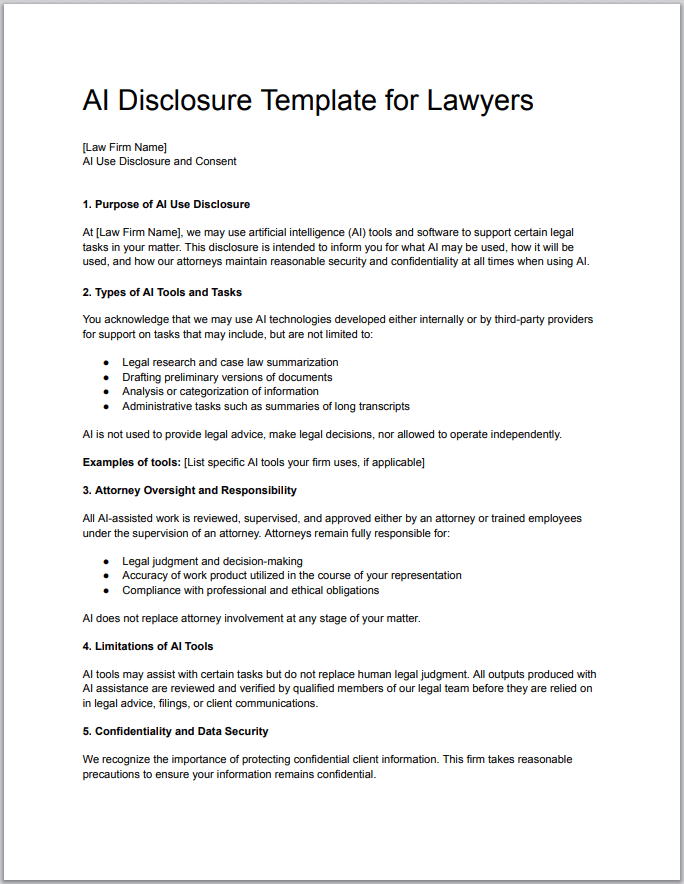
AI Disclosure Template for Lawyers (Free Download)
Not sure how to structure your disclosure? A clear template can help ensure you cover the key elements clients expect.
Download our AI Disclosure Template for Lawyers to get a ready-to-use starting point for engagement letters and client communications. The template includes sample language for explaining how your firm uses AI, confirming attorney oversight, and addressing data security and client consent.
Download: AI Disclosure Template for Lawyers
AI disclosure dos and don’ts
Dos
- Specify what AI is used for (research, drafting, review)
- Confirm human review and verification
- Explain how client data is protected
- Invite client questions or instructions
- Update disclosures if AI use changes
- Link AI use to client benefit (e.g., efficiency, cost savings)
- Ensure client consent is documented
Don’ts
- Use vague language like “technology-assisted services”
- Use jargon like “enterprise-grade security” without explanation
- Treat disclosure as a checkbox rather than a conversation
- Bury disclosure in boilerplate they won’t read
- Treat a one-time disclosure as permanent
- Describe what AI could do rather than what you actually use it for
- Overlook court-specific AI certification requirements when filing
Good vs. bad examples
Good example: “We use AI tools to assist with legal research and first drafts of certain documents. Our attorneys review all AI output for accuracy before relying on it. We only use AI tools that keep your data confidential and that don’t use your data to train their models.”
This tells the client what AI is used for, confirms human oversight, and addresses confidentiality—the three things clients most want to know.
Bad example: “Our firm may utilize advanced technology solutions in the delivery of legal services.”
This says nothing about AI specifically, what it’s used for, or how client information is handled.
Risks of not disclosing AI use to clients
Lawyers who skip AI disclosure when clients would reasonably expect it face several risks:
- Breach of confidentiality. Inputting confidential client data into public AI tools without informed consent can result in inappropriate disclosure to third parties, especially with tools that use inputs for training.
- Ethical violations and disciplinary action. Failing to disclose AI use when clients need that information to make informed decisions about their representation may violate communication duties under the rules of professional conduct. Consequences range from bar investigations to suspension or disbarment.
- Loss of client trust. Clients who learn about undisclosed AI use after the fact may feel misled, even if no rule was technically violated. That loss of trust can damage the relationship and the firm’s reputation.
- Billing disputes. If AI significantly increases efficiency but the lawyer bills at traditional hourly rates without adjustment or disclosure, the client may view the fee as excessive, and bar authorities may agree.
All of these risks share a common solution: tell clients how you use AI from the start.
Strengthen client relationships with AI disclosure
AI disclosure isn’t just about compliance—it’s about trust. Clients who understand how you use AI, and why, are more likely to see it as a benefit rather than a concern. Clear communication at intake, specific language in engagement letters, and attention to court requirements position you to use these tools confidently as they become standard in legal practice.
The lawyers who get this right won’t just avoid risk. They’ll strengthen client relationships in the process.
Download our guide, How AI Actually Fits Into Legal Work for a practical breakdown of how AI supports real legal tasks while keeping professional judgment at the center.
If you’re exploring AI in your practice, see how Clio Work helps you do it responsibly.
Book a Clio demoSubscribe to the blog
-


Software made for law firms, loved by clients
We're the world's leading provider of cloud-based legal software. With Clio's low-barrier and affordable solutions, lawyers can manage and grow their firms more effectively, more profitably, and with better client experiences. We're redefining how lawyers manage their firms by equipping them with essential tools to run their firms securely from any device, anywhere.
Learn More