

As clients increasingly use consumer AI for initial legal questions and document drafting, law firms must recognize this shift in dynamics and prepare to reinforce their unique value and adapt their services.
- Be ready for more informed clients who may seek adjusted service scopes, particularly for reviewing AI-drafted legal documentation.
- Invest in dedicated legal research AI solutions to quickly verify client information—often sourced from general-purpose AIs that lack up-to-date case law or context.
- Actively communicate the risks of consumer-based AI for legal advice, emphasizing the value of a licensed professional's comprehensive real-world context.
- Leverage the efficiency of legal-specific AI to deliver better quality work, timely communication, and more cost-effective workflows, using these advantages as key value propositions.
AI is a powerful tool for legal professionals, but it’s quickly becoming a resource for potential legal clients as well. It’s a shift in consumer trends that also has important implications for law firms, their ability to get hired, and the services that they deliver to their clients.
In this post, we’ll look at key trends in the use of AI by clients, how using AI affects what clients need from a lawyer, and how law firms can better prepare for a future of AI-assisted clients.

AI is already a go-to for client legal questions
According to data from the latest Legal Trends Report, 57% of consumers say they either have or would use AI to answer their legal questions.
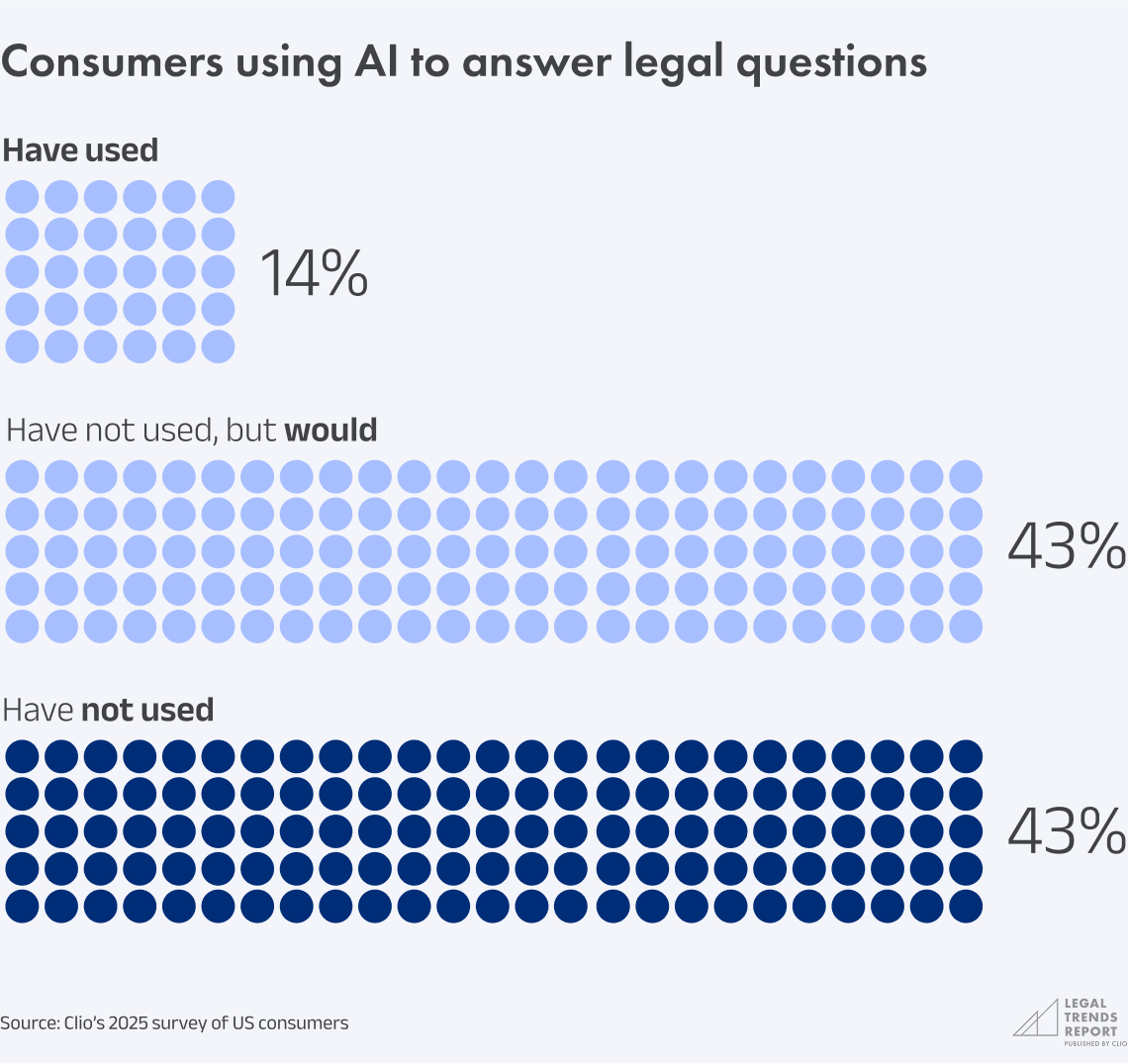
There are many good reasons for the trend. For one, the technology is simple to use and it’s available from virtually anywhere via mobile device. AI solutions provide instant and detailed information, often for free. For many potential legal clients, it can be a quick and easy way to determine whether a problem is worth pursuing legally.
Another benefit is that AI solutions are relatively anonymous and private (though, not without their risks, as discussed below). In some cases, they save people from having to reach out to someone about a legal issue that can be difficult to talk about.
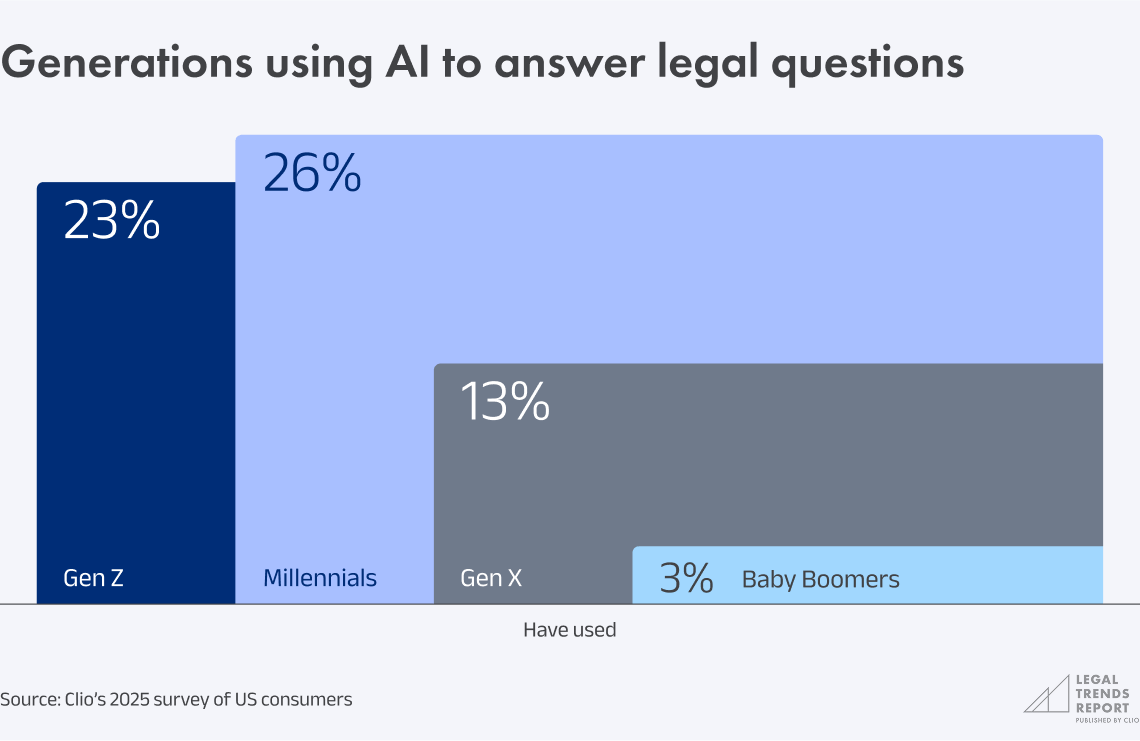
Not surprisingly, Gen Z and Millennials are the most likely to use AI to answer their legal questions. And since younger generations are quicker to adopt the technologies that influence future trends, it’s a practice that’s likely to become more common as AI grows more widespread.
In turn, as more people use AI technologies to explore their legal problems, often before they contact a lawyer, these technologies could have a growing influence on how they understand their legal situation.
How AI is shaping the experience of working with a lawyer
One of the most important implications for lawyers is how AIs may be affecting their firm’s business and their ability to get hired. Specifically, lawyers should be concerned with the question of quality (and potential competition) that AIs provide.
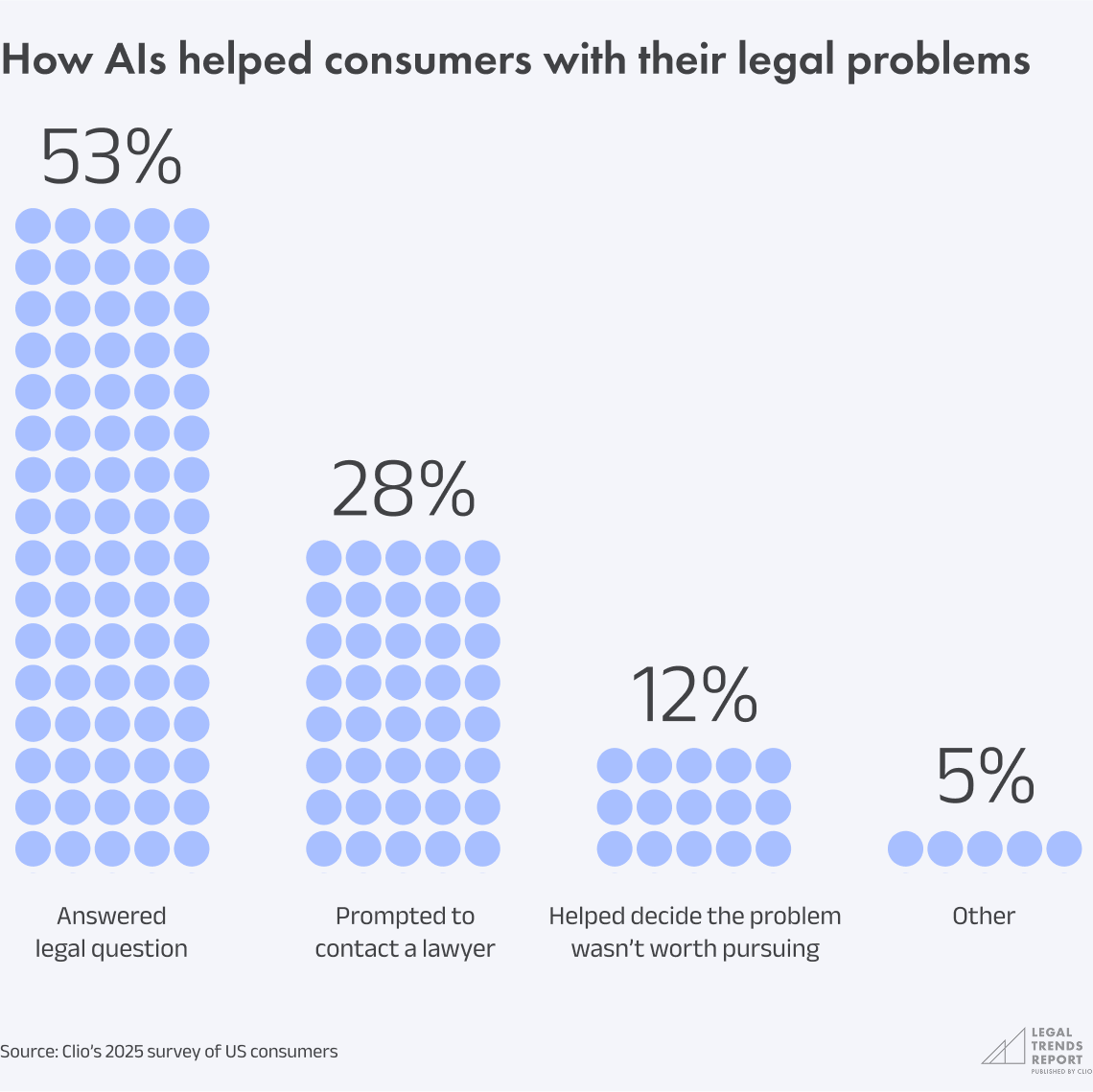
Of consumers who used AI to answer a legal question:
- More than half (53%) felt that their AI had sufficiently answered their legal question.
- In 28% of cases, the AI prompted them to contact a lawyer.
- 12% of consumers were convinced that their legal issue wasn’t worth pursuing.
In other words, while AIs are able to satisfy the needs of more than half of consumers, they are also advising on whether or not to pursue potential legal problems with a lawyer.
The obvious risk here is that consumers could be making judgments on their legal situation before getting an opinion from an actual legal professional. However, there could also be an upside; if accurate, these solutions may be doing law firms a service by pre-screening potential clients—saving lawyers the time and resources that they would have to spend on consultations with little case potential. (Most of the lawyers I know, however, would prefer to make that assessment for themselves.)
Another implication is that when potential clients do reach out to a law firm, there’s a good chance they’re doing so with a lot more foreknowledge about their legal problem than they’ve ever had before. If a client has already consulted an AI, they’re likely more informed of their issue, they may have a sense of how they’d like to proceed with their matter, and they may even have preconceived expectations of the process involved.
For the most part, working with these clients won’t be dissimilar to working with those who have already done their own research on the internet or consulted a friend or family member with strong opinions on how a matter should be handled. But on the other hand, with the sheer amount of context and information that AIs can reference, lawyers can expect much more hearsay to assess and verify.
Additionally, for clients who have already consulted an AI or who have considered it, lawyers also have an opportunity to reinforce the value of working with a certified lawyer, especially when it comes to making the final call on taking a definitive course of action.
How are legal clients using AI?
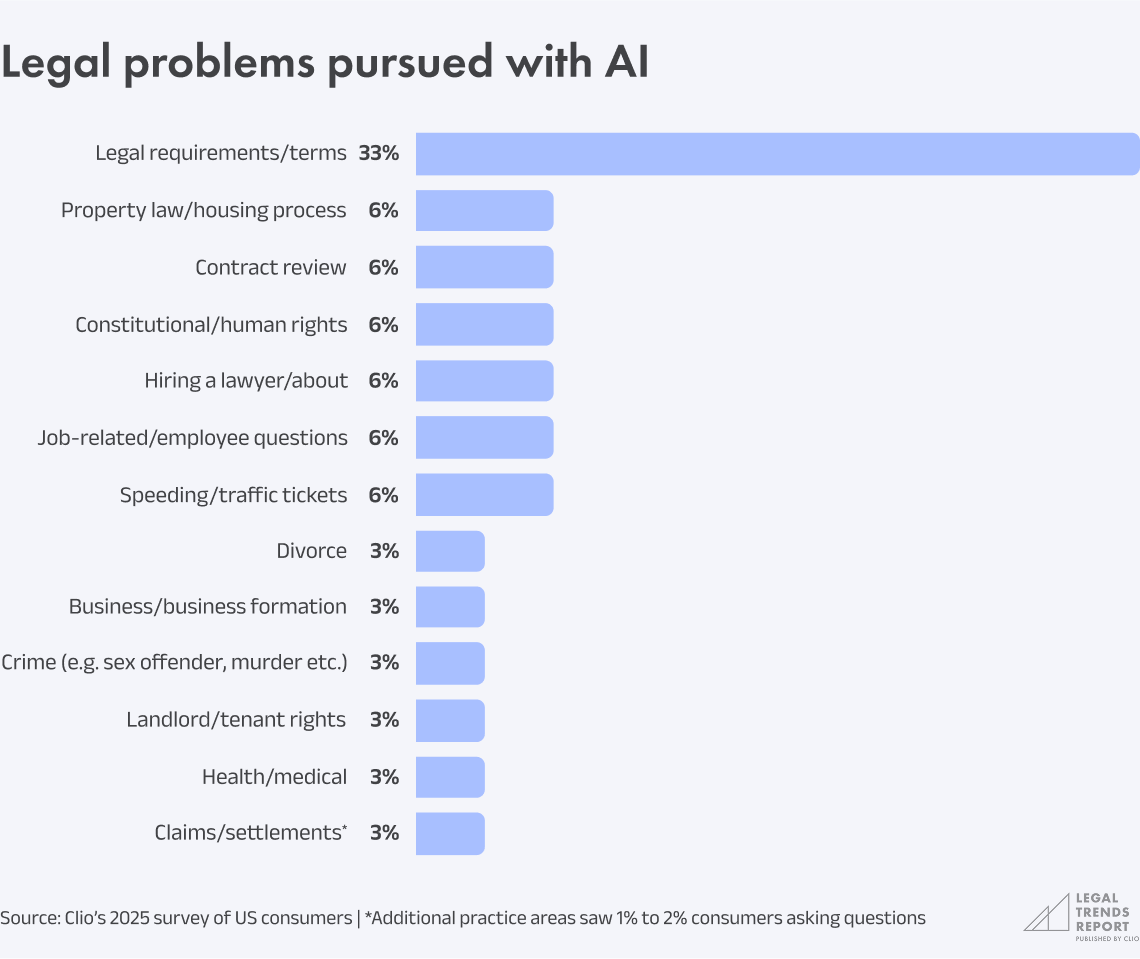
Most questions asked of AI tend to be very general queries about specific legal terms or about understanding certain legal requirements. But many are also querying about issues related to real estate, contracts, constitutional rights, employment-related issues, and traffic tickets. In fact, their questions cover pretty much every area of law.
In many cases, consumers are even turning to their AI solutions to take on the actual legal work of drafting documents:
- “I’m already seeing clients use ChatGPT and taking its word. I had a potential client use ChatGPT to explain the law to her and draft documents, and they were actually pretty on point. Since many lawyers charge by the hour, clients don’t want to pay for them to draft something. They’d rather have ChatGPT do it and have a lawyer review it.” — Samantha, owner at a solo firm practicing in community association law, Washington
- “Lots of clients ask generative AI to answer legal questions or draft legal documents. AIs are usually 80% right but always have errors. Drafting legal documents with general-purpose AI tools, it ends up being a word salad of well-written sentences that are not purposeful. I have to read them with extra care.” — Ken, lawyer at a small corporate and transactional firm, California
- “The fact is that lawyers charge clients for a lot of tasks that can be better and more efficiently handled through automation and AI. As clients realize this, they will refuse to pay lawyers thousands of dollars per hour to perform tasks that a computer could easily handle for almost nothing.” — Jerry, owner at a solo business litigation firm, California
(Note: The above quotations use pseudonyms and are taken from interviews conducted for the Legal Trends Report.)
But while cost is a factor for many consumers, they should know that using AI is not a substitute for working with a licensed legal practitioner who is well-versed in the relevant areas of the law.
Communicating the risks to consumers using AI
Consumers (and legal professionals) should know that general purpose AI solutions—the types most widely available—have inherent risks to those seeking legal advice. In fact, OpenAI recently updated its usage policies to make it clear that ChatGPT is not to be used for legal advice.
Aside from the obvious liability issues, here are some important reasons why clients (and law firms) should be cautious of using general-purpose AI solutions to answer legal questions:
- AI solutions are susceptible to hallucinations, meaning that they may reference precedent cases that don’t exist to inform an opinion or advice. For the client, this could lead them to have a false understanding of their legal situation. For the lawyer, this could also create potential misunderstandings to clarify with clients, and which can be verified with an AI trained specifically for legal research.
- The general-purpose solutions used by consumers have not been trained on up-to-date case law, which means that any response they provide could be based on law that is outdated or no-longer relevant. It’s important that lawyers have their own database of up-to-date case law to reference and verify.
- Many free or low-tier subscriptions to these services don’t provide any privacy guarantees, meaning that the information they provide can be used in training future models and could be served up in responses to other users. While this poses a risk to consumers using these solutions, this is a risk that lawyers should also be aware of should they be using these solutions in their practice—since they have the utmost of responsibility when it comes to the privacy of their clients’ information.
Of course, beyond the technical issues, AIs won’t have the necessary real-world context—the type you get when meeting a client face-to-face—to provide accurate legal advice. AIs will readily provide information that is seemingly authoritative, and in many cases, that pander to what users may want to hear. This can lead to misunderstanding and overconfidence in an approach that may not be in the client’s best interest, especially if critical details get missed.
Finally, AI solutions are not regulated by any professional body and have no obligations to the outcomes of their users. Due to their disclaimers, they also take no responsibility for any negative outcomes or risks that users take on as a result of their advice.
It seems that clients are aware of these risks, as many are skeptical of the use of AI in law firms.
Clients hold lawyers to a higher standard on AI
While many legal clients are willing to turn to AI for perspective on their legal problems, most also take issue with lawyers who use the technology:
- 47% are not comfortable with the idea of lawyers using AI to make decisions on client cases
- 36% are less likely to trust a lawyer who uses AI
- 56% would prefer that a lawyer use a paralegal instead of AI for support on a case
- 78% want their lawyers to disclose their use of AI
But while clients may have concerns with lawyers using AI, they likely aren’t aware that there are dedicated, legal-specific AI solutions that offer a lot more confidence when used by licensed legal professionals.
While consumer AI solutions like ChatGPT, Gemini, or Claude don’t have the ability to access up-to-date case law, dedicated legal AIs, like Clio Work, have been trained on proprietary legal databases. Clio Work offers a vast, expertly curated database of over one billion verified legal documents, from more than 100 countries, that includes:
- Primary law, secondary sources, and exclusive publications from across jurisdictions
- Historical versions of statutes and regulations to ensure you always cite the right law at the right time
- Procedural and practice rules, including published state and federal frameworks such as civil procedure and evidence
- Expert commentary and analysis from books, journals, and practice guides that add depth and interpretation
In addition to a vast library of legal content, Clio Work features dedicated workflows to refine research queries and draft summaries, strategy overviews, and legal briefings. All of the content generated through Clio Work includes detailed citations so that they can be cross-checked and verified in parallel while reviewing.
At the heart of the matter, clients ultimately want to work with a legal professional they can trust, and all the better when they know their lawyer has taken the time to vet the solutions that can help them deliver the best legal product possible.
In fact, some lawyers find that in working with their clients, most don’t have strong feelings on them using AI as long as the results are good.
- “Clients are interested in the results: the finished document, the outcome, the summary. As far as how you get there, whether sitting through hours of video and reading thousands of pages of police reports, or whether a machine does it for me, they don’t seem to care or appreciate it.” — Ivan, a partner at a small criminal defense law firm, California
- “I don’t specifically tell clients, ‘This was generated by AI.’ But I have seen that clients are happy with the quality of the work, product, and clarity.” — Sebastian, owner of a small law firm working in real estate, construction disputes, and transactions, California
Are law firms obligated to disclose the use of AI to clients?
According to Florida Bar Ethics Opinion 24-1 (January 19, 2024): “If the use of a generative AI program does not involve the disclosure of confidential information to a third-party, a lawyer is not required to obtain a client’s informed consent pursuant to Rule 4-1.6.”
In other words, lawyers may have discretion in whether to disclose to clients their use of AI. According to the Florida Bar Ethics Opinion, however, this is contingent on firms ensuring that they use an AI solution that does not ever share confidential information to a third-party, which typically is not something that is guaranteed with many free tiers for general purpose AI solutions.
How to deal with legal clients using AI
With the widespread availability of AI solutions, the bar is higher for everyone. Clients have access to more knowledge than ever before, and they expect an even higher standard of expertise from the legal professionals that they work with.
For these clients, when looking for a lawyer, they’re less likely to be sold on the actual legal knowledge that a lawyer provides and more on other factors like price, quality of service, and convenience.
As the nature of knowledge work evolves with technology, it’s going to become more clear who’s keeping up with these new benchmarks, and who’s falling behind.
In the meantime, here are a few steps that law firms can take to better prepare themselves for working with legal clients that are already using AI:
- Be prepared for clients who may already have a good understanding of their legal issue and may have even used an AI to draft legal documentation. These clients may not be looking for as in-depth a consultation and are likely trying to save money. For AI-generated document reviews, law firms may look to adjust the scope of their services to work with these types of clients based on an initial evaluation of the documentation.
- Explore AI research solutions that are equipped to verify client understandings quickly, as they may have been informed by a consumer AI solution like ChatGPT, which might not have the right context or background into an issue. A dedicated legal research solution will also ensure that firms have up-to-date access to the latest legal databases and the tools to quickly surface and verify queries and drafted content.
- Be prepared to manage conversations with clients regarding the risks of using consumer-based AI solutions for legal advice. These solutions aren’t designed to replace the advice of a licensed legal professional, and in many cases, using them for this purpose actually goes against their usage policies.
- Reinforce the value of working with a licensed legal professional who will take the time to understand the issue at hand, including all of the relevant context that goes into providing credible legal advice.
Interested in learning more about the use of AI in the legal profession, and getting access to insights based on aggregated and anonymized data from tens of thousands of legal professionals? Read more in the latest Legal Trends Report.
The value of legal professionals using AI
It’s no secret: Clients are consulting AI solutions to get insight into their legal problems, often before contacting an actual lawyer. As they bring more informed understanding of their issues, they are shifting the dynamics of the lawyer-client relationship.
Law firms can better adapt and prepare for these shifts by taking practical steps to help meet the evolving expectations of clients. Far from being a liability for legal professionals, the advantages to using AI should be a key value point for lawyers when promoting their services to potential clients.
Specifically, the use of AI can ultimately yield for clients:
- Better, higher quality legal work
- More timely and responsive communications
- Better, more efficient workflows, that in many cases may end up being cheaper
These key benefits, in addition to the extensive privacy and security guarantees provided (for example, Clio will not train its AI models on any personal data handled by law firms or used in any queries) should be used as key points to educate on the value of using legal AI solutions for client work.
In addition to working with a legal-specific AI solution with access to deep knowledge networks of legal reference materials, working within a platform like Clio also gives you the benefit of being able to reference your case and client information in your research queries.
Clio Manage and Clio Work operate seamlessly with each other to identify key case and client details, which provides the important context to perform more informed research. Clio Work will interpret documents, notes, tasks, deadlines, and communications in Clio Manage to create detailed case analysis and research. Visit www.clio.com/work to learn more.
Interested in learning more about how Clio’s Intelligent Legal Work Platform can provide the foundational support for the business and practice of your law firm? Book your demo with Clio today.
Book a Clio demoSubscribe to the blog
-


Software made for law firms, loved by clients
We're the world's leading provider of cloud-based legal software. With Clio's low-barrier and affordable solutions, lawyers can manage and grow their firms more effectively, more profitably, and with better client experiences. We're redefining how lawyers manage their firms by equipping them with essential tools to run their firms securely from any device, anywhere.
Learn More