
Mid-sized law firms are rapidly adopting AI to outpace smaller practices, yet many struggle with the manual burden of providing context to disconnected tools. Cloud-based solutions serve as the essential foundation for legal AI by integrating case data and jurisdictional context, eliminating time-consuming prompts and manual data entry.
Mid-sized law firms have been very quick to adopt AI. According to Clio’s Legal Trends for Mid-Sized Law Firms, 86% of legal professionals working in firms with 20–199 employees have already adopted AI in their work, outpacing smaller practices by a wide margin (71% for solos and 75% for small law firms). Many have formal AI policies in place, and nearly four in ten are actively encouraging their teams to use AI in daily work.
But despite the many benefits of using AI, many also face a fundamental challenge: An AI tool that doesn’t know your cases, your clients, or your jurisdiction requires a lot of prompting, which is time-consuming in itself. Your team still has to upload files, provide context, and copy-paste outputs into their documents. And if your team is using a generic AI solution not built for legal work, this can be a source of data privacy risks and concerns about the overall accuracy of its output.
Cloud solutions for law firms are the infrastructure layer that closes this gap. When your firm’s data lives in the cloud and your AI can securely access it, AI stops being a generic chatbot and starts being a tool that understands your practice. It can access your matter files, stay current as cases evolve, and deliver research and analysis grounded in both the law and your specific client details.
Yet while mid-sized firms are adopting powerful AI technology, many still rely on outdated server-based solutions to run their practice, limiting the benefits firms can realize from the AI tools they’ve invested in. This disconnect is a bigger obstacle than it might appear. Drawing on data from the 2026 Legal Trends for Mid-Sized Law Firms, this article breaks down where AI adoption stands, where cloud adoption lags, and why bridging the two matters.

On the surface, AI adoption is high and firms are thriving
Mid-sized law firms appear to be ahead on AI maturity. Most have gone beyond simply trying out the technology; instead, they’ve taken a more deliberate, structured approach, with 60% establishing formal AI policies, and 38% actively encouraging staff to use AI in their work.
And it’s paying off. Mid-sized firms are seeing the benefits to using AI:
- 39% report that AI has directly improved their revenue.
- 65% say AI has enabled them to handle a higher volume of work.
- 44% have seen improved client satisfaction.
But despite strong AI adoption, guidelines, and realized benefits, many mid-sized firms still struggle with a critical vulnerability in their AI infrastructure.
The problem with how most law firms are using AI
Right now, the most common AI tools in mid-sized firms are generic, consumer-grade solutions like ChatGPT, Claude, or Gemini. While these tools are easy to pick up, and in many cases are free to use, they come with serious limitations for legal work. For example:
- Data security risk. Generic AI tools weren’t built with attorney-client privilege in mind. Free versions may use your input data for model training, and even paid tiers may not offer the enterprise-grade security controls that legal work demands. In United States v. Heppner, a court ruled that materials generated using a free AI chatbot were not privileged, precisely because the tool lacked the confidentiality protections legal work requires.
- Accuracy and risk of error. Generic AI tools don’t have access to up-to-date legal databases that include the latest case law, statutes, court filings, and regulatory guidance. Without a verified legal library to ground their outputs, these tools are prone to hallucinations and other types of errors: citations that don’t exist, case law that’s been overturned, or legal reasoning that sounds convincing but doesn’t hold up under scrutiny. For a mid-sized firm handling complex, high-stakes matters, relying on AI that can’t verify its own legal conclusions can be a liability.
- Integration and connectivity. Typically, when working with a generic AI solution, your staff will work with an isolated chat interface with no ability to reference any of the context that lives in your firm. This means that each person on your team essentially starts from scratch every time they formulate a query. They’ll need to cite relevant case facts and upload documentation—and re-enter everything whenever they start a new chat or case details change.
There’s also the risk that if anything gets missed in briefing your AI, your team won’t get outputs that are relevant to their actual legal matter.
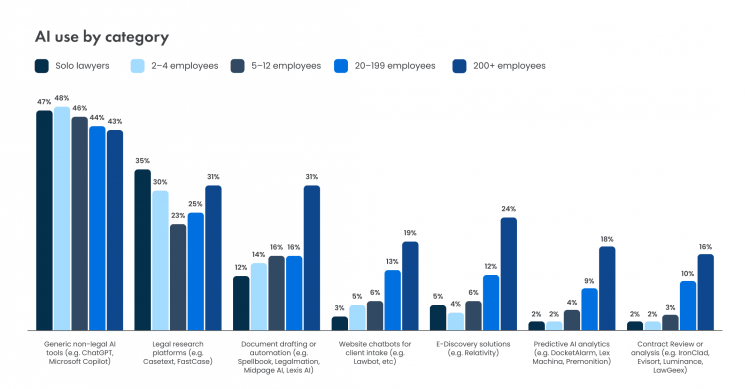
For simple, routine tasks that don’t require any references or involve client data, generic AI solutions might be fine. But for actual legal work—contract analysis, case strategy, document review (especially across hundreds of files)—generic AI solutions won’t give you the benefits you need.
The benefits of legal-specific AI
Legal-specific AI addresses these challenges directly. These tools are purpose-built for the work lawyers actually do. Clio Work, for example, can analyze, research, and draft legal content, and is grounded in a comprehensive legal library of over one billion court filings and legal documents. It also includes citation verification to reduce hallucinations, and it comes with the data privacy safeguards that legal work requires.
When a legal AI tool can base its output in authoritative sources, it gives you results that you can verify and use. That value improves even more when your legal AI tool can reference key matter details to ground its research and analysis. It’s what gives you better, more informed outputs from your AI and saves your staff from spending significant time and effort on prompting.
These solutions help address accuracy and the risk of error, but on their own, they may not completely solve the issue of integration and connectivity.
Be the first to see where legal is headed
Sign up now to get the Legal Trends Report in your inbox the moment it drops, and you’ll be automatically entered to win a one-hour strategy session.
Join the waitlist
How cloud platforms make AI actually useful for legal work
Cloud-based platforms act as a central hub for your law firm. Rather than a collection of disconnected tools, everything draws from a shared foundation. Different teams can use the software that works best for them without creating new silos or duplicating data.
When it comes to AI, all of those case details, documents, communications, and billing records can be securely referenced, giving AI tools the context they need to take on meaningful tasks across the firm and keep your team ahead in their work. And when a cloud platform is paired with a legal AI tool that’s grounded in the law, that tool can stay current on both the law and your matters to deliver quality, situation-specific results with minimal prompting. This is what’s known as “context-aware” AI—and it works much differently than a tool that doesn’t know anything about your practice.
The practical impact shows up across the firm’s daily work. Here are a few examples:
- Contract review is more precise when AI can reference the firm’s prior agreements and established language, not just generic templates.
- Legal research is sharper when AI considers the specific jurisdiction, facts, and procedural history of the active case.
- Document drafting moves faster when AI pulls relevant details directly from the case file instead of waiting for someone to provide them manually.
This is the kind of approach that Clio Work takes. You can connect your AI analysis, strategy, and research to live matter data in Clio Manage so the tool already understands the case before anyone asks it a question.
Context-aware AI can also support key administrative functions. For example, it can automatically draft bills on a set schedule and notify the responsible attorneys to review them, saving your office team the work of chasing these down themselves.
As with other tasks, your AI can do this work in minutes, not hours. Having a cloud solution for legal practice in place to connect these parts of your firm is what allows you to get more out of your AI solutions.
The broader benefits of cloud software for law firms
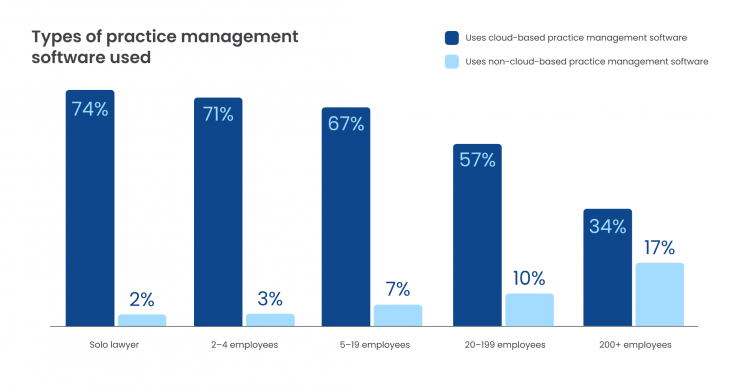
The advantages of cloud software reach well beyond AI, too. Yet many mid-sized law firms are still using server-based systems to run their practice, or they don’t have any practice management system in place at all. According to the Legal Trends for Mid-Sized Law Firms, only 57% of mid-sized law firms have moved to a cloud-based practice management system, compared to 71% to 74% of solo and small firms.
What’s telling is that 30% of mid-sized firms also say their biggest technology challenge is integrating new tools into existing workflows. Without a cloud-native foundation, every new tool—including AI—becomes another disconnected system.
For more than a decade, cloud-based solutions have created more interconnectivity between software platforms for law firms. They allow teams to work from one centralized database of information, making it much easier to keep everything accessible and up to date. This is a benefit for everyone working at the firm, saving them the trouble of hunting down information or keeping it updated in multiple places.
Beyond centralized data, cloud platforms handle much of the operational burden of server-based systems. Updates and security patches are applied automatically with no downtime or IT support. And as a firm grows, the platform scales with it: Adding users, matters, or new tools doesn’t require investing in additional hardware or infrastructure. That frees up both budget and IT resources for work that actually moves the practice forward.
Because data lives in the cloud rather than on a local server, lawyers and staff can work from any device, anywhere, without a VPN. That same accessibility protects the firm if something goes wrong. A hardware failure or office disruption won’t put client records at risk or bring operations to a halt. And for firms with multiple offices or practice groups, everyone is working from the same system in real time, which eliminates version control issues and makes cross-team collaboration far more seamless.
The benefits extend to clients, too. Cloud-based firms can offer clients real-time visibility into their matters, easier document sharing, and online payment options, which clients increasingly expect. For mid-sized firms competing against both smaller agile practices and larger well-resourced ones, that client experience can be a meaningful differentiator.
Law firms and cloud security
An integrated approach to using legal-specific AI with a secure cloud-based practice management system ensures that your data remains private and secure at all times. They both provide protections designed specifically for sensitive client data, including strict no-training policies, enterprise-grade encryption, and compliance safeguards that generic AI tools don’t offer.
Unlike server-based systems—where security depends on in-house IT, manual updates, and ongoing oversight—cloud platforms centralize audit trails and apply compliance controls automatically, reducing the risk of gaps as your firm grows.
Cloud solutions vs. server-based solutions for law firms
Here’s an overview of how cloud and server-based approaches compare in supporting the use and benefits of AI:
| Cloud-based solutions | Server-based solutions | |
| AI integration | AI tools connect directly to your firm data, enabling context-aware research, analysis, and drafting with minimal added input. | AI tools operate in isolation; staff must manually upload documents and re-provide context for every interaction. |
| Data accessibility | Case details, documents, and communications are accessible from any device, anywhere, and they’re available to connected tools in real time. | Data is locked to on-premise servers. Remote access requires a VPN or workarounds. |
| System integration | New tools plug into a shared data layer, reducing tool sprawl and enabling workflows that span intake, case management, billing, and AI. | Each tool operates independently, creating silos that require manual data transfers between systems. |
| Security and compliance | Enterprise-grade encryption, automatic updates, centralized audit trails, and built-in compliance controls. | Security depends on in-house IT; updates are manual, and compliance requires ongoing oversight. |
| Scalability | Add users, storage, and capabilities without hardware investment. AI features scale across the firm instantly. | Scaling requires hardware purchases, server maintenance, and IT resources that must keep pace with firm growth. |
| Maintenance | Automatic updates, patches, and backups are handled by the provider. | The firm’s IT team must manage updates, backups, and troubleshooting, which pulls them away from other responsibilities. |
| Cost structure | Predictable subscription pricing; infrastructure costs are included. | Firms must plan for upfront hardware investments, ongoing maintenance, energy usage, and IT staffing costs. |
How to evaluate cloud readiness at your law firm
Knowing that cloud infrastructure matters is one thing. Figuring out where your firm actually stands is another. Before evaluating specific platforms, it helps to get an honest picture of your current setup to know where the gaps are, where the risks live, and where the biggest opportunities exist.
These five questions are a good starting point for any managing partner or firm administrator thinking through the shift:
Where does our firm’s data currently live, and who maintains it?
If your case files, billing records, and client communications are spread across a local server, individual desktops, and disconnected cloud apps, that fragmentation is already costing your team time. Understanding who handles backups, updates, and security helps clarify what a cloud migration would actually change.
What AI tools are our attorneys already using, formally or informally?
In most firms, AI adoption isn’t entirely top-down. Lawyers and staff are already experimenting with tools like Claude and ChatGPT on their own, whether or not the firm has sanctioned it (a situation known as “shadow IT”). Getting a clear picture of what’s in use (and what data is being entered into those tools) can help identify if an alternative is needed.
Do our current systems allow AI tools to access case and client data securely?
If your practice management system can’t connect to AI tools through secure integrations, every interaction requires manual input, and every manual input is a potential security exposure. The answer here often reveals whether your current setup can support the AI strategy you’re building toward.
What are our biggest integration pain points today?
Most firms don’t need a full tech stack audit to answer this. There are the workarounds that everyone complains about: data entered twice, documents needed in a system where they don’t live, reporting that pulls from three different sources. These challenges are usually the clearest signals of where a cloud-native platform would have the most immediate impact.
Do we have an AI usage policy, and does it address data security for generic tools?
Sixty percent of mid-sized firms have formal AI policies, which puts them ahead of smaller practices. But if your guidelines don’t specifically address how client data should and shouldn’t be used in generic AI tools (or if staff aren’t confident about what’s allowed) there’s likely room for improvement.
The mid-sized firm advantage—if you act on it
Mid-sized firms are in a unique position within their respective markets. They have the budgets, processes, and team structures to adopt AI with real sophistication and without the layers of bureaucracy that slow enterprise firms down. The data from Legal Trends for Mid-Sized Law Firms confirms that mid-sized firms investing in AI are already outperforming smaller practices across revenue, client satisfaction, and competitive positioning.
But to close the gap with enterprise firms, AI adoption alone isn’t enough. The firms that will see the greatest returns are the ones building on a strong cloud foundation. These firms will be able to ensure that their AI use is an integrated part of how the firm operates.
If you want to learn more about getting the most out of AI at your firm, our experts can show you how cloud software and tools built for legal work make it possible. Book a demo to get started.
Is the cloud safe for law firms?
Yes. Reputable cloud providers offer enterprise-grade encryption, multi-factor authentication, compliance with standards like SOC 2 and HIPAA, and 24/7 threat monitoring. In most cases, cloud security exceeds what a mid-sized firm can maintain with on-premise servers. The key is choosing a provider with legal-specific security credentials, not consumer-grade storage.
What’s the difference between cloud software and cloud storage for law firms?
Cloud storage (like Dropbox or Google Drive) provides a place to keep files remotely. Cloud software goes further—it’s a full platform (like practice management or case management) that runs in the cloud, connecting your data, workflows, and tools in one system. For AI to work effectively, you need cloud software, not just storage.
Can AI tools access my firm’s data if it’s not in the cloud?
In most cases, no. AI tools need structured, accessible data to provide context-aware results. If your data lives on local servers or in disconnected systems, AI tools can only work with what you manually provide in each prompt, which limits their effectiveness and creates security risks.
What are the risks of using ChatGPT for legal work?
The primary risks are data security (since inputs may be used for model training, which can be a risk to attorney-client privilege), lack of legal-specific accuracy (hallucinated citations), and zero case context (the tool doesn’t know your matter, your client, or your jurisdiction). These aren’t reasons to avoid AI, but they are reasons to use AI that’s connected to your firm’s data through a secure cloud platform.
How does cloud adoption affect AI maturity in law firms?
Cloud adoption is the infrastructure layer that enables AI maturity. Without it, firms are limited to generic, disconnected AI tools. With cloud, AI can access case files, learn from firm-wide work product, and deliver results that are specific to the matter at hand, which is the difference between experimentation and real integration.
Subscribe to the blog
-


Software made for law firms, loved by clients
We're the world's leading provider of cloud-based legal software. With Clio's low-barrier and affordable solutions, lawyers can manage and grow their firms more effectively, more profitably, and with better client experiences. We're redefining how lawyers manage their firms by equipping them with essential tools to run their firms securely from any device, anywhere.
Learn More