

With the launch of OpenAI’s GPT-5.5, we are upgrading every Clio Work and Vincent customer to the new model for agentic work and document drafting. The upgrade sets a new bar for what Clio’s AI can do on substantive legal tasks, and is the foundation for the next wave of autonomous legal capability we are building across our product line.
Why we’re upgrading
Over the private preview period, we evaluated GPT-5.5 through Clio’s core evaluation set, designed by legal experts to reflect the work our customers do every day. This includes legal research, document analysis, drafting, discovery, and scenario-based advisory. These evaluations measure end-to-end system performance, including core agentic capabilities that support longer-horizon work, such as memory management and context retention across multi-turn sessions. They assess how effectively models orchestrated through Clio’s AI retrieve, integrate, and act on firm context, while leveraging our authoritative legal content library, one of the largest in the world.
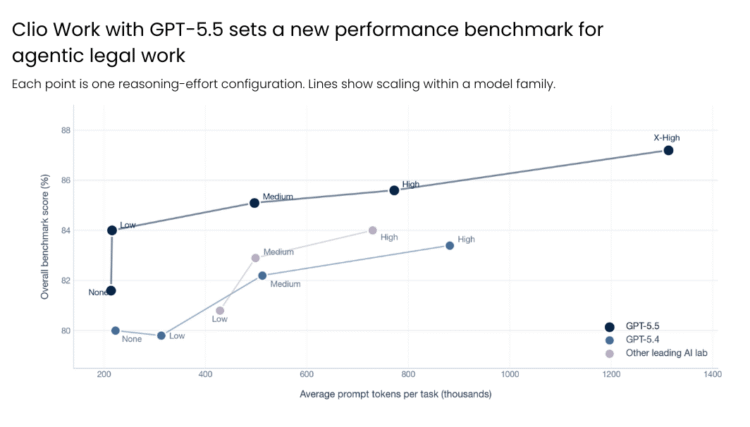
We evaluated GPT-5.5 against every other frontier model available to us, including OpenAI’s prior-generation GPT-5.4 and models from other leading AI labs. This evaluation covered hundreds of scenarios and thousands of graded criteria, at multiple reasoning-effort levels for every model. Within Clio’s AI, where models are combined with our agentic systems and legal data, GPT-5.5 delivered the strongest performance we recorded, achieving an overall score of 87.2%.
When powered by GPT-5.5, Clio’s AI delivered the top overall benchmark score at 87.2%, higher than any other frontier model we tested.
Bigger gains on the hardest legal work
Two categories of work push frontier models hardest in our evaluation, and they are where GPT-5.5 moves furthest from the prior generation.
The first is legal research that requires citing the controlling authority, including the specific case, the exact statutory section, and the leading commentary, rather than merely describing the rule. On these tasks, GPT-5.5 delivers a roughly 20% relative improvement over the prior generation, closing gaps that earlier systems consistently left open.
The second is difficult, open-ended document work, which includes contract analysis, deal-point extraction, multi-document review, and discovery across large file sets. Earlier models would reliably surface the right answer but could miss the qualifying language, scope clauses, and secondary requirements that might alter its legal meaning. GPT-5.5 reads further into the document and captures key information: the survival periods, the fraud carve-outs, the jurisdictional conditions, the conditions of exercise. Across our document-analysis scenarios, this translates to a ~7% relative improvement over the prior generation, and the difference is even larger at higher reasoning effort. The result is an answer that is not merely directionally correct but more legally complete.
More efficient use of the context window
GPT-5.5 is markedly more efficient in how it uses tokens during reasoning. It spends fewer tokens deliberating internally for the same quality of answer than other frontier models we tested. In one comparison, it used ten times fewer reasoning tokens per tool call. In practice, this means two concrete things for our customers: faster responses, and more headroom in the context window for Vincent to retain context in long, multi-turn sessions and autonomous agent work.
What this means for our customers
Clio Work and Vincent’s agent modes now run on GPT-5.5, and customers will start to see the difference in their day-to-day work. This includes:
- Legal and matter context are seamlessly integrated. Clio’s AI brings the relevant documents, notes, and matter history into its reasoning without user hand-holding.
- Drafted documents find more relevant precedent. Clio’s AI search and retrieval work is more thorough, and that thoroughness shows up in the documents it produces.
- Routing is faster, deep analysis is better. Simple legal research questions are answered quickly; Clio’s AI still triggers deep analysis when the task demands it and the quality of that deep analysis is meaningfully higher.
- Reasoning across provisions is stronger. On tasks that require connecting the dots between multiple contractual provisions or several authorities, Clio’s AI delivers more complete and confident answers, with minimal boilerplate and unnecessary qualification.
Intelligence grounded in legal context
Both Clio Work and Vincent are grounded in the Clio Library, our authoritative legal content spanning case law, statutes, and commentary across multiple jurisdictions. Clio Work can also connect to Clio Manage, allowing it to draw directly from the matter it’s working on, including documents, notes, communications, tasks, and deadlines, without the user needing to paste or re-explain context.
This grounding is what makes our AI answers usable rather than merely plausible. When our AI cites an authority, it is one it actually retrieves. When it references a clause from an engagement letter, it is one it actually reads. Because GPT-5.5 reasons more reliably across longer, richer inputs, customers get more value from the context they bring. Drafts need less cleanup, research lands closer to the final answer, and lawyers spend less time re-explaining the matter to the AI.
A foundation for the next generation
The upgrade is also foundational for the next generation of Clio’s agentic AI capabilities. Our AI can now autonomously locate and use the matter context required for a task, including documents, notes, tasks, and intake forms, without any user intervention. We are expanding these agentic capabilities so Clio’s AI takes a more active role across legal work.
In Clio Work and Vincent, GPT-5.5’s extended autonomy and reasoning ability directly supports our roadmap of highly reliable autonomous legal agents that perform relevant legal work at scale. And, as we continue to deepen our AI ability to leverage Clio Library and DocketAlarm data, the model’s stronger reasoning translates directly into more actionable guidance for legal professionals.
Looking forward
Consistency, reliability, and verifiability are the characteristics that unlock the full value of legal AI. That is the bar. Clio’s AI is built to meet it by integrating frontier models with our own systems, grounded in deep legal context. We partner closely with OpenAI and leading AI labs to push capabilities forward and bring the best of what’s possible to our platform, so those advances translate directly into the quality and scope of work our customers can achieve.
Subscribe to the blog
-


Software made for law firms, loved by clients
We're the world's leading provider of cloud-based legal software. With Clio's low-barrier and affordable solutions, lawyers can manage and grow their firms more effectively, more profitably, and with better client experiences. We're redefining how lawyers manage their firms by equipping them with essential tools to run their firms securely from any device, anywhere.
Learn More