

They say change happens gradually, then all at once. Just a few years ago, legal AI was a fringe concept. Today, it’s woven into everyday legal work, helping firms of all sizes automate tasks, improve accuracy, and deliver better client results.
So what does this actually mean for your firm?
You don’t need to become a data scientist overnight. But understanding how legal AI technologies can fit into your workflows, and how to use it well, is critical for staying competitive.
Let’s break down how legal AI works, how firms use it day to day, current adoption trends, and how to evaluate tools.
What is legal AI technology?
Legal AI technology uses artificial intelligence systems to assist with core legal tasks such as document review, contract analysis, legal research, and case prediction. Instead of simply storing data, AI tools analyze it, extract insights, and generate recommendations that support legal reasoning.
In modern legal practice, AI legal technology helps lawyers:
- Quickly process large volumes of information.
- Automate repetitive tasks.
- Reduce errors and improve consistency.
- Make better decisions.
According to the 2025 Legal Trends Report, law firms adopting AI are seeing measurable results. Nearly two thirds report improved work quality (65%) and faster client responsiveness (63%), while more than half say AI has increased their capacity (54%). These gains are translating into business outcomes as well, with over a third of firms reporting higher profitability (36%) and improved client satisfaction (34%).
AI adoption among legal professionals is now at 79%, and 82% expect to increase their use of AI in the next 12 months. Among firms that have adopted AI widely, 69% report positive revenue impact, nearly double the rate (36%) of firms overall.
As AI continues to elevate performance across the industry, the next step is understanding how the technology actually works.
How is legal AI different from traditional legal software?
Traditional legal software organizes and stores information, while legal AI actively analyzes data, generates insights, and supports better decision-making.
How legal AI technology actually works

Modern legal AI is built on a layered system that governs how tools process information, extract meaning, and connect to your workflows. Think of it as your legal AI technology stack. Understanding this structure is essential because it reveals where AI creates real value, where it falls short, and which tools are worth your time.
Layer 1: Legal data layer
This layer is the foundation of the stack. It contains the legal information that AI learns from:
- Case law databases: Judicial decisions from courts at all levels.
- Legislation: Statutes, regulations, and administrative rules.
- Legal commentary: Textbooks, law reviews, and expert analysis.
- Internal firm documents: Briefs, memos, and precedents.
- Contracts and filings: Agreements, pleadings, and discovery materials.
- Matter context: Client-specific facts, timelines, and documents that give legal work its real-world context.
The quality of this data is crucial because it determines the quality of the output. Tools grounded in verified legal databases and firm-specific materials are better positioned to produce accurate, reliable results. By contrast, tools that rely heavily on the open web or general-purpose training data may lack legal authority, jurisdictional relevance, or up-to-date information.
When the foundation is weak, lawyers run the risk of producing incomplete or unreliable results—a risk they cannot afford to take.
Layer 2: AI reasoning layer
This layer interprets legal language and extracts meaning. It’s where data becomes insight. At a simplified level, AI reasoning uses technologies such as:
- Large language models (LLMs): Understand and produce legal text.
- Machine learning: Learn patterns from past data to predict outcomes or classify information.
- Natural language processing: Read, parse, and extract information from unstructured documents.
These technologies analyze legal documents, recognize patterns, pinpoint key clauses, and surface information that’s relevant to the matter at hand.
Layer 3: Retrieval and citation systems
The retrieval and citation layer establishes the AI’s credibility, when grounded in the law. It connects reasoning models to trusted legal sources, ensuring outputs are accurate and traceable. Key components include:
- Retrieval-augmented generation (RAG): Allows AI to reference live databases when generating responses, keeping results current.
- Citation verification: Checks references to case law and legislation, confirming that AI-generated content cites the proper sources.
- Legal knowledge graphs: Map relationships among cases, laws, and topics to strengthen context.
By anchoring AI models to authoritative sources, this layer keeps hallucinations in check and ensures lawyers can trust—and, with the right verification workflow, easily confirm—the results.
Layer 4: Workflow integration layer
At the top of the AI legal technology stack, technology and practice come together. AI tools connect directly with the systems lawyers already use, weaving insights and automation directly into existing workflows. Examples include:
- Case management systems: Organize case files, track deadlines, and suggest next steps.
- Document automation platforms: Draft, review, and populate contracts or pleadings.
- Billing software: Analyze time entries, highlight inefficiencies, and improve accuracy.
- Client intake systems: Extract and structure information from forms or emails.
When integrated across these systems, legal AI can draw from both legal databases and matter-specific context, such as client communications, documents, and case details. This additional context significantly improves the relevance and usefulness of its outputs. For example, when AI incorporates both verified legal sources and information from emails or matter files, it can produce more tailored research and more accurate drafts.
Modern legal platforms like Clio are designed to support this kind of integration, connecting data with workflow inputs so that AI is informed by the full picture of the matter. As more systems and data sources are connected, the benefits begin to compound, producing results that are more precise and useful in day-to-day legal work.
How do legal AI systems reduce hallucinated legal citations?
Legal AI tools reduce hallucinations by using retrieval and citation systems to ground outputs in trusted legal sources and confirm references.
How law firms use AI in real legal workflows

The value of AI’s use by law firms becomes clear when you see how it fits into everyday legal work. Here’s how it helps lawyers navigate common workflows.
Litigation preparation workflow
Whether you’re preparing for a motion, trial, or deposition, AI can handle the heavy lifting. By quickly summarizing documents and highlighting key information, it reduces time spent sifting through large volumes of material, freeing lawyers to focus on strategy and case theory.
Example process
- Lawyer uploads discovery documents
- AI summarizes evidence and extracts key facts
- AI identifies potentially relevant precedents and related issues
- Lawyer reviews, verifies, and refines the analysis
Contract drafting and review workflow
There’s no doubt that contract work can be tedious. AI accelerates drafting and review while helping ensure consistency and risk awareness across documents.
Example process
- Lawyer uploads a contract or selects a template
- AI identifies key clauses, obligations, and missing provisions
- AI suggests language based on similar agreements or internal templates
- AI flags potential risks, inconsistencies, or deviations from standards
- Lawyer edits and approves the final version
Legal research workflow
Even a seemingly simple legal question can lead to hours of research. Legal research AI technology speeds up the process by quickly surfacing relevant materials, while the lawyer ensures accuracy and applies their expert judgment.
Example process
- Lawyer asks a research question
- AI searches case law and statutory databases
- AI summarizes relevant authorities and extracts key principles
- Lawyer verifies citations and applies the insights to the matter
eDiscovery and document review workflow
The sheer volume of data in e-discovery and document review can be overwhelming. AI helps manage it, making review faster and more focused.
Example process
- Lawyer uploads large collections of emails, documents, or discovery files
- AI scans materials to identify relevant evidence
- AI groups related documents and highlights key information
- AI prioritizes documents most likely to be relevant
- Lawyer reviews flagged documents and confirms relevance
Client intake and communication workflow
Dealing with clients is one of the most challenging parts of a lawyer’s job. AI streamlines intake and communication while keeping you in control of client interactions.
Example process
- Client submits intake forms, emails, or documents
- AI summarizes client information and key facts
- AI organizes communications within the matter file
- AI drafts responses or follow-up messages
- Lawyer reviews and sends communications to the client
Law firm operations and insights workflow
Managing a law firm can be just as time-consuming as practicing law. AI provides visibility into firm performance, supporting better operational and strategic decisions.
Example process
- AI analyzes matter activity, billing records, and case data
- AI generates summaries of case progress and workload
- AI identifies operational trends, such as billing patterns or task bottlenecks
- Firm leadership reviews insights to improve efficiency and resource allocation
Benefits of legal AI technology
Whether you run a solo practice or a large firm, work in litigation or transactional law, AI has something to offer, and the benefits show up across both legal work and day-to-day operations.
- Increased efficiency: Automates repetitive tasks, freeing lawyers to focus on higher-value legal work and contributing to the increased capacity reported by 54% of firms.
- Faster legal research: Surfaces relevant cases, statutes, and precedents in seconds.
- Reduced operational costs: Decreases time-intensive administrative work and manual review, helping drive profitability gains reported by 36% of firms.
- Improved accuracy and consistency: Minimizes errors and ensures standardization across documents, workflows, and legal outputs.
- Reduced cognitive load: According to the 2025 Legal Trends Report, legal technology like Clio can reduce cognitive load by up to 25% in everyday tasks, freeing mental energy for strategy and client outcomes. In document review tasks, Clio’s AI improved correct responses by 129% and task completion by 40%.
Legal AI helps firms do more legal work in less time with greater precision.
Risks of legal AI and how lawyers mitigate them
Like any innovation, AI introduces new risks, especially when firms adopt the wrong tools or lack clear policies for how to use them. Here are the most common pitfalls and how to manage them.
- Data privacy and confidentiality concerns: Using AI tools may involve sharing sensitive client information. To address this, choose AI tools that boast top security features and protocols, such as end-to-end encryption, role-based access controls, multi-factor authentication, and regular third-party security audits. Any tool you use should also comply with applicable professional and regulatory obligations around client confidentiality.
- Inaccurate or unsupported outputs: AI hallucinations—responses that appear correct but are incomplete or unsupported by the law—are a significant and valid concern for many lawyers. Treat AI as a support tool, not a final authority. You can minimize this risk by verifying outputs, checking citations, and using a legal AI solution grounded in the law.
- Unstructured or ungoverned use of AI: Deploying AI without a clear policy governing its outputs creates unnecessary exposure. Without defined guidelines, lawyers may over-rely on AI-generated content, miss errors, or use tools that don’t meet client confidentiality standards. Make sure your firm has a comprehensive AI policy in place, one that covers acceptable use, output verification, and client disclosure obligations.
Why is human review still necessary when using legal AI?
Human review is essential to upholding professional standards and maintaining client trust. It ensures accuracy, validates legal reasoning, and applies professional judgment to AI-generated outputs.
How to evaluate legal AI technology
Your AI stack is only as strong as the tools you choose. But with so many options on the market, how do you pick the right one? The key is to understand how it performs in real legal contexts. The steps below provide a practical framework for assessing legal AI platforms.
Step 1: Assess the legal data sources
Not all legal AI tools draw from the same quality of data sources. Some rely on the open web, some have access to select legal databases, and others draw from comprehensive libraries of primary and secondary law. Determine what sources the tool you’re evaluating uses, as the quality of the underlying data directly affects the reliability of the AI’s output.
Step 2: Evaluate accuracy safeguards
Check if the tool includes mechanisms such as citation verification, source linking, or retrieval-based systems. These safeguards are essential to reducing the risk of unsupported or incorrect outputs, and source linking in particular makes it easier and less time-consuming to fact-check results.
Step 3: Review security and compliance controls
Consider how the tool protects confidential client information. As a baseline, it should include strong data security measures such as encryption, role-based access controls, and regular security testing or audits. Additionally, the system should align with professional responsibility and regulatory requirements, including safeguards around confidentiality.
Step 4: Analyze workflow integration
Examine how the tool integrates with existing systems. The ability to integrate with case management platforms, document automation tools, and billing or intake software helps ensure seamless adoption. It also strengthens the quality of AI outputs by allowing the system to incorporate matter-specific details, leading to more relevant and accurate results.
Step 5: Test real legal workflows
Finally, see the AI platform in action. Use real tasks like contract review, document analysis, or legal research to evaluate how well it functions in practice and whether it delivers meaningful efficiency gains.
The future of legal AI technology
The speed of innovation in legal AI suggests that the law firms of the future will look vastly different from those of today. Rather than functioning as standalone tools, AI will be increasingly embedded into core workflows, shaping the entire lifecycle of legal work. Here’s what’s on the horizon:
- Agentic AI embedded in legal workflows: Legal AI technology is moving beyond in-context suggestions toward autonomous, multi-step execution. Rather than prompting AI one question at a time, lawyers will delegate entire tasks. Analyzing a complaint, identifying defenses, and drafting a strategy memo will all be executed through a single, goal-based instruction. The AI plans the steps, executes them in sequence, and delivers a structured output for review.
- Automated litigation analysis: Predict outcomes, assess judges’ tendencies, and tailor strategy dynamically. This enables faster, more data-informed decision-making in case strategy.
- AI-assisted contract lifecycle management: From drafting to negotiation to compliance tracking, all with minimal manual input. This can streamline repetitive contract work while improving consistency and ensuring that obligations are properly tracked and managed.
- Deeper integration with legal workflows: AI continually monitors deadlines, documents, and billing to anticipate needs. Rather than reacting to tasks as they arise, lawyers can rely on systems that proactively surface issues and opportunities for action.
Taken together, these developments point toward a more integrated, connected model of legal work. In this context, the focus shifts from whether to use AI to how it is implemented within that new environment.
How Clio uses legal AI tech
While the future of legal AI is still unfolding, many of these capabilities are already enhancing modern legal platforms. Clio is a trusted leader in legal AI, providing one of the clearest examples of how AI can be seamlessly integrated into daily law firm workflows, supporting firms of all sizes across the practice and business of law. Rather than functioning as a standalone tool, AI is embedded within the platform to assist across a range of workflows.
By connecting with core areas of practice management, AI can help organize information, surface relevant context, and reduce the time spent on routine tasks. This allows lawyers to move more efficiently between tasks and positions AI as part of the broader workflow.
Clio Work (legal work AI)
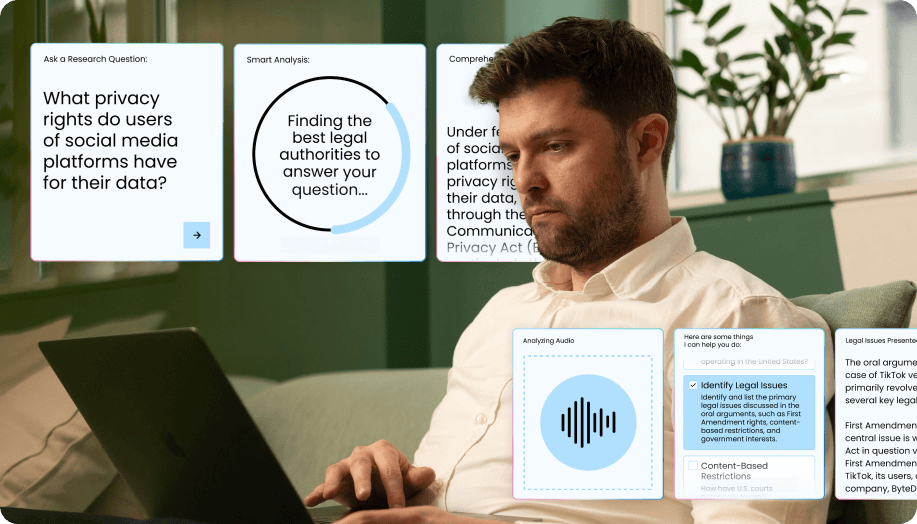
Clio Work is the only AI that understands your cases, their context, and the law. It applies AI directly to legal work, supporting analysis, case preparation, and research within the full context of a matter. It enables lawyers to understand their files more quickly and extract meaningful insights from legal materials. Importantly, it is grounded in Clio’s global legal library of more than one billion verified legal documents and designed with a built-in verification workflow, ensuring outputs are citation backed and verifiable. This supports accuracy while giving lawyers greater confidence in AI-generated insights. Clio Work offers several key capabilities, including:
- AI-powered matter insights: Scan an entire matter’s worth of files to pull out key facts, flag risks, and map a timeline of events, giving lawyers a clear picture of where a case stands without hours of manual review.
- AI legal research: Connect matter-specific context with relevant legal authorities, helping lawyers identify precedents and applicable law more efficiently.
- Legal strategy support: Evaluate how a position holds up against counterarguments, weigh alternative approaches, and identify a defensible direction before committing to it.
These capabilities enhance efficiency and insight while keeping lawyers firmly in control of legal analysis and decision-making. When paired with Clio Manage, Clio Work becomes fully matter-aware, drawing on operational and historical firm data, including documents, deadlines, tasks, notes and communications, without requiring manual uploads. As more context flows into the workspace, outputs become faster, more relevant, and more precise over time.
Manage AI (legal operations AI)

Clio also deploys AI to improve law firm operations, reducing administrative overhead and creating smoother internal workflows. Manage AI focuses on delivering operational outputs that you just need to review, so you can get back to practicing law.
- Deadline and calendar management: Extract key dates and events from court notices, scheduling orders, and other documents to instantly draft calendar events—complete with automated reminders—so deadlines are never missed.
- Billing: Auto-generate draft invoices based on parameters you set, flag duplicate or unusual entries before bills reach approval, and route drafts to the right approvers with automated reminders.
- Client communication support: Summarize conversations, organize communication histories within matters, and assist with follow-ups to ensure timely and consistent engagement.
These features help firms manage operations more effectively, freeing lawyers to focus on high-value legal work.
AI in Clio Draft (document automation AI)

Clio Draft streamlines document generation and drafting workflows, allowing firms to produce legal documents more efficiently and consistently. By combining structured data with automation, it minimizes repetitive drafting while maintaining professional oversight.
- Document automation and drafting: Generate legal documents using templates and structured client or matter data, ensuring consistency and saving time across document types.
- Template creation and management: Automatically create reusable templates for specific practice areas or workflows, enabling firms to standardize drafting processes and scale document production.
With this approach, lawyers can review, refine, and finalize work more quickly, keeping quality high while reducing drafting burden.
Final thoughts
Legal AI is here, and it’s already changing how law firms work. By supporting legal research, document review, contract analysis, and day-to-day operations, AI helps lawyers work more efficiently, make more informed decisions, and deliver more consistent results for their clients.
Across five main areas, legal research, document and contract management, litigation analytics, workflow automation, and compliance, AI technology is streamlining essential tasks that once took hours of manual effort. At the center of it all is the legal AI stack, turning complex legal data into clear, actionable insights.
The advantages are plain to see: greater efficiency, reduced costs, improved accuracy, and stronger client outcomes. Still, human expertise remains crucial. AI can process data and surface insights, but only lawyers can apply judgment, strategy, and experience to ensure quality and accountability.
By learning how legal AI works, firms can use it with purpose. Not as a passing trend, but as a competitive advantage that amplifies the value of legal work.
Ready to explore how legal AI can fit into your firm’s everyday workflows? See how Clio’s tools are helping lawyers streamline research, case analysis, client communication, and more. Book a demo today.
Legal AI Technology FAQs
How accurate are legal AI tools for legal research?
Legal research AI technology tools can be highly accurate when trained on reliable data and paired with citation verification. However, results should always be reviewed by a lawyer.
How are law firms using legal AI today?
Law firms are using legal AI to streamline research, review documents, draft contracts, manage workflows, and gain key insights into matters.
What should law firms consider before adopting legal AI technology?
Firms should evaluate the platform’s data sources, accuracy safeguards, security and compliance controls, workflow integration, and performance in real legal tasks.
Is legal AI secure for confidential client information?
Legal AI can be secure when used in platforms that have strong encryption, robust data controls, and safeguards aligned with professional and regulatory obligations.
What is legal AI technology?
Legal AI technology uses artificial intelligence to assist lawyers with tasks such as legal research, document review, contract analysis, and workflow automation.
What types of tasks can legal AI automate for lawyers?
Legal AI can automate document review, legal research, contract analysis, client intake, billing, and administrative workflows.
What is the legal AI technology stack?
Legal AI is built on four layers: the legal data layer (case law, statutes, commentary, firm documents, matter context), the reasoning layer (LLMs, machine learning, and NLP that interpret legal language), the retrieval and citation layer (RAG and citation verification that ground outputs in trusted sources), and the workflow integration layer (connecting AI to case management, billing, and intake).
What are the risks of legal AI technology, and how do law firms manage them?
Three main risks: data privacy and confidentiality (managed with encryption, role-based access, and audits), inaccurate or unsupported outputs and hallucinations (managed by verifying outputs, checking citations, and using law-grounded tools), and ungoverned use (managed with a firm AI policy covering acceptable use, output verification, and client disclosure).
What are the main legal AI workflows in a law firm?
Six common workflows: litigation preparation (summarizing discovery, surfacing precedents), contract drafting and review (flagging clauses, obligations, and risks), legal research (searching case law and statutes), eDiscovery and document review (scanning and prioritizing large document sets), client intake and communication (summarizing and organizing client information), and firm operations and insights (analyzing billing and matter data).
How will agentic AI change legal work?
Agentic AI moves beyond answering one prompt at a time toward executing entire multi-step tasks. Instead of asking question by question, a lawyer can delegate a goal, like analyzing a complaint, identifying defenses, and drafting a strategy memo, and the AI plans the steps, executes them in sequence, and delivers a structured output for review.