
Build your legal AI skills for free



AI for Legal Work















AI for Running Your Firm














AI Ethics, Policy & Regulation









AI & the Legal Profession






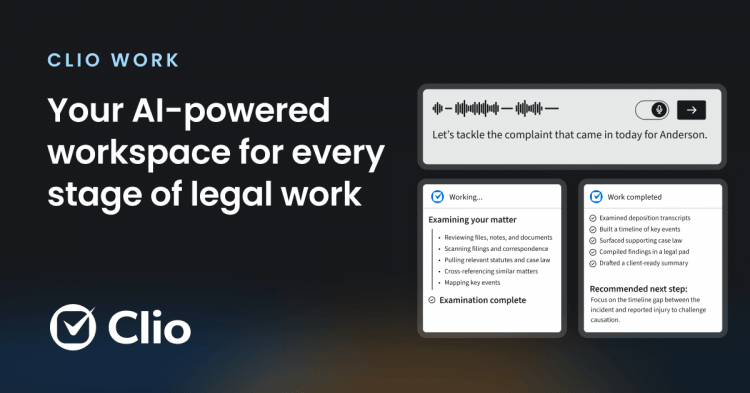

Get started with legal technology
See how legal technology like Clio can help your law firm practice more efficiently.
AI for Law Firms FAQs
What can AI do for law firms?
AI helps law firms automate routine tasks like legal research, document management, and billing, while improving accuracy and freeing lawyers for higher-value work. Across the practice, it supports legal work (research, litigation, drafting), firm operations (intake, automation, marketing), and compliance with ethics and data-security obligations.
What are the main areas where law firms use AI?
Law firms use AI across four broad areas: legal work (research, litigation, deposition prep, contract analysis), running the firm (client intake, automation, email marketing, reputation management), ethics, policy, and regulation (data security, AI policies, compliance), and understanding AI’s broader impact on the profession.
How should a law firm get started with AI?
Start by assessing where your firm falls on the AI adoption curve, then build foundational literacy through training like a legal AI certification. From there, begin with low-risk, high-volume tasks, choose legal-specific tools over generic ones, and put a firm AI policy in place before scaling.
What should law firms consider about AI ethics and security?
The main considerations are protecting client confidentiality and privilege, verifying AI outputs to avoid hallucinations, meeting professional responsibility rules like ABA Formal Opinion 512, and establishing a firm AI policy. Choosing legal-specific tools with strong data security helps address most of these concerns.