
For solo and small law firms, AI efficiency only translates into profitability when paired with a deliberate shift away from exclusive hourly billing toward flat-fee models and automated intake. By charging for outcomes rather than time and using reclaimed hours to fill new capacity, practitioners can protect their margins and deliver the predictable pricing modern clients demand.
If you’re using AI in your daily work at a solo or small law firm, you’ve probably noticed a pattern. You’ve integrated the technology into how you draft documents, handle legal research, and write emails. Work that used to take up your afternoons gets done in a fraction of the time. Files close faster, clients hear back sooner, and the day-to-day rhythm of running a practice has genuinely improved. By every measure, AI has delivered. Then the quarterly numbers come in, and revenue is sitting where it was last year.
You’re not alone in this. Clio’s newly released 2026 Legal Trends for Solo and Small Law Firms shows that 71% of solo practitioners and 75% of small firms now use AI. They report higher quality work, less time on tedious tasks, faster client response, and lower stress. But only about a third have grown revenue from it.
The issue isn’t effort or adoption. What’s missing at most firms is a deliberate plan for the time AI gives back. Without one, those hours turn into shorter days and smaller invoices instead of new clients and more billable work. The firms growing fastest built that plan in from the start, and this blog walks through exactly what they’re doing differently.

Want the full data behind what’s working at the firms growing revenue with AI? Download Clio’s 2026 Legal Trends for Solo and Small Law Firms.
Solo and small law firm AI adoption: Why revenue gains are lagging
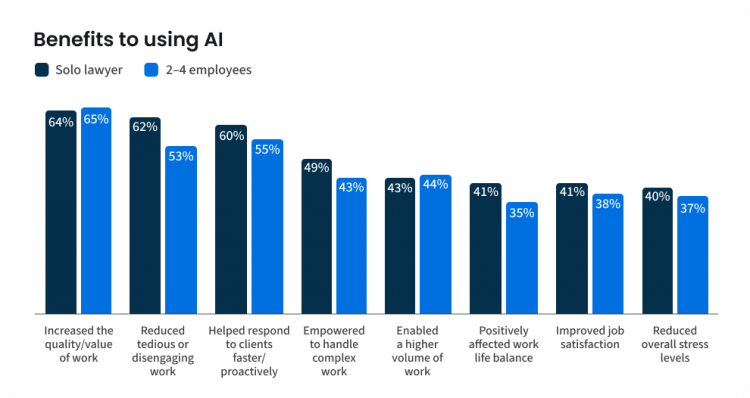
Day-to-day, the picture in most smaller firms is encouraging. The 2026 Legal Trends for Solo and Small Law Firms report found that 64% of solo firms say AI has lifted the quality of their work, 62% say it’s cut tedious tasks, and 60% say they’re responding to clients faster. Almost half feel empowered to handle more complex matters, and 43% say AI has enabled them to take on more work overall. If your practice feels better than it did a few years ago, that’s the technology doing what it was supposed to do.
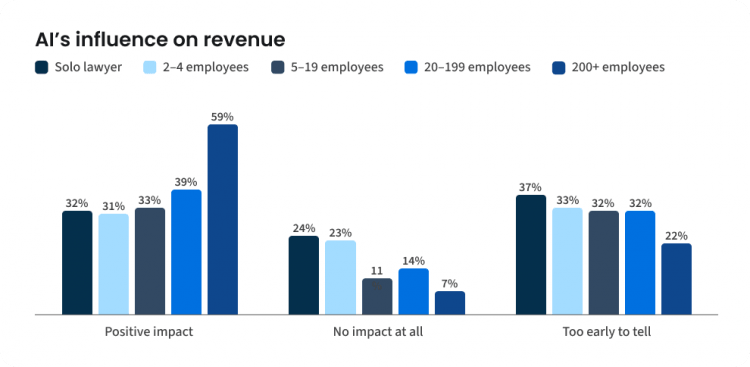
The financial picture, however, is a different story. Only 32% of solos and 31% of small firms have seen AI lift revenue, while that figure climbs to 59% at enterprise firms. A further 24% of solos and 23% of small firms say AI has had no impact on revenue at all. That gap is the heart of the ROI question for the use of legal AI in smaller practices, and it doesn’t mean the technology is failing them. For most firms, the time it gives back simply hasn’t been redirected into anything that produces revenue.
How hourly billing works against AI for solo lawyers
If AI helps you finish a five-hour task in an hour, and you bill by the hour, you’ve just given your client an 80% discount. The savings landed in their pocket, instead of yours. As long as your billing structure stays the same, you’ll need to bring in more new clients each year just to hold revenue steady.
Solo and small firms have been slowly moving in the right direction. Among solos, the share billing exclusively by the hour has dropped from 55% in 2019 to 50% today. Small firms have moved further over the same stretch, from 53% to 43%.
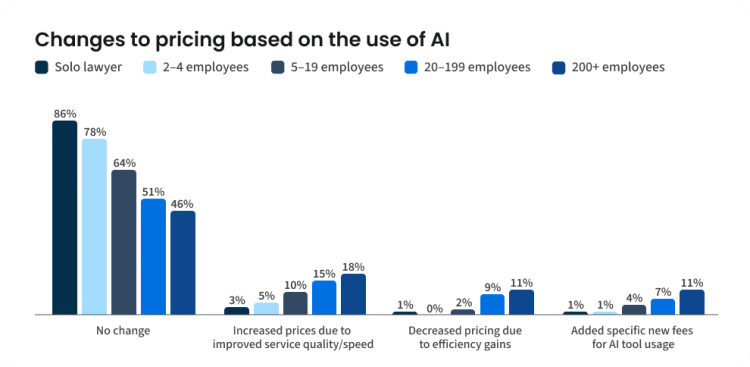
But that shift hasn’t kept pace with AI’s impact on the work itself. The report found that 86% of solo firms and 78% of small firms haven’t changed their pricing at all since they started using AI, compared with 51% of mid-market firms and 46% of enterprise firms. And the small number that have moved aren’t doing it boldly: Only 3% of solos and 5% of small firms have raised prices to reflect the higher-quality work AI now lets them deliver.
The flat fee vs. hourly billing question is one most clients have already answered for themselves. Clio’s 2024 Legal Trends Report found that 71% prefer flat fees over hourly when given the option. Moving away from exclusive hourly billing protects your margin and gives clients the pricing model they were going to ask for anyway.
Be the first to see where legal is headed
Sign up now to get the Legal Trends Report in your inbox the moment it drops, and you’ll be automatically entered to win a one-hour strategy session.
Join the waitlist
What hourly billing will cost your firm over the next two years
It helps to put some numbers on this. Take an estate planning matter that used to take 30 hours at a $250 rate and bill out at $7,500. If AI saves 40% of the time on that kind of work, the same matter takes 18 hours and bills at $4,500. The 12 hours that used to show up on the bill no longer do, and the savings stay with the client.
AI capabilities are only getting more powerful. If next year’s tools save you another 15 to 20% on the same matter, you’re down to roughly 14 or 15 hours of billable time. That same estate plan, at the same hourly rate, becomes a $3,500–$3,750 invoice. Two years in, you’ve lost more than half the revenue on a matter you’re handling at least as well as before.
Clients are still figuring out what AI should mean for legal pricing. That gives firms a chance to adjust now, before expectations settle. Wait a year or two and it gets harder. Competitors will have moved, clients will have new reference points, and the same change will feel like a price hike. The firms growing revenue with AI today priced for it from the start.
How to turn AI efficiency into law firm revenue
Firms growing revenue with AI tend to do two things differently: They’ve changed how they price their work, and they’ve found a way to put the saved hours back to use. Most are working on both at the same time, and neither one means rebuilding your practice.
Lever one: Rethink your billing model
Flat fees let you charge for the outcome instead of the hours, and once you do, efficiency stops working against you. Firms that navigate this shift best pick one practice area where the scope is predictable, such as estate planning or an uncontested divorce, and price the work as a package.
Many smaller firms have already started moving in this direction. Exclusive hourly billing has dropped at solo and small firms every year since 2019, which means flat fees and hybrid arrangements are how a growing share of work already gets priced.
A practical place to start: Choose the matter type where AI has saved you the most time over the last six months. Work out what it used to take, what it takes now, and what your hourly bill on that work has become. The gap is your repricing opportunity.
Lever two: Fill the capacity AI creates
Saving time only helps your revenue if you use that time to take on more work. Most solos haven’t gotten there yet. AI can free up several hours a week, but those hours don’t fill themselves with new clients. The firms growing their revenue from AI are actively bringing in more work to fill the time they’ve saved.
Three changes do most of the heavy lifting, and none of them require new headcount:
- Cut your response time on inbound inquiries. A same-day reply puts you ahead of most of your competition. With online intake forms, lead information lands in one place the moment a prospect submits it, so you’re not piecing together details from voicemails and emails before you can respond.
- Reduce the friction in onboarding. Clients shouldn’t have to wait while you mail forms or chase signatures. Clio Scheduler lets prospects book consultations directly from your website, and e-signatures on retainer agreements close the loop without an in-person meeting.
- Follow up automatically on leads that don’t convert right away. A short email sequence after the initial contact will recover business you’d otherwise lose. Clio Grow runs those sequences in the background and shows you where each prospect stands, so a missed reply doesn’t become a lost client.
These three changes are the core of growing a solo law practice in a way that compounds: Faster intake brings in the work, lighter onboarding closes it, and steady follow-up recovers what would otherwise slip away.
Why generic AI tools aren’t enough for small law firms
Most solo and small firms are using AI, but many are using technology that wasn’t built for legal work. About 47% of solos and 48% of small firms rely on generic, consumer-grade tools like Claude, ChatGPT or Microsoft Copilot. They save time on basic tasks, and as a starting point, that’s fine. The limitations show up once the work gets more complex.
Generic models don’t understand legal context, which means a lot of re-prompting before you get something usable. They’re also prone to AI hallucinations—confidently citing case law, statutes, or regulations that don’t exist—because they aren’t grounded in verified legal sources. And they don’t connect to your matter records, so you end up copying and pasting between systems just to make them work for you.
Then there’s the confidentiality risk. Generic AI tools may use your input data to train their models, which means anything you paste into them can leave your firm and contribute to a public model. California is moving toward legislation that would prohibit law firms from entering confidential client information into public generative AI tools, and other states are likely to follow.
That’s a problem for most solo and small firms, because they don’t have the guardrails in place. The report found that 55 to 57% of solo and small firms have no AI policy at all, which means there’s nothing in writing telling staff what tools are allowed or how client data should be handled.
So how can you tell whether the AI tool you’re using is built for legal work? Here are four questions worth asking:
- Does it understand legal context, or do you have to re-explain your practice area, jurisdiction, and matter type every time you open it?
- Does your client data stay inside a secure, purpose-built environment, or is it leaving your firm the moment you paste it into a prompt?
- Does the tool connect to the rest of how you run your firm (such as billing, intake, matter management, or document storage), or is it another login on a list that’s already too long?
- Is it saving you time on billable work, or only on tasks you weren’t billing for in the first place?
If the answers point you toward a separate, generic tool with no legal context and no integration, the time savings are smaller than they look. Firms using legal-specific platforms with AI built in tend to have fewer adoption barriers and better outcomes, in part because the friction of switching tools and re-prompting diminishes when intake, billing, and matter management already live in the same place. That integrated approach is the idea behind Clio’s Intelligent Legal Work Platform, where AI works across the case record rather than alongside it.
Three ways to turn AI efficiency into revenue this quarter
Turning saved time into revenue takes deliberate work, but it doesn’t take a full strategy reset. Three small changes this quarter will get you most of the way there.
- Audit one practice area. Pick the matter type where AI has cut your time the most. Pull a few recent matters and run the math: What your hourly bill used to be on that work, what it is now, and the difference. If a matter that used to bill at $7,500 now bills at $5,000, you have a clear number to anchor a repricing conversation.
- Introduce a flat-fee option for your most repeatable work. There’s no need to change everything at once. Pick one practice area where the scope is predictable and offer a flat fee alongside your hourly rate. Set the price based on the value of the outcome and what the work used to take, not on what it takes you now. Most clients will choose it, and your margin will improve.
- Track where your reclaimed time is going. If the hours AI is saving you aren’t going to billable work or business development, repricing won’t fix that. Block a week and account for what’s filling the time.
The bottom line
If you’ve put AI to work in your firm and revenue hasn’t moved, the problem isn’t you. Adopting AI is the first step, and you’ve taken it. The next step is deciding what to do with the time it gives you back, whether that’s rethinking how you price your work, building a steadier client pipeline, or both. That’s what solo and small law firm profitability ultimately comes down to.
Ready to see exactly what the firms growing fastest are doing? Download the 2026 Legal Trends for Solo and Small Law Firms report for the full data, the benchmarks, and the strategies behind them.
If you’re ready to see what a legal-specific platform looks like in practice, one that builds AI into intake, billing, and matter management, book a demo of Clio today.
How can a solo lawyer increase revenue?
Solo lawyers grow revenue most reliably by shifting some work from hourly to flat-fee billing, investing in client intake tools that shorten the path from inquiry to retainer, and using AI-driven time savings to take on additional work rather than absorbing the gain into shorter days.
Is AI worth it for solo law firms?
Yes, but the value depends on how the firm uses it. AI delivers real day-to-day benefits, such as time savings, higher quality work, faster client response. However, it only translates into revenue when paired with pricing changes and a pipeline that can absorb the new capacity.
What is the best billing model for a solo attorney?
Most solo attorneys are best served by a hybrid model: flat fees for predictable, repeatable work and hourly billing for matters where scope is genuinely uncertain. Clients overwhelmingly prefer flat fees, and Clio’s 2024 Legal Trends Report found that 71% would choose them over hourly when given the option.
Does flat fee billing make sense for solo lawyers?
For most solo lawyers, yes, particularly in practice areas with predictable scope. Flat-fee billing protects margin as AI compresses the time required for legal work, aligns with what the majority of clients now prefer.
Subscribe to the blog
-


Software made for law firms, loved by clients
We're the world's leading provider of cloud-based legal software. With Clio's low-barrier and affordable solutions, lawyers can manage and grow their firms more effectively, more profitably, and with better client experiences. We're redefining how lawyers manage their firms by equipping them with essential tools to run their firms securely from any device, anywhere.
Learn More